Watermelon Radish
Lathyrus odoratus
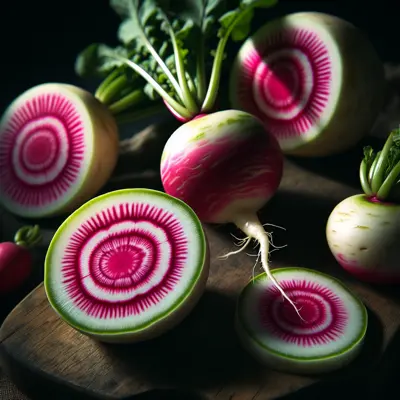
Watermelon Radish is a visually striking heirloom root vegetable with a pale green exterior and distinctive pink-red flesh with white striations, resembling watermelon. Maturing in 90 days, this Japanese variety produces crisp, tender roots ideal for both fresh eating and cooking. The flesh offers a mild, sweet flavor with a subtle peppery finish and pleasant crispness that adds visual appeal and refreshing crunch to salads, slaws, and garnishes. This easy-to-grow variety thrives in deep, well-drained loam with full sun exposure.
Harvest
90d
Days to harvest
Sun
Full sun
Zones
2–11
USDA hardiness
Height
3-8 feet
Planting Timeline
Showing dates for Watermelon Radish in USDA Zone 7
All Zone 7 root-vegetable →Zone Map
Click a state to update dates
Watermelon Radish · Zones 2–11
Growing Details
Succession Planting
Direct sow watermelon radish every 3 weeks starting March 1 in zone 7, through mid-April for a summer harvest. Because this variety takes around 90 days — much longer than a standard table radish — you have fewer succession windows than you'd think. A second round sown in late July to early August will mature October through November once temperatures drop back below 75°F; that fall planting often produces the best eating, since cool nights tighten the flesh and bring out the vivid pink interior.
Skip any sowing that would put harvest squarely in peak Georgia summer heat, with daytime highs consistently above 85°F. Watermelon radish bolts under those conditions and the roots turn pithy and bitter fast. If your spring sowing goes in after April 15, harvest what you can by late June and redirect your energy to the fall planting — that's where the real crop is anyway.
Complete Growing Guide
Light: Full sun (6 or more hours of direct sunlight a day). Soil: High Organic Matter. Drainage: Good Drainage, Moist. Height: 3 ft. 0 in. - 8 ft. 0 in.. Spread: 2 ft. 0 in. - 3 ft. 0 in.. Spacing: 3 feet-6 feet. Growth rate: Rapid. Maintenance: Medium. Propagation: Seed. Regions: Coastal, Mountains, Piedmont.
Harvesting
Type: Legume.
Edibility: Sweet pea fruits are inedible and poisonous to humans.
Storage & Preservation
Fresh watermelon radishes store exceptionally well compared to smaller radish varieties. Remove greens immediately, leaving 1 inch of stem, and brush off excess soil without washing. Store in perforated plastic bags in your refrigerator's crisper drawer at 32-35°F with high humidity.
Properly stored roots maintain quality for 3-4 weeks, though their stunning color may fade slightly. Don't wash until ready to use, as moisture accelerates decay.
For preservation, watermelon radishes excel at quick pickling—slice thin and pickle in rice vinegar with sugar and salt for spectacular pink pickles. They also ferment beautifully in salt brine, developing complex flavors while retaining crunch. Roasting concentrates their sweetness, but freezing isn't recommended as it destroys their crisp texture. Dehydrated slices make colorful, peppery chips when dried at 125°F for 8-12 hours.
History & Origin
Origin: Southern Italy, Sicily, Crete
Advantages
- +Attracts: Butterflies
- +Edible: Sweet pea fruits are inedible and poisonous to humans.
- +Fast-growing
Considerations
- -Toxic (Seeds): Low severity
Companion Plants
Carrots and watermelon radish work well together because they're pulling from different soil depths — the radish bulb sits in the top 6 to 8 inches while carrots push considerably deeper, so root competition is minimal. Lettuce and spinach serve as a living mulch around radish rows: their shallow roots don't crowd the crop, and they shade the soil enough to hold the consistent moisture this variety needs over its 90-day run. Nasturtiums and marigolds pull their weight by drawing in aphid predators like ladybugs before aphid colonies have a chance to build up on the foliage.
Keep watermelon radish well away from other brassicas — broccoli, kale, turnips, cabbage — especially in our zone 7 Georgia garden where clubroot (Plasmodiophora brassicae) can persist in the soil for 10 or more years. Stacking radish next to its brassica relatives concentrates the same pest and disease pressure in one spot and undercuts any crop rotation you've planned. Hyssop is worth skipping too; it inhibits radish growth and there's nothing gained from the pairing.
Plant Together
Carrots
Different root depths prevent competition, carrots help break up soil for radish growth
Lettuce
Shallow roots don't compete, provides ground cover and efficient space utilization
Spinach
Fast-growing leafy green that can be harvested before radishes need full space
Peas
Fix nitrogen in soil benefiting radish growth, different growth habits complement each other
Chives
Repel root maggots and other pests that attack radishes
Nasturtiums
Act as trap crop for flea beetles and aphids that commonly attack radishes
Marigolds
Repel nematodes and other soil pests, deter flea beetles
Cucumber
Radishes can deter cucumber beetles while cucumbers provide shade for cool-season radishes
Keep Apart
Brassicas
Same family plants compete for nutrients and attract similar pests like flea beetles and clubroot
Hyssop
Inhibits growth of radishes and other root vegetables through allelopathic compounds
Nutrition Facts
Per 100g serving. % Daily Value based on 2,000 calorie diet. Source: USDA FoodData Central (FDC #169276)
Pests & Disease Resistance
Resistance
Good cold tolerance and slow to bolt
Common Pests
Flea beetles, cabbage root maggots, aphids
Diseases
Clubroot, black rot, white rust
Troubleshooting Watermelon Radish
What you'll see, why it happens, and what to do about it.
Small, irregular holes peppering the leaves — looks like someone took a hole punch to them — appearing within the first few weeks after germination
Likely Causes
- Flea beetles (Phyllotreta spp.) — tiny, fast-jumping beetles that feed on young brassica-family leaves
- Seedlings under heat stress are more vulnerable; damage looks worse on dry stretches
What to Do
- 1.Cover rows with floating row cover immediately after direct sowing — flea beetles locate the plants by smell, so blocking access early is your best move
- 2.If beetles are already present, dust with kaolin clay or apply spinosad as a foliar spray in the evening
- 3.Don't leave bare, freshly turned soil exposed for long; flea beetles overwinter in soil debris and emerge hungry in spring
Seedlings wilting and collapsing at the soil line despite adequate watering, roots brown and tunneled when pulled
Likely Causes
- Cabbage root maggot (Delia radicum) — larvae tunnel through the taproot and crown, cutting off water uptake
- Damage is worst in cool, wet spring soil below 60°F, when adult fly activity peaks
What to Do
- 1.Place floating row cover over beds immediately after sowing and seal the edges — the adult fly must lay eggs at the soil line to do damage, so physical exclusion stops it cold
- 2.Cut 3-inch cardboard or plastic collars and lay them flat around each seedling at the crown to block egg-laying
- 3.Rotate this bed out of all brassica-family crops for at least 3 years — NC State Extension IPM guidance notes that rotating related crops only once every three to four years is what actually reduces soil-borne pest cycles
V-shaped yellow lesions starting at the leaf margins, sometimes with darkened veins running toward the center; roots discolored or rotted at harvest
Likely Causes
- Black rot (Xanthomonas campestris pv. campestris) — a bacterial disease that enters through leaf edges and moves inward through the vascular tissue
- Overhead irrigation and warm, humid weather accelerate spread
- Infected seed, or planting into a bed that still holds brassica debris from a previous season
What to Do
- 1.Remove and bag affected leaves immediately — trash them, don't compost
- 2.Switch to drip irrigation or water at the base to keep foliage dry
- 3.NC State Extension recommends a 3- to 4-year rotation out of brassica crops to break the disease cycle; don't follow cabbage, kale, or turnips with watermelon radish in the same bed
Frequently Asked Questions
How long does watermelon radish take to grow?▼
Can you grow watermelon radish in containers?▼
What does watermelon radish taste like?▼
When should I plant watermelon radish seeds?▼
Why is my watermelon radish white inside instead of pink?▼
Are watermelon radishes good for beginners?▼
Zone-by-Zone Planting Calendar
| Zone | Indoor Start | Transplant | Direct Sow | Harvest |
|---|---|---|---|---|
| Zone 1 | — | — | June – July | September – September |
| Zone 2 | — | — | May – July | August – September |
| Zone 11 | — | — | January – February | March – December |
| Zone 12 | — | — | January – February | March – December |
| Zone 13 | — | — | January – February | March – December |
| Zone 3 | — | — | May – June | August – October |
| Zone 4 | — | — | April – June | July – October |
| Zone 5 | — | — | April – May | July – November |
| Zone 6 | — | — | April – May | July – November |
| Zone 7 | — | — | March – May | June – November |
| Zone 8 | — | — | March – April | June – December |
| Zone 9 | — | — | February – March | May – December |
| Zone 10 | — | — | January – March | April – December |
Growing Guides from Wind River Greens
Sources & References
External authority sources used in compiling this guide.
See the Methodology page for how this data is sourced, what's AI-assisted, and known limitations.