Thumbelina Carrot
Daucus carota 'Thumbelina'
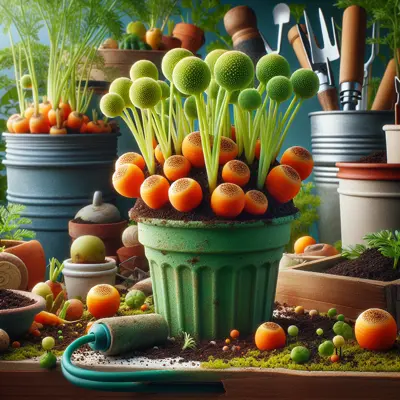
An adorable golf ball-sized carrot that's perfect for container gardens and shallow soils where longer varieties struggle. Despite their tiny size, these round carrots pack full-sized flavor and sweetness. Winner of the All-America Selections award for its exceptional performance and unique appeal to gardeners with space constraints.
Harvest
65-70d
Days to harvest
Sun
Full sun to partial shade
Zones
4–11
USDA hardiness
Difficulty
Easy
Planting Timeline
Showing dates for Thumbelina Carrot in USDA Zone 7
All Zone 7 root-vegetable →Zone Map
Click a state to update dates
Thumbelina Carrot · Zones 4–11
Growing Details
Succession Planting
Direct sow Thumbelina every 14-21 days starting around March 1 in zone 7, and keep going through early May for a late-spring harvest. Pick it back up in late July or early August for a fall run — aim to have your last sowing in the ground by September 1 so roots hit their 65-70 days before hard frost. Skip June through mid-July when soil temps push above 80°F; germination drops off sharply and the seedlings that do emerge tend to bolt or fork.
Because Thumbelina tops out around 1.5 inches in diameter and doesn't need much vertical depth, it slots in well after you pull spring lettuce or radishes. Refresh the top 4-6 inches of soil with compost before sowing — compacted or depleted soil is the main reason these round carrots come out misshapen.
Complete Growing Guide
These golf ball-sized carrots thrive in loose, well-draining soil and shallow containers, making them ideal for raised beds or pots where standard long varieties won't develop properly. Sow seeds directly 2–3 weeks earlier than full-sized varieties since Thumbelina reaches maturity in just 65–70 days, allowing successive plantings every three weeks for continuous harvests. Their diminutive size means they're less susceptible to root-knot nematodes than larger cultivars, but watch for carrot rust flies and ensure consistent soil moisture to prevent splitting and cracking. Unlike longer carrots, Thumbelinas won't bolt prematurely if exposed to cool spring conditions; instead, they actually prefer temperatures between 60–70°F. For best results, thin seedlings to 2 inches apart rather than the standard 3 inches, since crowding these compact roots actually encourages the roundness that defines the variety.
Light: Full sun (6 or more hours of direct sunlight a day), Partial Shade (Direct sunlight only part of the day, 2-6 hours). Soil: Clay, High Organic Matter, Loam (Silt), Sand, Shallow Rocky. Soil pH: Acid (<6.0), Alkaline (>8.0), Neutral (6.0-8.0). Drainage: Good Drainage, Moist, Occasionally Dry. Growth rate: Rapid. Maintenance: High. Propagation: Seed.
Harvesting
Thumbelina carrots are ready to harvest when they reach their characteristic golf ball size of about one to one-and-a-half inches in diameter, displaying a deep orange color that extends from shoulder to root. Gently loosen the soil around each carrot and check for firm resistance when you give them a light tug—they should pull free without snapping. These miniature roots can be harvested continuously as they mature, allowing you to pick individual carrots while leaving others to develop, or harvest the entire crop at once around 65 to 70 days. For best sweetness and tenderness, pick them in the early morning when the soil is cool and moisture levels are highest, as this maximizes their crisp texture and sugar content.
Small, dry, and ribbed with bristly hairs. The compound umbel of fruits folds inward to form a roundish shape that can be blown by the wind and roll across the ground dropping seeds.
Color: Brown/Copper. Type: Achene. Length: < 1 inch. Width: < 1 inch.
Edibility: Leaves, roots, flowers, and seeds are edible. The young fleshy roots can be cooked or eaten raw, the flower clusters can be french-fried to produce a carrot-flavored dish, the aromatic seed is used as a flavoring in stews, etc. The dried roasted roots are ground into a powder and are used for making coffee.
Storage & Preservation
Store freshly harvested Thumbelina carrots in the refrigerator crisper drawer for up to 3 weeks. Remove green tops immediately after harvest—they draw moisture from the roots. Don't wash until ready to use; brush off soil and store in perforated plastic bags to maintain humidity while allowing air circulation.
For longer preservation, blanch whole carrots for 2-3 minutes and freeze in sealed containers for up to 8 months. Their small size makes them perfect for freezing whole—no chopping required. They also excel for pickling due to their uniform size and sweet flavor. Create quick pickles using equal parts water and vinegar with salt and your favorite spices.
Dehydrating works well for baby food or soup mixes—slice into rounds and dehydrate at 125°F for 8-12 hours until crisp. Their concentrated sweetness intensifies when dried, making them excellent for trail mixes or healthy snacks.
History & Origin
While detailed documentation on the specific breeder and year of development is limited, Thumbelina Carrot emerged through modern vegetable breeding programs focused on creating compact varieties for home gardeners and container cultivation. The variety represents the broader trend of miniaturized root vegetables developed in the late 20th century, likely originating from European carrot breeding lines that prioritize round, ball-shaped forms. Its All-America Selections award validates rigorous testing across North American growing regions. The cultivar belongs to the Nantes carrot group's evolutionary descendants, refined to prioritize small stature and sweetness over traditional elongated forms, making it an accessible option for contemporary gardeners with spatial limitations.
Origin: Europe, Eastern Asia and northern Africa
Advantages
- +Perfect for container gardens and small spaces with shallow soil depth
- +Golf ball-sized carrots mature quickly in just 65-70 days
- +Full-sized sweet flavor and tenderness despite their adorable miniature size
- +All-America Selections award winner demonstrates exceptional reliability and garden performance
- +Ideal for gardeners with limited yard space seeking quality homegrown carrots
Considerations
- -Susceptible to carrot rust fly and flea beetle damage during growing season
- -Small individual size means lower total yield compared to standard carrot varieties
- -Requires consistent moisture and well-draining soil to prevent splitting and disease
- -Vulnerable to damping off in cool, wet conditions during germination stage
Companion Plants
Chives and leeks are the most useful neighbors for Thumbelina. Both are alliums, and their sulfur compounds are thought to repel carrot rust fly (Psila rosae) and aphids — plant them in a border or interplanted row within 12 inches of your carrot bed. Rosemary and sage add similar interference through volatile oils that disrupt pest host-finding. Because Thumbelina only needs about 4-6 inches of vertical soil depth, neither herb will compete meaningfully for root space the way a deep-rooted crop would. Radishes pull double duty: they germinate in 5-7 days versus Thumbelina's 10-17, marking the row while the carrots catch up, and pulling them at maturity loosens the top few inches of soil without disturbing the carrots below.
Dill and coriander are the ones to keep at a distance. Both are Apiaceae — same family as carrots — so they draw the same pest pressure and will cross-pollinate if you're saving seed. Parsnips share that problem too; stacking three Apiaceae crops in adjacent beds just concentrates carrot rust fly populations without any compensating benefit.
Plant Together
Chives
Repels carrot fly and aphids with strong onion scent
Leeks
Deters carrot rust fly while carrots repel leek moth
Rosemary
Strong aromatic oils confuse and repel carrot fly
Sage
Repels carrot fly and other harmful insects with pungent fragrance
Lettuce
Shallow roots don't compete, provides living mulch and efficient space use
Radishes
Loosens soil for carrot growth and matures quickly before carrots need space
Tomatoes
Provide partial shade and may improve carrot flavor
Peas
Fix nitrogen in soil and light foliage doesn't shade small carrots
Keep Apart
Dill
Can stunt carrot growth and attract carrot fly when mature
Parsnips
Compete for same soil nutrients and space as fellow root vegetable
Coriander
May inhibit carrot germination and early growth through allelopathy
Nutrition Facts
Per 100g serving. % Daily Value based on 2,000 calorie diet. Source: USDA FoodData Central (FDC #170393)
Pests & Disease Resistance
Resistance
Good overall disease resistance
Common Pests
Carrot rust fly, aphids, flea beetles
Diseases
Alternaria leaf blight, damping off
Troubleshooting Thumbelina Carrot
What you'll see, why it happens, and what to do about it.
Seedlings collapse at soil level — stems look pinched or blackened, sometimes a fuzzy white mold on the soil surface nearby
Likely Causes
- Damping off — caused by soil-borne fungi (Pythium, Rhizoctonia) that spike when humidity is high and air circulation is poor
- Overwatering or compacted soil that stays wet too long after germination
What to Do
- 1.Thin seedlings to at least 1 inch apart as soon as they emerge — crowded stands trap moisture and accelerate collapse
- 2.Water in the morning so the soil surface dries before nightfall; back off frequency if the top half-inch isn't drying between waterings
- 3.Rotate carrot beds so you're not sowing into a bed that had the same problem last season — NC State Extension notes that crop rotation slows fungal buildup in the soil
Roots have brown, corky tunnels or rusty streaks just under the skin when you pull them at 65-70 days
Likely Causes
- Carrot rust fly (Psila rosae) — larvae tunnel through the root and leave oxidized, rust-colored galleries
- Inconsistent soil moisture causing surface cracking, which gives larvae easier entry
What to Do
- 1.Cover the bed with floating row cover (Reemay or similar) immediately after sowing and keep edges pinched to the ground — rust fly is a direct-contact pest and physical exclusion is the most reliable control
- 2.Pull any infested roots completely out of the bed; don't compost them
- 3.For next season, delay your first sowing by 2-3 weeks past the main adult flight in early spring to reduce egg-laying on young plants
Frequently Asked Questions
Can you grow Thumbelina carrots in containers?▼
How long do Thumbelina carrots take to grow?▼
What do Thumbelina carrots taste like?▼
Are Thumbelina carrots good for beginners?▼
When should I plant Thumbelina carrots?▼
How many Thumbelina carrots can I grow in one pot?▼
Zone-by-Zone Planting Calendar
| Zone | Indoor Start | Transplant | Direct Sow | Harvest |
|---|---|---|---|---|
| Zone 3 | — | — | May – June | July – October |
| Zone 4 | — | — | April – June | July – October |
| Zone 5 | — | — | April – May | June – November |
| Zone 6 | — | — | April – May | June – November |
| Zone 7 | — | — | March – May | May – November |
| Zone 8 | — | — | March – April | May – December |
| Zone 9 | — | — | February – March | April – December |
| Zone 10 | — | — | January – March | March – December |
| Zone 1 | — | — | June – July | August – September |
| Zone 2 | — | — | May – July | July – September |
| Zone 11 | — | — | January – February | February – December |
| Zone 12 | — | — | January – February | February – December |
| Zone 13 | — | — | January – February | February – December |
Growing Guides from Wind River Greens
Sources & References
External authority sources used in compiling this guide.
See the Methodology page for how this data is sourced, what's AI-assisted, and known limitations.