Tokyo Cross Turnip
Brassica rapa 'Tokyo Cross'
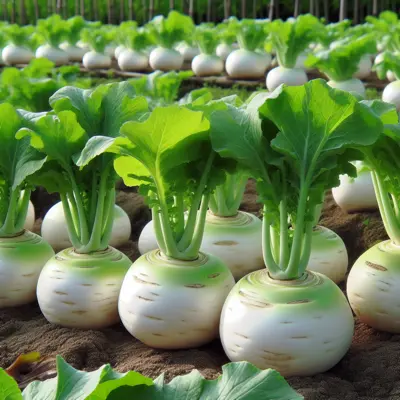
An award-winning Japanese hybrid turnip that revolutionized home turnip growing with its incredible speed and sweet, mild flavor. This All-America Selections winner produces perfectly white, smooth roots in just over a month, with crisp texture that never gets woody or strong-tasting. The compact size and quick maturity make it perfect for succession planting and small gardens.
Harvest
35-40d
Days to harvest
Sun
Full sun to partial shade
Zones
5–9
USDA hardiness
Height
3 feet
Planting Timeline
Showing dates for Tokyo Cross Turnip in USDA Zone 7
All Zone 7 root-vegetable →Zone Map
Click a state to update dates
Tokyo Cross Turnip · Zones 5–9
Growing Details
Succession Planting
Direct sow every 14–21 days starting March 1 and continuing through early May for a spring run. Tokyo Cross hits harvest at 35–40 days, so a March 1 sowing is ready by mid-April; a late-April sowing finishes before summer heat does much damage. Stop spring sowings when daytime highs are consistently hitting 80°F — heat pushes the roots to pithy and bitter faster than almost any other turnip variety, hybrid genetics notwithstanding.
Pick it back up in late August for fall. Sow every 14–21 days from around August 20 through late September; fall-grown roots are generally sweeter and hold in the ground longer without quality loss. In zone 7, a final sowing around October 1 can carry harvest into November before hard freezes below 28°F damage roots left in the ground.
Complete Growing Guide
Tokyo Cross turnip thrives in cool weather, making it perfect for spring and fall cultivation. You'll want to prepare your planting site with well-draining soil enriched with 2-3 inches of compost or aged manure. This variety performs best in soil with a pH between 6.0-7.0, so test and amend accordingly with lime if needed.
Direct sowing is the only viable method for Tokyo Cross turnips, as they don't transplant well due to their taproot. Plant seeds 2-4 weeks before your last spring frost when soil temperatures reach 45-65°F. For your fall crop, sow 10-12 weeks before the first hard frost. Plant seeds ¼ inch deep in rows spaced 12 inches apart, then thin seedlings to 4-6 inches apart when they reach 2 inches tall.
Fertilize at planting with a balanced 10-10-10 fertilizer, applying 1 tablespoon per square foot and working it into the top 3 inches of soil. Side-dress with nitrogen-rich fertilizer like blood meal when plants are 3 weeks old to promote both root and leaf development. Avoid over-fertilizing with nitrogen late in the season, as this encourages leaf growth at the expense of root development.
Consistent moisture is crucial – maintain 1 inch of water weekly through drip irrigation or soaker hoses to prevent roots from becoming woody or splitting. Mulch around plants with 2 inches of straw to retain moisture and suppress weeds, but keep mulch 2 inches away from stems to prevent pest issues.
Common mistakes include planting too deep (seeds won't germinate well), overcrowding (leads to small, malformed roots), and harvesting too late (roots become pithy). In zones 3-5, focus on spring plantings and early fall sowings. In zones 6-9, you can succession plant every 2-3 weeks from early spring through mid-fall, skipping the hot summer months. Southern gardeners in zones 8-9 should treat this as a winter crop, planting from October through February.
Harvesting
Harvest Tokyo Cross turnips when roots reach 2-3 inches in diameter, typically 35-40 days from seeding. The roots should feel firm when gently squeezed and have smooth, bright white skin with no cracks or blemishes. Don't wait for maximum size – smaller turnips offer the sweetest, most tender flavor that this variety is famous for.
Perform the 'shoulder test' by gently brushing soil away from the top of the root. If the shoulder (top portion) shows white and measures 2+ inches across, it's ready. Harvest in the morning when roots are most crisp and full of moisture. Grasp the greens close to the root and pull straight up with a twisting motion, or use a garden fork to loosen soil around larger roots. The entire plant typically lifts easily from loose, well-prepared soil. If you encounter resistance, loosen the soil around the root rather than pulling harder, which can break the root and leave portions in the ground.
Storage & Preservation
Fresh Tokyo Cross turnips store best when you remove the greens immediately after harvest, leaving about ½ inch of stem. Store unwashed roots in perforated plastic bags in the refrigerator crisper drawer at 32-35°F with high humidity. They'll maintain peak quality for 3-4 weeks, though flavor is best within the first two weeks.
For longer preservation, turnips freeze well when blanched first. Cut into ½-inch cubes, blanch for 2 minutes in boiling water, then ice bath and freeze in portions. They're also excellent for quick pickling – slice thin and pack in vinegar brine for a crisp, tangy condiment that keeps 2-3 months refrigerated. The tender greens can be sautéed immediately or blanched and frozen like spinach. Unlike storage turnips, Tokyo Cross is bred for immediate use rather than long-term storage, so prioritize fresh consumption or quick preservation methods.
History & Origin
Tokyo Cross was developed in Japan through careful hybridization aimed at creating the perfect home garden turnip. This variety earned All-America Selections recognition, a prestigious award given to outstanding new varieties that show superior performance across diverse North American growing conditions.
The breeding program focused on eliminating common turnip problems: slow growth, bitter flavor, woody texture, and poor disease resistance. Japanese plant breeders selected parent lines that combined rapid maturity with exceptional sweetness, creating a hybrid that could produce tender, mild roots in just over a month. This was revolutionary for home gardeners who previously had to wait 60+ days for quality turnips.
The variety gained popularity in North America during the 1980s and 1990s as gardeners discovered its reliability and superior eating quality. Tokyo Cross represents the successful marriage of traditional Japanese vegetable breeding expertise with modern hybrid techniques, resulting in a turnip that converts even turnip skeptics with its sweet, crisp texture and complete lack of the strong, sometimes bitter flavor associated with older turnip varieties.
Advantages
- +Exceptional speed with harvest-ready roots in just 35-40 days
- +Never develops woody or pithy texture even when slightly oversized
- +Sweet, mild flavor with zero bitter aftertaste appeals to all palates
- +Compact size perfect for succession planting and container growing
- +Strong resistance to clubroot and turnip mosaic virus
- +Tender, edible greens provide bonus harvest opportunity
- +Reliable germination and consistent performance across different climates
Considerations
- -Short storage life compared to traditional storage turnip varieties
- -Hybrid seeds cannot be saved for replanting next season
- -Susceptible to flea beetle damage on young leaves
- -Premium seed price compared to open-pollinated turnip varieties
- -May bolt quickly in unexpected warm spells during spring growing
Companion Plants
Radishes are the most practical companion for Tokyo Cross turnips. They mature in 25–30 days and can be sown in the same bed simultaneously — they'll be out of the ground before the turnips need the space. More usefully, radishes draw flea beetle feeding away from your turnip seedlings during that first vulnerable week or two. Onions and garlic planted nearby add pest confusion through volatile sulfur compounds; brassicas grown next to alliums tend to see less aphid pressure than brassicas planted in a solid block by themselves. Marigolds (Tagetes spp.) at the bed edges offer some deterrence against soil pests, though their effect on cabbage root maggots is modest — sealed row cover does that job better.
Peas are worth including for a different reason entirely: nitrogen. Tokyo Cross hits harvest in 35–40 days and pulls nutrients fast. Following a pea planting — or running peas on a trellis at the north edge of the bed — leaves residual nitrogen from legume root nodules that the turnips can use without a synthetic side-dress. Lettuce and spinach tuck well into gaps between turnip rows; they share the 6.0–7.0 pH range, don't compete for deep root space, and come out before turnip bulbs start to push.
Mustard and broccoli are the companions to skip. Both are brassicas, and crowding them in with Tokyo Cross concentrates Plasmodiophora brassicae spore load and hands flea beetles and cabbage root maggots a much larger target. NC State Extension's vegetable gardening guidance is explicit: same-family crops shouldn't share a planting spot more than once every 3 years. That principle applies within the bed during the same season, not only across years.
Plant Together
Radishes
Break up soil for turnip root development and deter flea beetles
Carrots
Different root depths prevent competition and improve soil structure
Onions
Repel root maggots and aphids that commonly attack turnips
Garlic
Natural fungicide properties protect against soil-borne diseases
Lettuce
Shallow roots don't compete and provide living mulch
Spinach
Cool-season companion with similar growing requirements
Peas
Fix nitrogen in soil and turnips benefit from increased nitrogen availability
Marigolds
Repel nematodes and other soil pests that damage turnip roots
Keep Apart
Mustard
Same family (Brassicaceae) attracts similar pests like flea beetles and clubroot
Broccoli
Fellow brassica competes for nutrients and attracts cabbage worms
Black Walnut
Produces juglone toxin that inhibits growth of most vegetables including turnips
Nutrition Facts
Per 100g serving. % Daily Value based on 2,000 calorie diet. Source: USDA FoodData Central (FDC #170465)
Pests & Disease Resistance
Resistance
Good resistance to clubroot and turnip mosaic virus
Common Pests
Flea beetles, aphids, cabbage root maggots
Diseases
Clubroot, black rot, white rust
Troubleshooting Tokyo Cross Turnip
What you'll see, why it happens, and what to do about it.
Tiny round holes scattered across leaves, seedlings looking ragged within the first 2 weeks after germination
Likely Causes
- Flea beetles (Phyllotreta spp.) — adults overwinter in soil and leaf litter, emerge in spring and chew shot-hole damage into brassica seedlings
- Dry, warm conditions that stress young plants and also favor flea beetle activity
What to Do
- 1.Cover the bed immediately with row cover (Agribon-15 or similar) at seeding — flea beetles are fast and you won't outrun them once they arrive
- 2.Keep soil consistently moist; stressed seedlings take much longer to outgrow the damage
- 3.Once plants hit 4–5 inches tall and have a few true leaves, they can usually tolerate minor feeding without losing yield
Plants stunted and yellowing, outer leaves wilting in the afternoon even when soil is wet — roots pulled up show brown or black discoloration inside
Likely Causes
- Black rot (Xanthomonas campestris pv. campestris) — a bacterial disease that enters through leaf margins and moves down into the vascular tissue
- Overhead watering or prolonged wet foliage that spreads the bacteria between plants
What to Do
- 1.Pull and bag affected plants entirely — roots included — and put them in the trash, not the compost
- 2.Switch to drip irrigation or water at the base of plants to keep foliage dry
- 3.Don't plant any brassicas — cabbage, kale, other Brassica rapa crops — in that bed for at least 3 years; NC State Extension recommends rotating same-family crops no more than once every 3 years
Plants suddenly collapse at the soil line around day 20–30; roots are stunted, gnarled, or missing entirely when you pull them
Likely Causes
- Cabbage root maggots (Delia radicum) — fly larvae that hatch in the soil and feed directly on the root system
- Cool, wet spring soils (below 60°F) that slow plant growth and give larvae more time to do damage before the plant can recover
What to Do
- 1.Lay floating row cover over the bed at seeding time and seal the edges with soil — the adult fly lays eggs at the soil line, so physical exclusion is the most reliable control
- 2.After harvest, remove all root debris from the bed; larvae overwinter in old root material
- 3.Rotate out of brassicas for at least 3 years in that spot to reduce soil populations
Roots are misshapen, swollen, or club-shaped — sometimes with a foul smell — and plants are stunted and pale even in fertile soil
Likely Causes
- Clubroot (Plasmodiophora brassicae) — a soil-borne pathogen that infects root cells and causes characteristic galling; thrives in acidic soils below pH 6.0
- Infected transplants or tools moved from a contaminated bed
What to Do
- 1.Test your soil pH and lime up to 6.5–7.0 if needed — clubroot is far less active above pH 6.5, and NC State Extension's disease management guidance supports raising pH as a practical cultural control
- 2.Remove and destroy every bit of infected root material; the spores can persist in soil for 20 years, so nothing from that bed goes in the compost
- 3.Pull brassicas out of the affected area for 3 to 4 years minimum — that's the floor, not the fix; Plasmodiophora brassicae doesn't disappear, it just declines
Frequently Asked Questions
How long does Tokyo Cross turnip take to grow?▼
Can you grow Tokyo Cross turnips in containers?▼
What does Tokyo Cross turnip taste like?▼
When should I plant Tokyo Cross turnips?▼
Are Tokyo Cross turnip greens edible?▼
Do Tokyo Cross turnips need full sun?▼
Zone-by-Zone Planting Calendar
| Zone | Indoor Start | Transplant | Direct Sow | Harvest |
|---|---|---|---|---|
| Zone 1 | — | — | June – July | July – September |
| Zone 2 | — | — | May – July | June – September |
| Zone 11 | — | — | January – February | January – December |
| Zone 12 | — | — | January – February | January – December |
| Zone 13 | — | — | January – February | January – December |
| Zone 3 | — | — | May – June | June – October |
| Zone 4 | — | — | April – June | June – October |
| Zone 5 | — | — | April – May | May – November |
| Zone 6 | — | — | April – May | May – November |
| Zone 7 | — | — | March – May | April – November |
| Zone 8 | — | — | March – April | April – December |
| Zone 9 | — | — | February – March | March – December |
| Zone 10 | — | — | January – March | February – December |
Growing Guides from Wind River Greens
Sources & References
External authority sources used in compiling this guide.
See the Methodology page for how this data is sourced, what's AI-assisted, and known limitations.