Summit
Raphanus sativus var. longipinnatus
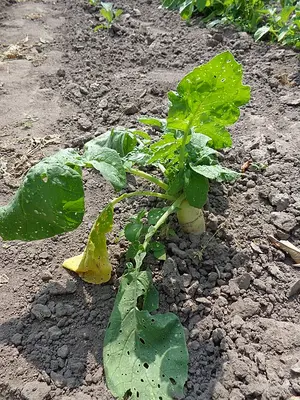
Crisp and juicy with mildly spicy flavor. Bolt resistant for spring plantings. Very similar to Alpine in size, maturity, and appearance. A great choice for kimchi.
Harvest
55d
Days to harvest
Sun
Full sun
Zones
2–11
USDA hardiness
Height
0 ft. 6 in. - 3 ft. 0 in.
Planting Timeline
Showing dates for Summit in USDA Zone 7
All Zone 7 root-vegetable →Zone Map
Click a state to update dates
Summit · Zones 2–11
Growing Details
Succession Planting
Daikon hits harvest around 55 days from direct sow, which is short enough to fit two or three rounds into a season if you time them around the heat. In zone 7, start direct sowing in March and repeat every 3 weeks through early May. Then stop — heat pushes daikon to bolt before the root has a chance to size up properly, and roots grown through summer tend to be pithy and hot rather than mild and dense. Pick back up in late August or early September for a fall run that carries into November.
Daikon germinates best when soil temps are between 50°F and 65°F; above 75°F, germination gets patchy. The UGA Vegetable Garden Calendar recommends treating seed before the first spring sowing to guard against seed-corn maggots and damping off — both are more likely in cool, wet soils — and that's a step worth taking on your March planting especially.
Complete Growing Guide
Crisp and juicy with mildly spicy flavor. Bolt resistant for spring plantings. Very similar to Alpine in size, maturity, and appearance. A great choice for kimchi. According to Johnny's Selected Seeds, Summit is 55 days to maturity, annual, hybrid (f1).
Soil: Loam (Silt), Sand. Soil pH: Neutral (6.0-8.0). Drainage: Good Drainage. Height: RAF-an-us raf-an-IS-trum sa-TEE-vus. Spread: RAF-an-us raf-an-IS-trum sa-TEE-vus. Growth rate: Rapid. Maintenance: Medium. Propagation: Seed. Regions: Coastal, Mountains, Piedmont.
Harvesting
Summit reaches harvest at 55 days from sowing per Johnny's Selected Seeds. As an annual, harvest continues until frost ends the season.
Ready for harvest in 55 days from sowing or transplant. Harvest at peak ripeness for best flavor and storage life. Pick regularly to encourage continued production where applicable.
Storage & Preservation
Store freshly harvested Summit radishes in a perforated plastic bag within the refrigerator at 32–40°F with 95% humidity; remove any green tops first to prevent moisture loss from the roots. Under these conditions, they retain quality for 3–4 weeks. For longer preservation, consider freezing: blanch thin slices for 2–3 minutes, cool rapidly, and pack in freezer bags for up to eight months. Fermentation works well for this variety—slice roots, layer with salt (2% by weight), and allow to develop in a cool place over 1–3 weeks for a tangy condiment. Drying is also effective; slice thinly, dry at 130–150°F until brittle, and store in airtight containers. Summit's elongated form makes it particularly suited to quick pickling whole or halved, which requires just vinegar, salt, and spices heated to 180°F before jarring.
History & Origin
Summit is an F1 hybrid developed through controlled cross-pollination. Listed in the Johnny's Selected Seeds catalog.
Mediterranean
Advantages
- +Bolt resistant makes it ideal for unpredictable spring weather conditions
- +Crisp texture and mild spice flavor work perfectly for kimchi
- +Matures quickly in 55 days for succession planting schedules
- +Easy difficulty level makes it suitable for beginner gardeners
Considerations
- -Requires consistent moisture to maintain crispness and prevent woodiness
- -Similar to Alpine variety offers little differentiation in commercial markets
- -Daikon types need deeper soil than many other radish varieties
Companion Plants
Carrots and daikon pair well because their roots don't compete — daikon can drive 18 inches or more into the soil, while carrots max out around 10–12 inches. More practically, daikon's thick taproot fractures compacted layers that shallower roots struggle to penetrate on their own. Onions, garlic, and chives earn a spot nearby because their sulfur compounds disorient the same insects — particularly aphids and flea beetles — that target daikon early in the season. Marigolds (specifically Tagetes patula) at the bed edges are worth including; there's reasonable evidence they suppress soil-dwelling nematodes, and a root crop like daikon doesn't need that extra pressure on its taproot.
Lettuce is a genuinely useful fill-in between daikon plants. It's shallow-rooted, won't compete for moisture at depth, and its low canopy doesn't shade the daikon. You'll harvest the lettuce before the daikon gets tall enough to matter, so the timing works out cleanly — 30-day lettuce in the gaps, 55-day daikon in the main row.
Keep other brassicas out of the same bed. Daikon is Raphanus sativus — it's in the brassica family itself — so planting it beside cabbage, kale, or broccoli stacks host plants for cabbage moths and root maggots in one concentrated spot. Fennel is similarly worth keeping well away from the whole bed; it releases allelopathic compounds that suppress germination and early root development in a wide range of vegetables, daikon included.
Plant Together
Carrots
Helps break up compacted soil with taproots, complementary root depths
Onions
Repels root maggots and other soil pests that attack root vegetables
Garlic
Natural fungicide properties help prevent root rot and soil-borne diseases
Lettuce
Shallow roots don't compete, provides ground cover to retain soil moisture
Radishes
Quick-growing companion that breaks up soil and deters root flies
Chives
Repels aphids and other pests while improving soil structure
Marigolds
Reduces nematode populations in soil and deters harmful insects
Parsley
Attracts beneficial insects and doesn't compete for root space
Keep Apart
Black Walnut
Produces juglone toxin that inhibits root development and overall plant growth
Fennel
Allelopathic compounds suppress growth of most root vegetables
Brassicas
Heavy feeders that compete for nutrients and may attract similar soil pests
Nutrition Facts
Per 100g serving. % Daily Value based on 2,000 calorie diet. Source: USDA FoodData Central (FDC #170393)
Pests & Disease Resistance
Common Pests
Flea beetles, root maggots, cabbage moths
Diseases
Damping off, white rust, root rot in waterlogged soil
Troubleshooting Summit
What you'll see, why it happens, and what to do about it.
Seedlings collapse at soil level within the first 1–2 weeks after germination — stems look pinched or blackened at the base, and the whole plant falls over
Likely Causes
- Damping off — a fungal complex (commonly Pythium or Rhizoctonia) that's naturally present in most soils and flares up when moisture is high and air circulation is poor
- Overwatering or a poorly drained seed bed that keeps the soil surface wet for extended periods
What to Do
- 1.Thin seedlings to 2–3 inches as soon as they're tall enough to handle — crowded stands trap humidity right at soil level, which is where damping off does its damage
- 2.Water in the morning so the soil surface can dry before nightfall; avoid evening watering in dense plantings
- 3.Rotate daikon out of any bed with a history of damping off problems — NC State Extension notes that crop rotation stops the buildup of these soil-borne fungi over successive seasons
Small, ragged holes scattered across leaves, especially on young plants shortly after germination
Likely Causes
- Flea beetles (Epitrix or Phyllotreta spp.) — tiny, fast-jumping beetles that feed heavily on brassica-family seedlings including daikon
- Dry conditions and plant stress, which slow seedling growth and extend the window when flea beetle feeding can set plants back
What to Do
- 1.Cover the bed with row cover immediately after direct sowing and keep it on through the first 3–4 weeks — flea beetles can't feed through it
- 2.Keep soil consistently moist during germination; a seedling that's outgrowing the damage by adding a new leaf every few days will shrug off light feeding pressure
- 3.If pressure is severe, apply kaolin clay (Surround) to the foliage as a physical deterrent — reapply after each rain
Frequently Asked Questions
How long does Summit radish take to mature?▼
Is Summit radish good for beginners?▼
What does Summit radish taste like?▼
Can you use Summit radish for kimchi?▼
When should I plant Summit radish?▼
How does Summit compare to Alpine radish?▼
Zone-by-Zone Planting Calendar
| Zone | Indoor Start | Transplant | Direct Sow | Harvest |
|---|---|---|---|---|
| Zone 3 | — | — | May – June | June – October |
| Zone 4 | — | — | April – June | June – October |
| Zone 5 | — | — | April – May | June – November |
| Zone 6 | — | — | April – May | May – November |
| Zone 7 | — | — | March – May | May – November |
| Zone 8 | — | — | March – April | April – December |
| Zone 9 | — | — | February – March | March – December |
| Zone 10 | — | — | January – March | March – December |
| Zone 1 | — | — | June – July | July – September |
| Zone 2 | — | — | May – July | July – September |
| Zone 11 | — | — | January – February | February – December |
| Zone 12 | — | — | January – February | February – December |
| Zone 13 | — | — | January – February | February – December |
Growing Guides from Wind River Greens
Sources & References
External authority sources used in compiling this guide.
- BreederJohnny's Selected Seeds
- USDAUSDA FoodData Central
See the Methodology page for how this data is sourced, what's AI-assisted, and known limitations.