Purple Plum Radish
Raphanus sativus 'Purple Plum'
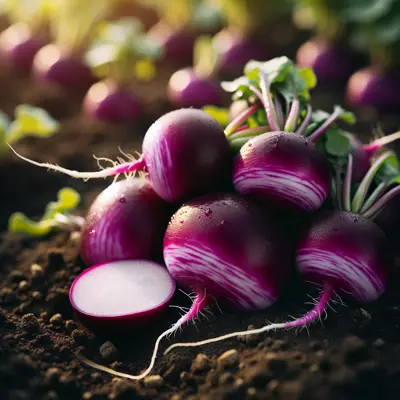
An eye-catching round radish with stunning deep purple skin and crisp white flesh that adds vibrant color to any garden or plate. This fast-growing variety maintains its mild, sweet flavor even as it reaches full size, making it perfect for gardeners who want beauty and taste. The golf ball-sized roots are as decorative as they are delicious.
Harvest
25-30d
Days to harvest
Sun
Full sun to partial shade
Zones
2–11
USDA hardiness
Height
0-3 feet
Planting Timeline
Showing dates for Purple Plum Radish in USDA Zone 7
All Zone 7 root-vegetable →Zone Map
Click a state to update dates
Purple Plum Radish · Zones 2–11
Growing Details
Succession Planting
Direct sow Purple Plum every 10–14 days starting around March 1 in zone 7, and keep going through late April. At 25–30 days to harvest, you can move fast. Pick back up in late August — aim for September 1 through mid-October — to catch the fall window before hard frost closes it. Don't bother sowing between mid-May and mid-August; once daytime highs clear 80°F, radishes bolt and go pithy before the root has a chance to size up.
Each sowing is small — a 3-foot row per person in your household is plenty. Stagger by date rather than by bed location so you're not pulling 40 radishes on the same Tuesday.
Complete Growing Guide
Purple Plum radishes thrive in cool weather, so timing is everything. Start your first plantings 2-4 weeks before your last frost date when soil temperatures reach 45-65°F. In zones 3-5, this means early April; zones 6-8 can plant in late March. The key to success is preparing loose, well-draining soil that won't restrict root development.
Amend heavy clay soils with compost and coarse sand to improve drainage—compacted soil leads to stunted, misshapen roots. Work in 2-3 inches of aged compost or well-rotted manure before planting, but avoid fresh nitrogen-rich amendments that promote leafy growth at the expense of root development. Your soil pH should be between 6.0-7.0 for optimal nutrient uptake.
Direct sow seeds ½ inch deep in rows spaced 6 inches apart. Plant seeds every inch, then thin seedlings to 2-inch spacing once they develop their first true leaves. Skip indoor starting—radishes develop taproots that don't transplant well, and the stress often causes premature bolting.
Water consistently to maintain even soil moisture throughout the growing period. Inconsistent watering causes woody, pithy roots and can trigger stress-induced bolting. Apply a light side-dressing of balanced fertilizer (10-10-10) 10 days after emergence if your soil lacks organic matter.
Avoid the common mistake of waiting too long between sowings. Plant new rows every 10-14 days through spring for continuous harvests, then resume planting in late summer (6-8 weeks before first frost) for fall crops. Summer plantings in zones 7+ often bolt quickly due to heat and long daylight hours.
Protect young seedlings from flea beetles with row covers, removing them once plants are established. In areas with cabbage root maggots, time plantings to avoid peak egg-laying periods in late spring.
Harvesting
Purple Plum radishes are ready when they reach golf ball size (1-1.5 inches diameter) after 25-30 days from seeding. The deep purple skin should be vibrant and smooth, without cracks or splits that indicate overmaturity.
Test readiness by gently brushing soil away from the top of one root to check size and color development. The shoulders should be well-rounded and fully purple. Harvest in the morning when roots are crisp and full of moisture from overnight recovery.
Pull radishes straight up with a gentle twisting motion, grasping the leaves close to the crown. If leaves break off, use a garden fork to carefully lift the root without puncturing it. Don't leave mature radishes in the ground longer than 35 days—they become woody and develop a sharper bite, losing their characteristic mild sweetness. Cool fall crops can stay in the ground slightly longer than spring plantings, but harvest before hard freezes damage the roots.
Storage & Preservation
Remove tops immediately after harvest, leaving about ½ inch of stem to prevent moisture loss. Store unwashed radishes in perforated plastic bags in the refrigerator crisper drawer where they'll maintain quality for 2-3 weeks at 32-40°F with high humidity.
For longer storage, layer whole radishes in slightly damp sand in a cool basement or root cellar (35-40°F), where they'll keep for up to two months. Quick pickling showcases their beautiful purple and white coloring—slice them to display the striking contrast and pickle in rice vinegar for a mild, sweet flavor that complements their natural taste. They also ferment well in kimchi or sauerkraut blends. Avoid freezing fresh radishes as they become mushy, but you can freeze pickled preparations successfully.
History & Origin
Purple Plum radish represents modern hybrid breeding focused on combining visual appeal with improved eating quality. Developed in the late 20th century by commercial seed companies responding to growing consumer interest in colorful, mild-flavored radish varieties that appealed to both gardeners and chefs.
This hybrid draws from Asian radish genetics, particularly purple-skinned varieties that have been cultivated in China and Japan for centuries. Traditional purple radishes were often quite pungent, but breeders selected for milder flavor profiles that would appeal to Western palates while maintaining the striking coloration.
The variety gained popularity in the early 2000s as part of the heirloom and specialty vegetable movement, despite being a hybrid rather than an heirloom itself. Its development reflects the successful marriage of traditional Asian radish genetics with modern breeding techniques aimed at creating varieties that perform consistently across different growing conditions while offering superior flavor and visual appeal for contemporary cuisine.
Advantages
- +Maintains mild, sweet flavor even at full maturity unlike many radishes that turn hot and woody
- +Stunning visual contrast when sliced shows deep purple skin with bright white interior
- +Excellent heat tolerance for spring plantings extends harvest window in warming weather
- +Strong disease resistance to clubroot and downy mildew reduces crop failures
- +Golf ball size provides substantial harvest from small garden space
- +Fast 25-30 day maturity allows multiple successive plantings per season
- +Reliable germination and uniform sizing make harvest timing predictable
Considerations
- -Hybrid variety means seeds cannot be saved for next year's planting
- -Purple skin color can mask early pest damage making detection more difficult
- -More expensive seed cost compared to standard red radish varieties
- -Limited availability in some regions requires ordering from specialty suppliers
- -Flea beetle damage is more visible on purple skin than red varieties
Companion Plants
Lettuce, spinach, and peas are the easiest wins here. They're all cool-season crops, so the timing lines up naturally for a spring or fall planting, and none of them compete with radishes at root depth — radishes pull from the top 6–8 inches while peas anchor deeper. Chives and nasturtiums are worth tucking in along the edges; nasturtiums in particular draw aphids onto themselves and away from the radish foliage, which sounds counterproductive until you realize you can just pinch off the infested stems. In zone 7 Georgia, I pair radishes with carrots as often as anything — they mark the carrot rows while the slow-germinating carrots catch up, and they're pulled well before the carrots need that space.
Hyssop is the one to skip. It's allelopathic toward several crops in the Brassicaceae, and radishes sit squarely in that family. Brussels sprouts and turnips are a different issue — planting brassicas together concentrates pest pressure, giving flea beetles (Phyllotreta spp.) and cabbage root maggots (Delia radicum) a bigger, easier target than if you'd scattered the family across the garden.
Plant Together
Lettuce
Quick-growing leaves provide shade for radish roots and help retain soil moisture
Carrots
Root zones don't compete as carrots grow deeper, and radishes help break up soil for carrot growth
Spinach
Cool-season companion that shares similar growing conditions and harvest timing
Chives
Natural pest deterrent that repels aphids and flea beetles that commonly attack radishes
Nasturtiums
Acts as trap crop for flea beetles and aphids, protecting radish foliage
Marigolds
Repels root maggots and other soil pests that can damage radish roots
Peas
Fixes nitrogen in soil and provides natural support structure without competing for root space
Cucumber
Radishes help deter cucumber beetles and can be harvested before cucumbers need full space
Keep Apart
Hyssop
Allelopathic compounds inhibit radish germination and early growth
Brussels Sprouts
Both are brassicas competing for same nutrients and susceptible to similar pests and diseases
Turnips
Same plant family with identical pest and disease issues, creating concentrated infestations
Nutrition Facts
Per 100g serving. % Daily Value based on 2,000 calorie diet. Source: USDA FoodData Central (FDC #169276)
Pests & Disease Resistance
Resistance
Good resistance to clubroot and downy mildew
Common Pests
Flea beetles, aphids, cabbage root maggots
Diseases
Clubroot, black rot, downy mildew
Troubleshooting Purple Plum Radish
What you'll see, why it happens, and what to do about it.
Small, ragged holes punched through leaves, especially on seedlings in the first 2 weeks after germination
Likely Causes
- Flea beetles (Phyllotreta spp.) — tiny, jumping beetles that chew shot-hole patterns in brassica leaves
- Dry or stressed seedlings, which take far more damage than vigorous ones
What to Do
- 1.Cover the bed with row cover (Agribon-15 or similar) immediately at sowing — flea beetles are worst on young plants and row cover stops them cold
- 2.Keep soil consistently moist; stressed seedlings are more attractive targets
- 3.If plants are past the seedling stage and look mostly healthy, flea beetle pressure usually eases once leaves harden up — no intervention needed
Plants wilting and yellowing despite adequate water, with stunted tops and a corky, distorted root instead of a clean round radish
Likely Causes
- Clubroot (Plasmodiophora brassicae) — a soil-borne pathogen that persists for 10+ years and is common in acidic soils
- Cabbage root maggots (Delia radicum) — larvae tunnel into the root, causing rot and collapse
What to Do
- 1.For clubroot: raise soil pH to 7.0 or just above by liming before planting — P. brassicae is far less active above pH 6.8
- 2.Rotate brassicas (radishes, turnips, cabbage, arugula) out of the same bed for at least 3 seasons
- 3.For root maggots: lay row cover at sowing to block the adult fly from laying eggs at the soil line; there's no good rescue treatment once larvae are inside the root
V-shaped yellow lesions along leaf margins, with black veins visible inside the cut surface of the root or stem
Likely Causes
- Black rot (Xanthomonas campestris pv. campestris) — a bacterial disease that enters through leaf margins and water pores, spreading fast in warm wet weather
- Infected seed, or planting into a bed that still has brassica debris from the previous season
What to Do
- 1.Pull and trash (do not compost) any affected plants immediately — black rot moves between plants quickly
- 2.Switch to drip or soaker hose irrigation to keep leaves dry
- 3.Source certified disease-free seed; at 25–30 days to harvest, a second sowing in a clean bed is faster than trying to rescue an infected one
Gray or purple fuzzy growth on the undersides of leaves, with yellowing patches on the upper surface
Likely Causes
- Downy mildew (Peronospora parasitica) — an oomycete that sporulates on leaf undersides in cool, humid conditions, typically when nights drop below 60°F and humidity stays high
- Overcrowded planting that traps moisture between leaves
What to Do
- 1.Thin plants to 1–2 inches apart so air moves through the bed — P. parasitica thrives in stagnant, humid air
- 2.Water in the morning so foliage dries before nightfall
- 3.Remove and trash heavily infected leaves; at 25–30 days to harvest, a quick resow in a fresh spot is usually more practical than any spray program
Frequently Asked Questions
How long does Purple Plum radish take to grow?▼
Can you grow Purple Plum radish in containers?▼
What does Purple Plum radish taste like?▼
Is Purple Plum radish good for beginners?▼
When should I plant Purple Plum radish?▼
Purple Plum vs Cherry Belle radish - what's the difference?▼
Zone-by-Zone Planting Calendar
| Zone | Indoor Start | Transplant | Direct Sow | Harvest |
|---|---|---|---|---|
| Zone 3 | — | — | May – June | May – October |
| Zone 4 | — | — | April – June | May – October |
| Zone 5 | — | — | April – May | May – November |
| Zone 6 | — | — | April – May | April – November |
| Zone 7 | — | — | March – May | April – November |
| Zone 8 | — | — | March – April | March – December |
| Zone 9 | — | — | February – March | February – December |
| Zone 10 | — | — | January – March | February – December |
| Zone 1 | — | — | June – July | June – September |
| Zone 2 | — | — | May – July | June – September |
| Zone 11 | — | — | January – February | January – December |
| Zone 12 | — | — | January – February | January – December |
| Zone 13 | — | — | January – February | January – December |
Growing Guides from Wind River Greens
Sources & References
External authority sources used in compiling this guide.
See the Methodology page for how this data is sourced, what's AI-assisted, and known limitations.