Long Black Spanish Radish
Raphanus sativus 'Long Black Spanish'
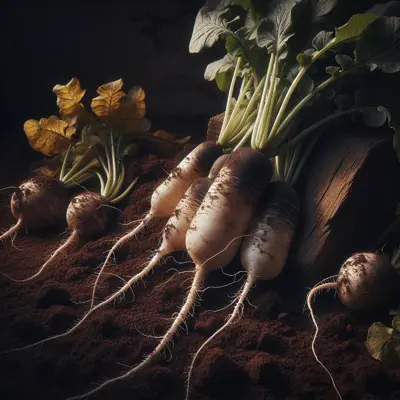
This impressive heirloom winter radish dates back to the 1600s and offers a completely different experience from common spring radishes. Growing 8-10 inches long with distinctive black skin and pure white interior flesh, these storage radishes develop complex, pungent flavors that mellow beautifully when cooked. Perfect for gardeners seeking unusual varieties that provide fresh eating well into winter months.
Harvest
55-60d
Days to harvest
Sun
Full sun to partial shade
Zones
2–11
USDA hardiness
Height
0-3 feet
Planting Timeline
Showing dates for Long Black Spanish Radish in USDA Zone 7
All Zone 7 root-vegetable →Zone Map
Click a state to update dates
Long Black Spanish Radish · Zones 2–11
Growing Details
Succession Planting
Long Black Spanish radish bolts and turns pithy when daytime highs push past 75–80°F, so in zone 7 you're working two windows. For spring, direct sow starting around March 1, every 14 days through mid-April — that gives you two to three rounds before heat shuts things down in late May. Each sowing takes 55–60 days to mature, so count backward from your last comfortable harvest date and stop sowing when the math stops working.
The fall window is the more reliable one in Georgia. Start sowing again around August 20–September 1, every 14 days through early October. Roots that mature in October and November pick up flavor after a light frost. A final sowing in early October gives you storage roots to pull before a hard freeze — or you can mulch them in place with 4–6 inches of straw if no hard freeze is imminent. Skip summer entirely; this variety will bolt before it forms a usable root.
Complete Growing Guide
Start preparing your planting site in mid to late summer, timing your sowing for 10-12 weeks before your area's first hard frost. Long Black Spanish radishes need deep, loose soil to accommodate their impressive 8-10 inch taproot. Work the soil to at least 12 inches deep, removing rocks and breaking up clay clumps that could cause the roots to fork or become misshapen.
Amend heavy clay soils with coarse sand and compost to improve drainage, as waterlogged conditions will cause root rot. In sandy soils, incorporate plenty of organic matter to retain moisture and nutrients. Avoid fresh manure, which can cause excessive leaf growth at the expense of root development and may lead to forked roots.
Direct sow seeds ½ inch deep in rows spaced 12-18 inches apart. Unlike spring radishes, these winter varieties need more space – thin seedlings to 4-6 inches apart once they're 2 inches tall. Skip starting indoors, as radishes don't transplant well and disturbing the taproot stunts development.
Water consistently but avoid overwatering, which produces all leaves and small roots. Apply a balanced fertilizer (10-10-10) at planting, then side-dress with compost midway through the growing season. Avoid high-nitrogen fertilizers after the first month, as they'll push leafy growth instead of root development.
Keep the soil consistently moist but not soggy throughout the 55-60 day growing period. Inconsistent watering causes woody, bitter roots or splitting. Mulch around plants to maintain soil moisture and suppress weeds, but keep mulch away from the root shoulders to prevent pest harboring.
Common mistakes include planting too early in summer heat (which causes bolting), overcrowding plants (resulting in small, underdeveloped roots), and harvesting too early (before the distinctive black skin fully develops). In zones 7-9, you can succession plant every 3 weeks through early fall for continuous harvests.
Harvesting
Harvest Long Black Spanish radishes when they reach 6-10 inches long and develop their characteristic coal-black skin, typically 55-60 days from sowing. The shoulders should be well-filled and the skin completely dark – white or pale areas indicate the root needs more time to mature.
Test readiness by gently brushing soil away from the top of the root. A mature radish will have firm, solid shoulders without soft spots or wrinkling. The black skin should be smooth and taut, not loose or papery.
Harvest in the morning when roots are fully hydrated and crisp. Loosen soil around each root with a garden fork, working 6 inches away from the radish to avoid piercing it. Grasp the leaves close to the root and pull straight up with steady pressure – don't twist, as this can break the root.
Cut leaves off immediately, leaving about an inch of stem to prevent moisture loss. Brush off excess soil but don't wash until ready to use, as wet roots deteriorate faster in storage. Light frost actually improves flavor by converting starches to sugars, so don't rush to harvest at the first frost warning.
Storage & Preservation
Fresh Long Black Spanish radishes store exceptionally well, lasting 3-6 months in proper conditions. Store unwashed roots in barely damp sand or sawdust in a cool (32-40°F), humid location like a root cellar or refrigerator crisper drawer. Wrap individually in perforated plastic bags if using the refrigerator.
For traditional root cellar storage, layer roots in wooden boxes with damp sand, ensuring they don't touch each other. Check monthly and remove any soft or sprouting roots. Properly stored radishes will remain crisp and develop milder, sweeter flavors over time.
Pickle sliced radishes in rice vinegar for an authentic Asian-style condiment that keeps for months. Ferment them whole or chunked for a tangy, probiotic-rich preserve. They also dehydrate well when sliced thin – rehydrate dried pieces for winter soups and stews. Unlike many root vegetables, Long Black Spanish radishes don't freeze well raw but can be blanched and frozen for cooked dishes.
History & Origin
Long Black Spanish radishes trace their lineage to ancient cultivation in the Mediterranean and eastern Europe, with documented varieties dating back to the 1600s. Spanish traders and settlers brought these distinctive black-skinned radishes to the Americas, where they became staples in colonial gardens and immigrant communities.
These hardy winter radishes were prized for their exceptional storage qualities, providing fresh vegetables through harsh winters when other crops failed. German and Eastern European immigrants particularly valued them, often storing barrels of these radishes alongside potatoes and turnips in root cellars.
The variety gained prominence in 19th-century American seed catalogs, where it was praised for both culinary and medicinal uses. Traditional herbalists valued the roots for their warming properties and digestive benefits. Unlike the small, quick-growing radishes that dominate modern markets, Long Black Spanish represents an older tradition of substantial winter storage crops that sustained families through the cold months. Today's varieties remain largely unchanged from those historical selections, maintaining their distinctive appearance and complex, pungent flavors that mellowed during long winter storage.
Advantages
- +Exceptional storage life of 3-6 months without refrigeration
- +Develops sweeter, milder flavor after light frost exposure
- +Impressive 8-10 inch size makes dramatic harvest presentation
- +Thrives in cooler weather when other crops struggle
- +Unique black skin and white flesh creates striking visual contrast
- +Complex flavor profile transforms from pungent raw to sweet when cooked
- +Extremely hardy with excellent disease tolerance in fall conditions
Considerations
- -Long growing season limits succession planting opportunities
- -Requires deep, well-prepared soil to prevent forked or stunted roots
- -Very pungent raw flavor can be overwhelming for mild palates
- -Takes up significant garden space compared to spring radish varieties
- -Poor transplant tolerance requires direct seeding only
Companion Plants
Carrots and lettuce are the most straightforward neighbors for Long Black Spanish radish, and the reason is mostly about root depth and timing. Carrots run deep; radishes stay in the top few inches of soil. They don't compete for the same resources, and the radishes are out of the ground in 55–60 days while the carrots are still bulking up. Lettuce fills gaps in the row, shades the soil surface from crusting during the shoulder seasons, and has no chemistry conflict with radishes. Spinach works the same way — all three are cool-season crops, so you're already growing them in the same window anyway.
Nasturtiums and marigolds pull their weight by drawing aphids and flea beetles (Phyllotreta spp.) away from your radish seedlings. Nasturtiums in particular act as a trap crop — aphids pile onto them preferentially, and you can pull the nasturtiums when they get overrun or just let them absorb the damage. Chives and dill get credit for scent-based pest confusion, though that effect is less documented than the gardening literature implies. Still, neither one causes problems, and dill will attract beneficial wasps that go after aphid populations.
Concentrating other brassicas — kale, turnips, arugula, mustard — right next to your radishes is the arrangement to avoid. In our zone 7 Georgia garden, where clubroot (Plasmodiophora brassicae) and black rot (Xanthomonas campestris) can carry over in soil from one season to the next, packing all your brassicas into one bed makes it easy for those pathogens to spread and nearly impossible to rotate away from them. NC State Extension's cultural disease management guidance is direct on this point: crops in the same family shouldn't follow each other in the same bed. Keep brassicas spread out across the garden. Hyssop is the other plant to skip — it's allelopathic to a range of vegetables, radishes included, and there's nothing it offers that compensates for that.
Plant Together
Carrots
Radishes break up soil for carrots and mature quickly, allowing carrots more space
Lettuce
Radishes naturally loosen soil for shallow lettuce roots and provide pest protection
Spinach
Cool-season companions that don't compete for space due to different root depths
Nasturtiums
Act as trap crops for flea beetles and aphids that commonly attack radishes
Marigolds
Repel nematodes and other soil pests that can damage radish roots
Chives
Deter aphids and flea beetles while improving radish flavor
Dill
Attracts beneficial insects that control radish pests like aphids and flea beetles
Peas
Fix nitrogen in soil and grow vertically, not competing with radish root space
Keep Apart
Brassicas
Same family plants compete for nutrients and attract similar pests like flea beetles
Hyssop
Allelopathic properties inhibit radish germination and root development
Grapes
Root competition and radishes may negatively affect grape vine growth
Nutrition Facts
Per 100g serving. % Daily Value based on 2,000 calorie diet. Source: USDA FoodData Central (FDC #169276)
Pests & Disease Resistance
Resistance
Generally hardy with good disease tolerance
Common Pests
Flea beetles, cabbage root maggots, aphids
Diseases
Clubroot, black rot, white rust
Troubleshooting Long Black Spanish Radish
What you'll see, why it happens, and what to do about it.
Tiny round holes scattered across the leaves — looks like the foliage was hit with birdshot
Likely Causes
- Flea beetles (Phyllotreta spp.) — adults chew small pits that punch through the leaf surface
- Seedling-stage plants are most vulnerable; damage slows as plants mature past 3–4 true leaves
What to Do
- 1.Cover seedlings with floating row cover immediately after sowing — flea beetles find plants by sight and smell, and exclusion is the most reliable control
- 2.Sprinkle diatomaceous earth around the base of plants; reapply after rain
- 3.If populations are heavy, a pyrethrin spray in the early morning can knock adults back, but row cover is your long-term answer
Plants wilt and yellow despite adequate water; pulling one up reveals a swollen, distorted root with no resemblance to a normal radish
Likely Causes
- Clubroot (Plasmodiophora brassicae) — a soil-borne pathogen that infects brassica roots, forming galls that block water and nutrient uptake
- Acidic soil below pH 6.0 dramatically favors clubroot development
What to Do
- 1.Dig up and trash every affected plant and as much surrounding soil as you can — do not compost them
- 2.Lime the bed to bring pH up to at least 6.8–7.0; clubroot struggles above that range
- 3.Rotate out of all brassica-family crops (radish, turnip, cabbage, kale) for a minimum of 4 years — NC State Extension notes this pathogen can persist in soil for years, so rotation isn't optional
V-shaped yellow-to-brown lesions at the leaf margins, working inward; veins may look dark or blackened
Likely Causes
- Black rot (Xanthomonas campestris) — a bacterial disease; NC State Extension's diagnostic guidance flags these V-shaped lesions on crucifers as high-destructive-potential, and notes they can be tricky to confirm when lesions are atypical
- Infected seed or debris from a previous brassica crop left in the bed
What to Do
- 1.Remove and bag affected leaves immediately — the bacteria spread in water, so work when foliage is dry
- 2.Switch to drip or soaker hose for the rest of the season; overhead irrigation keeps leaf surfaces wet and moves the pathogen around
- 3.Source hot-water-treated seed next year, and keep this bed out of brassicas for at least 2 seasons
Chalky white pustules on leaf undersides and upper surfaces; affected leaves yellow and die back before the roots are close to sizing up
Likely Causes
- White rust (Albugo candida) — an oomycete pathogen common on radishes and other brassicas, especially in cool, humid stretches
- Crowded rows that stay wet after rain, or overhead watering late in the day
What to Do
- 1.Strip and trash infected leaves as soon as you spot pustules — don't compost them
- 2.Thin plants to the full 4–6 inch spacing so air moves between them
- 3.Apply a copper-based fungicide on a 7-day schedule if the infection is spreading, and stop any overhead watering
Frequently Asked Questions
How long does Long Black Spanish radish take to grow?▼
What does Long Black Spanish radish taste like?▼
Can you grow Long Black Spanish radish in containers?▼
When should I plant Long Black Spanish radish seeds?▼
Is Long Black Spanish radish good for beginners?▼
How do you store Long Black Spanish radishes for winter?▼
Zone-by-Zone Planting Calendar
| Zone | Indoor Start | Transplant | Direct Sow | Harvest |
|---|---|---|---|---|
| Zone 3 | — | — | May – June | June – October |
| Zone 4 | — | — | April – June | June – October |
| Zone 5 | — | — | April – May | June – November |
| Zone 6 | — | — | April – May | May – November |
| Zone 7 | — | — | March – May | May – November |
| Zone 8 | — | — | March – April | April – December |
| Zone 9 | — | — | February – March | March – December |
| Zone 10 | — | — | January – March | March – December |
| Zone 1 | — | — | June – July | July – September |
| Zone 2 | — | — | May – July | July – September |
| Zone 11 | — | — | January – February | February – December |
| Zone 12 | — | — | January – February | February – December |
| Zone 13 | — | — | January – February | February – December |
Growing Guides from Wind River Greens
Sources & References
External authority sources used in compiling this guide.
See the Methodology page for how this data is sourced, what's AI-assisted, and known limitations.