Hakurei Turnip
Brassica rapa
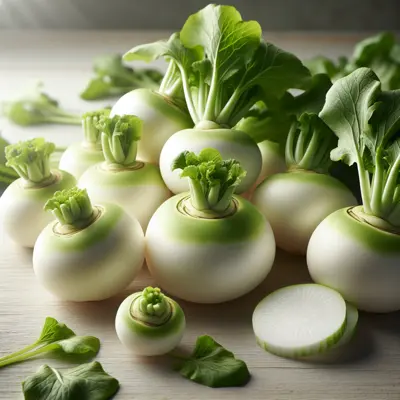
The smooth, flat-round, white roots mature early (just after radishes) and are best harvested young, up to 2" diameter. Eaten raw, the flavor is sweet and fruity and the texture is juicy and tender. The tops may be eaten raw or lightly cooked. Hakurei stays smooth as it sizes.
Harvest
38d
Days to harvest
Sun
Full sun to partial shade
Zones
5–11
USDA hardiness
Height
3 feet
Planting Timeline
Showing dates for Hakurei Turnip in USDA Zone 7
All Zone 7 root-vegetable →Zone Map
Click a state to update dates
Hakurei Turnip · Zones 5–11
Growing Details
Succession Planting
Hakurei is ready in about 38 days and doesn't hold in the ground once it hits size — it turns pithy and sharp-tasting fast — so succession sowing is how you get a steady supply instead of a two-week glut. Direct sow every 14 days starting when soil temps reach 45°F in early spring, and keep going through early May. Stop when daytime highs are consistently above 75–80°F; heat pushes them to bolt and the roots lose the mild sweetness that makes this variety worth growing in the first place.
Pick back up in late summer for a fall run. Count back 38 days from your first expected frost and use that as your last sow date. In zone 7, that typically means restarting direct sows in late August and continuing through late September. Fall Hakurei tends to outperform spring — cooler nights slow the growth rate down and the roots stay tender longer before you pull them.
Complete Growing Guide
Start by preparing your soil in early spring as soon as it can be worked, or in late summer for fall crops. Hakurei turnips thrive in loose, fertile soil with a pH between 6.0-7.0. Work in 2-3 inches of compost or well-aged manure before planting, as these fast-growing roots need readily available nutrients.
Direct sow seeds ¼ inch deep in rows spaced 12 inches apart. Unlike many root vegetables, Hakurei turnips tolerate light crowding, so you can plant seeds just 1 inch apart initially. The soil temperature should be between 45-85°F for optimal germination, which occurs in 4-7 days. Skip starting indoors – turnips develop better roots when direct sown and don't transplant well.
Thin seedlings to 2-3 inches apart when they're 2 inches tall. Don't discard the thinnings – these baby greens are delicious in salads. For continuous harvest, succession plant every 2-3 weeks through spring and again starting 10-12 weeks before your first fall frost.
Fertilize lightly with a balanced 10-10-10 fertilizer at planting, then side-dress with nitrogen when plants are 3 inches tall. Avoid over-fertilizing with nitrogen late in the season, as this promotes leaf growth at the expense of root development.
Maintain consistent moisture with 1 inch of water weekly. Inconsistent watering causes roots to crack or become woody. Mulch around plants to retain moisture and suppress weeds, but keep mulch 2 inches away from the stems to prevent rot.
Hakurei turnips are remarkably bolt-resistant, but in zones 7-9, provide afternoon shade during hot summer months. Plant your fall crop 6-8 weeks before the first frost – these turnips actually sweeten after light frosts.
Avoid the common mistake of letting soil become compacted, which causes misshapen roots. Never cultivate deeply near the plants; instead, hand-pull weeds or use a shallow hoe. Watch for flea beetles early in the season and cover with row covers if damage is severe.
Harvesting
Harvest Hakurei turnips when roots reach 1-4 inches in diameter, typically 38-45 days from seeding. Unlike traditional turnips, these remain sweet and crisp even at larger sizes, so you have flexibility in timing. The ideal harvest size is 2-3 inches across – large enough for substantial yield but still at peak tenderness.
Look for smooth, bright white globes that feel firm when gently squeezed. The shoulders should be pushing slightly above soil level. Perform the 'twist test' – grasp the greens and gently twist the root. If it resists, it's ready. If it gives too easily, wait a few more days.
Harvest in the morning when roots are crisp and full of moisture. Loosen soil around each turnip with a hand fork, then pull straight up by the greens. Cut greens off immediately, leaving ½ inch of stem to prevent the root from 'bleeding.' Brush off soil but don't wash until ready to use. Both the roots and young, tender greens are edible and valuable.
Storage & Preservation
Store freshly harvested Hakurei turnips in the refrigerator crisper drawer in a perforated plastic bag. They'll maintain peak quality for 2-3 weeks when kept at 32-35°F with high humidity. Remove the greens before storage, as they continue to draw moisture from the roots.
For longer preservation, these turnips pickle beautifully due to their firm texture. Quick-pickle small whole turnips in rice vinegar with a touch of sugar for a Japanese-inspired tsukemono. They also freeze well when blanched for 2 minutes, though they'll be softer when thawed – perfect for cooked dishes.
Fermentation is another excellent option. Slice them thin and add to kimchi or sauerkraut for extra crunch. Unlike storage turnips, Hakurei doesn't keep well in root cellars due to its thin skin and high water content, so focus on refrigeration and preservation methods for long-term storage.
History & Origin
Hakurei turnips originated in Japan, where small, sweet turnips have been cultivated for centuries as both a vegetable crop and for traditional pickles (tsukemono). The name 'Hakurei' translates roughly to 'white spirit' or 'white soul,' reflecting the pure white appearance and clean flavor of these roots.
This variety gained popularity in American gardens through specialty seed companies in the 1990s, particularly after being featured in high-end restaurant menus where chefs praised its versatility. Unlike the strong, sometimes bitter turnips many Americans knew, Hakurei's apple-like crispness and sweet flavor revolutionized perceptions of turnips in Western cuisine.
As a hybrid variety, Hakurei was developed to combine the best traits of Japanese salad turnips: quick maturity, resistance to becoming woody, and the ability to be eaten raw. Its introduction to American gardens coincided with the farm-to-table movement, where its dual-purpose nature (both roots and greens) and chef appeal made it a favorite among market gardeners and home growers seeking restaurant-quality vegetables.
Advantages
- +Never becomes woody or bitter, even when harvested large at 4+ inches
- +Exceptional bolt resistance allows spring planting in warm climates
- +Both roots and greens are edible, maximizing garden space efficiency
- +Rapid 38-45 day maturity allows multiple succession crops per season
- +Superior raw eating quality with crisp, apple-like texture
- +Tolerates light frosts, actually improving flavor after cold exposure
- +Compact size makes it ideal for container growing and small spaces
Considerations
- -Thin skin makes it more susceptible to damage during harvest and storage
- -Higher water content means shorter storage life compared to traditional turnips
- -Flea beetles can severely damage young seedlings in early season
- -More expensive than standard turnip varieties due to hybrid breeding
- -Requires consistent moisture - drought stress causes cracking and poor texture
Companion Plants
Lettuce, spinach, and radishes fit well alongside Hakurei because they're shallow-rooted and stay low — they're not competing with turnip bulbs developing 3–4 inches down in the same soil column. Peas are worth tucking in nearby too; the nitrogen-fixing bacteria in their roots add back some of what a fast-maturing brassica pulls out in its 38-day sprint. Nasturtiums tend to draw aphids off the turnips entirely, acting as a decoy rather than a repellent — which is actually the more reliable mechanism. Onions and garlic at the bed edges give off sulfur compounds that seem to confuse aphids before they settle in.
Skip anything else in the brassica family as a neighbor — cabbage, mustard, and their relatives share all the same pest and disease vulnerabilities. Flea beetles and Plasmodiophora brassicae don't distinguish between a turnip and a cabbage, so planting them adjacent just doubles the target. NC State Extension's rotation guidance makes clear that related crops from the same family should cycle out of a bed for 3 years minimum; planting them side by side undermines that entirely. Tomatoes are more of a structural problem — they'll shade out a low turnip planting within weeks, and the two crops have nothing useful to offer each other.
Plant Together
Lettuce
Shallow roots don't compete with turnip roots, provides living mulch
Spinach
Compatible root depths, both cool-season crops with similar water needs
Radishes
Help break up soil for turnip root development, harvest before turnips mature
Peas
Fix nitrogen in soil which benefits turnip growth, vertical growth saves space
Carrots
Deep taproots complement turnip's shallow roots, efficient space usage
Onions
Repel root maggots and flea beetles that commonly attack turnips
Garlic
Natural pest deterrent against aphids and root flies
Nasturtiums
Trap crop for flea beetles and aphids, keeps pests away from turnips
Keep Apart
Mustard
Same family (Brassicaceae) - attracts similar pests and diseases like clubroot
Cabbage
Fellow brassica that competes for nutrients and attracts cabbage root maggots
Tomatoes
Heavy feeders that deplete soil nutrients needed by developing turnip roots
Nutrition Facts
Per 100g serving. % Daily Value based on 2,000 calorie diet. Source: USDA FoodData Central (FDC #170465)
Pests & Disease Resistance
Resistance
Good bolt resistance and heat tolerance for a turnip
Common Pests
Flea beetles, cabbage root maggots, aphids
Diseases
Clubroot, black rot, white rust
Troubleshooting Hakurei Turnip
What you'll see, why it happens, and what to do about it.
Tiny round holes scattered across leaves, seedlings look like they've been hit with a pin punch — worst in the first 2 weeks after germination
Likely Causes
- Flea beetles (Phyllotreta spp.) — they overwinter in soil and leaf litter and go straight for young brassicas in spring
- Dry, warm spells that stress seedlings and slow recovery
What to Do
- 1.Cover the bed with row cover immediately at direct sow and leave it on until plants are 4–5 inches tall — flea beetles can't find what they can't land on
- 2.Keep soil consistently moist; stressed seedlings take much longer to outgrow the damage
- 3.If pressure is heavy, spinosad-based sprays (OMRI-listed) applied in the evening can knock populations back
Plants stunted and yellowing, roots pulled up show galls or hard warty swellings — no improvement after watering or fertilizing
Likely Causes
- Clubroot (Plasmodiophora brassicae) — a soil-borne pathogen that persists in the ground for 10–20 years and is nearly impossible to eradicate once established
- Low soil pH below 6.0, which favors spore germination
What to Do
- 1.Pull and bag the entire plant — roots included — and put it in the trash, not the compost
- 2.Lime the bed to raise pH to at least 7.0–7.2; P. brassicae activity drops significantly above that range
- 3.NC State Extension's rotation guidelines recommend keeping brassicas out of that bed for at least 3–4 years; with clubroot, longer is better
V-shaped yellow lesions on leaf margins turning brown and papery, dark veins visible when you hold the leaf to light, starting on outer leaves
Likely Causes
- Black rot (Xanthomonas campestris pv. campestris) — a bacterial disease spread by rain splash, contaminated seed, and infected transplants
- Overhead irrigation or prolonged wet weather that keeps foliage wet for hours at a time
What to Do
- 1.Remove and trash affected leaves as soon as you spot them — don't compost anything showing these symptoms
- 2.Switch to drip irrigation or water at the base; keeping leaf surfaces dry cuts transmission significantly
- 3.Per NC State Extension IPM guidance, rotate brassicas out of the affected bed for a minimum of 3 years — black rot inoculum survives in crop debris
Frequently Asked Questions
How long does Hakurei turnip take to grow?▼
Can you grow Hakurei turnips in containers?▼
What does Hakurei turnip taste like?▼
When should I plant Hakurei turnips?▼
Are Hakurei turnips good for beginners?▼
Do Hakurei turnip greens taste good?▼
Zone-by-Zone Planting Calendar
| Zone | Indoor Start | Transplant | Direct Sow | Harvest |
|---|---|---|---|---|
| Zone 1 | — | — | June – July | July – September |
| Zone 2 | — | — | May – July | June – September |
| Zone 11 | — | — | January – February | January – December |
| Zone 12 | — | — | January – February | January – December |
| Zone 13 | — | — | January – February | January – December |
| Zone 3 | — | — | May – June | June – October |
| Zone 4 | — | — | April – June | June – October |
| Zone 5 | — | — | April – May | May – November |
| Zone 6 | — | — | April – May | May – November |
| Zone 7 | — | — | March – May | April – November |
| Zone 8 | — | — | March – April | April – December |
| Zone 9 | — | — | February – March | March – December |
| Zone 10 | — | — | January – March | February – December |
Growing Guides from Wind River Greens
Sources & References
External authority sources used in compiling this guide.
See the Methodology page for how this data is sourced, what's AI-assisted, and known limitations.