Cherry Belle Radish
Raphanus sativus 'Cherry Belle'
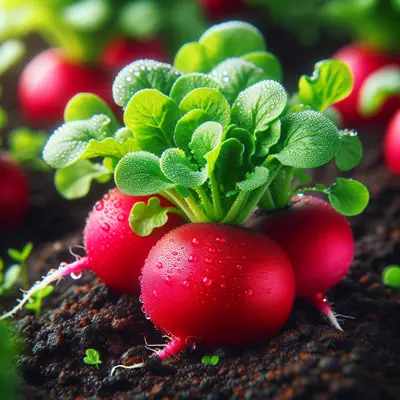
America's most popular radish variety and an All-America Selections winner, Cherry Belle delivers reliable results for gardeners of all skill levels. These perfectly round, cherry-red radishes mature in just 22-30 days, making them ideal for quick satisfaction and succession planting throughout the growing season. Their mild, crisp bite and uniform shape make them a favorite for fresh eating and beautiful garnishes.
Harvest
22-30d
Days to harvest
Sun
Full sun to partial shade
Zones
2–11
USDA hardiness
Height
0-3 feet
Planting Timeline
Showing dates for Cherry Belle Radish in USDA Zone 7
All Zone 7 root-vegetable →Zone Map
Click a state to update dates
Cherry Belle Radish · Zones 2–11
Growing Details
Succession Planting
Cherry Belle turns in 22–30 days, which makes it one of the better candidates for tight succession planting. In zone 7, direct sow every 10–14 days starting around March 1 and keep going through late April. Stop when daytime highs are consistently hitting 75–80°F — heat turns the roots pithy and sharp-flavored fast, and the plant bolts within days of the threshold.
Pick back up with a fresh sowing in late August or early September for the fall run. Successions every 2 weeks will carry you through October and into early November; a light frost cloth extends that window a bit further if a hard freeze threatens before you've pulled the last round.
Complete Growing Guide
Cherry Belle radishes thrive in cool weather, making them perfect for early spring and fall plantings. Start preparing your soil by working in 2-3 inches of compost or well-aged manure, ensuring the bed is loose to at least 6 inches deep. These radishes need room to expand, so remove any rocks or clumps that could cause misshapen roots.
Always direct sow Cherry Belle seeds—never start them indoors or attempt transplanting, as disturbed roots will fork or become woody. Plant seeds ½ inch deep and 1 inch apart in rows spaced 6 inches apart. In zones 3-5, begin sowing 2-3 weeks before your last frost date. Southern gardeners in zones 8-10 should wait until soil temperatures drop below 70°F, typically starting in October.
The key to continuous harvests is succession planting every 10-14 days from early spring through late May, then resuming in late August through October. Skip summer plantings in zones 6 and warmer—hot weather causes Cherry Belle to bolt quickly and develop a harsh, pithy texture.
Fertilize lightly with a balanced 10-10-10 fertilizer at planting time, but avoid high-nitrogen feeds that promote leaf growth at the expense of root development. Side-dress with compost tea every two weeks if your soil is particularly poor.
Maintain consistent moisture throughout the growing period—Cherry Belle radishes that experience drought stress become woody and overly pungent. However, avoid overwatering, which can cause splitting and increase disease pressure. A light mulch of grass clippings helps retain moisture without creating overly wet conditions.
Common mistakes include planting too thickly (thin to 2 inches apart when seedlings emerge), allowing weeds to compete (radishes have shallow roots), and leaving mature radishes in the ground too long. Cherry Belle becomes pithy and loses its crisp texture within a week of reaching maturity, so harvest promptly for best quality.
Harvesting
Cherry Belle radishes are ready to harvest when they reach ¾ to 1¼ inches in diameter, typically 22-30 days from sowing. The best visual cue is when the red shoulders push up through the soil surface—they should be bright cherry-red with smooth, taut skin. Harvest in the morning when radishes are fully hydrated and at their crispest.
To test readiness, gently brush soil away from the largest radish and check its size. If it feels firm when pressed lightly, it's ready. Avoid the temptation to let them grow larger—Cherry Belle quickly becomes woody and hollow once it exceeds 1¼ inches.
Harvest by grasping the leaves close to the root and pulling straight up with a gentle twisting motion. In heavy clay soil, use a hand fork to loosen the soil around larger radishes to prevent breaking. Remove all mature radishes within a week of reaching size, as they deteriorate rapidly in the ground, becoming spongy and losing their characteristic mild flavor.
Storage & Preservation
Fresh Cherry Belle radishes keep best when stored immediately after harvest. Remove the greens (which can be eaten like spinach) leaving about ½ inch of stem to prevent moisture loss. Store unwashed radishes in perforated plastic bags in the refrigerator crisper drawer, where they'll maintain their crisp texture for 2-3 weeks.
For longer storage, Cherry Belle radishes excel in fermentation—their mild flavor and firm texture make them perfect for quick kimchi or lacto-fermented vegetables. Simply slice and pack in 2% salt brine for tangy pickled radishes ready in 3-5 days.
Pickling is another excellent preservation method. Their uniform size makes them ideal for whole pickled radishes, maintaining their beautiful red color and adding visual appeal to pickle platters. Unlike storage radishes, Cherry Belle doesn't store well in root cellars due to its thin skin and high moisture content.
History & Origin
Cherry Belle radish was developed by the Burpee Seed Company in the 1940s and earned the prestigious All-America Selections award in 1949, cementing its place as America's favorite radish variety. The variety was specifically bred to address home gardeners' need for a reliable, quick-maturing radish that would perform consistently across different climates and soil types.
Burpee's plant breeders selected for the variety's distinctive round shape, uniform bright red color, and mild flavor that appealed to American palates. Unlike the longer, more pungent European radish varieties popular at the time, Cherry Belle was designed to be approachable for children and those sensitive to sharp flavors.
The variety quickly became synonymous with American home gardens and school garden programs due to its foolproof nature and rapid germination that provided nearly instant gratification for young gardeners. Today, Cherry Belle remains largely unchanged from its original 1940s genetics, a testament to the quality of the original breeding work and the variety's inherent stability as an open-pollinated heirloom.
Advantages
- +Exceptional uniformity in shape and size makes for consistent harvests and attractive presentations
- +Remarkable heat tolerance for a spring radish, extending the growing season into early summer
- +Mild, sweet flavor appeals to children and those who typically dislike radishes
- +22-day maturity allows for multiple successions and quick garden turnover
- +Reliable germination rates exceed 85% even in less-than-ideal soil conditions
- +Beautiful red color remains vibrant even after light cooking or pickling
- +Performs well in partial shade where other root vegetables struggle
Considerations
- -Becomes pithy and hollow within days of reaching maturity if not harvested promptly
- -Thin skin makes it prone to cracking during periods of irregular watering
- -Limited storage life compared to winter radish varieties
- -Susceptible to flea beetle damage which creates unsightly holes in leaves and roots
- -Bolts quickly in temperatures above 75°F, making summer cultivation challenging
Companion Plants
Lettuce, spinach, and peas are the workhorses here — they share Cherry Belle's cool-season window, have shallow or non-competing roots, and the lettuce and spinach cast a little ground shade as temperatures inch up in late April in zone 7 Georgia gardens. Chives may deter aphids through sulfur compounds in their foliage, and nasturtiums act as documented trap crops — aphids pile onto them and largely ignore the radishes nearby. Keep radishes away from hyssop, which is thought to stunt their growth through allelopathic root exudates, and don't tuck them in next to broccoli, cabbage, or any other brassica — cabbage maggots and flea beetles will move freely between related plants, and clubroot spores don't care which brassica they started on.
Plant Together
Lettuce
Shallow roots complement radish growth, provides shade to keep soil cool
Carrots
Radishes break up soil for carrot growth and mature quickly without competing
Spinach
Cool season companion with compatible growing requirements and spacing
Chives
Repels root maggots and other soil pests that attack radish roots
Nasturtiums
Acts as trap crop for flea beetles and aphids that commonly damage radishes
Cucumber
Radishes repel cucumber beetles while cucumbers provide ground shade
Marigolds
Natural pest deterrent against soil nematodes and root-damaging insects
Peas
Fix nitrogen in soil and radishes are harvested before peas need full space
Keep Apart
Hyssop
Strong aromatic compounds can inhibit radish germination and root development
Brassica crops
Same family plants compete for nutrients and attract similar pests like cabbage root maggots
Grape vines
Radishes can stunt grape growth and interfere with vine root systems
Nutrition Facts
Per 100g serving. % Daily Value based on 2,000 calorie diet. Source: USDA FoodData Central (FDC #169276)
Pests & Disease Resistance
Resistance
Generally disease-free when grown in proper conditions
Common Pests
Flea beetles, aphids, cabbage maggots
Diseases
Clubroot, black rot, downy mildew
Troubleshooting Cherry Belle Radish
What you'll see, why it happens, and what to do about it.
Tiny round holes punched through leaves, especially on seedlings in the first 2 weeks after germination
Likely Causes
- Flea beetles (Phyllotreta spp.) — adults overwinter in soil and leaf litter, emerge as soon as the ground warms and make straight for brassica-family seedlings
- Dry, warm conditions that stress seedlings and slow their ability to outgrow the damage
What to Do
- 1.Cover the bed with row cover (Agribon AG-15 or similar) immediately at sowing — flea beetles can devastate a stand before you even notice them
- 2.Water consistently to keep seedlings pushing growth fast; a radish at 22–30 days to harvest can outrun mild flea beetle pressure if it's not drought-stressed
- 3.If pressure is heavy, dust with kaolin clay (Surround WP) as a physical deterrent
Plants stunted and yellowing, roots gnarled or swollen into irregular clubbed shapes rather than round bulbs
Likely Causes
- Clubroot (Plasmodiophora brassicae) — a soil-borne pathogen that can persist in soil for 20 years or more
- Acidic soil below pH 6.0, which favors Plasmodiophora spore germination
What to Do
- 1.Pull and bag the entire plant — roots and all — and put it in the trash, not the compost; spores spread easily
- 2.Test soil pH and lime to at least 6.8–7.0 if clubroot is confirmed; NC State Extension recommends raising pH as the primary cultural control
- 3.Rotate radishes and all other brassicas out of that bed for a minimum of 4 years
V-shaped yellow-to-brown lesions at leaf margins, leaves eventually dying back, sometimes with a foul smell at the crown
Likely Causes
- Black rot (Xanthomonas campestris pv. campestris) — a bacterial disease that enters through natural leaf pores or wounds and spreads rapidly in warm, wet weather
- Infected seed or brassica debris left in the bed from a previous crop
What to Do
- 1.Remove affected leaves immediately and dispose of them in the trash
- 2.Switch to drip or soaker hose irrigation; overhead watering in the afternoon keeps foliage wet overnight and speeds bacterial spread
- 3.Start with certified disease-free seed, and give any bed that had black rot a 2-season break before planting brassicas again
Gray-purple fuzzy coating on the undersides of leaves, with pale yellow patches on top — usually showing up during cool, damp stretches in early spring or fall
Likely Causes
- Downy mildew (Peronospora parasitica) — thrives when nights are 50–60°F and humidity is high, exactly the conditions radishes prefer
- Crowded planting that traps moisture and cuts airflow between plants
What to Do
- 1.Thin seedlings to at least 1 inch apart (2 inches is better) as soon as they're large enough to handle — dense stands are the main accelerant here
- 2.Water in the morning so foliage dries before nightfall
- 3.Pull and discard heavily infected plants; the crop finishes in 22–30 days, so if you're past day 20, just harvest what's usable and clear the bed
Frequently Asked Questions
How long does Cherry Belle radish take to grow?▼
Can you grow Cherry Belle radishes in containers?▼
What does Cherry Belle radish taste like?▼
When should I plant Cherry Belle radish seeds?▼
Why are my Cherry Belle radishes cracking and splitting?▼
Is Cherry Belle radish good for beginners?▼
Zone-by-Zone Planting Calendar
| Zone | Indoor Start | Transplant | Direct Sow | Harvest |
|---|---|---|---|---|
| Zone 1 | — | — | June – July | June – September |
| Zone 2 | — | — | May – July | June – September |
| Zone 11 | — | — | January – February | January – December |
| Zone 12 | — | — | January – February | January – December |
| Zone 13 | — | — | January – February | January – December |
| Zone 3 | — | — | May – June | May – October |
| Zone 4 | — | — | April – June | May – October |
| Zone 5 | — | — | April – May | May – November |
| Zone 6 | — | — | April – May | April – November |
| Zone 7 | — | — | March – May | April – November |
| Zone 8 | — | — | March – April | March – December |
| Zone 9 | — | — | February – March | February – December |
| Zone 10 | — | — | January – March | February – December |
Growing Guides from Wind River Greens
Sources & References
External authority sources used in compiling this guide.
See the Methodology page for how this data is sourced, what's AI-assisted, and known limitations.