Black Spanish Round Radish
Raphanus sativus 'Black Spanish Round'
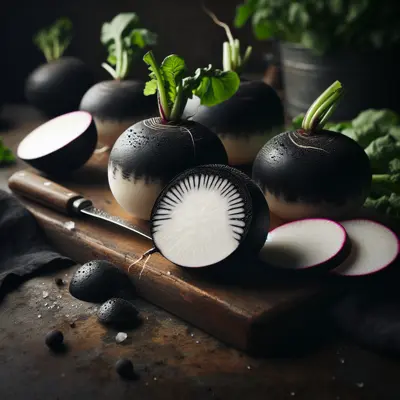
An ancient heirloom winter radish prized for its striking black skin and crisp white flesh that delivers a bold, peppery punch perfect for adding excitement to winter meals. This hardy storage radish can be kept for months in proper conditions, making it invaluable for extending the harvest season. With its unique appearance and intense flavor, it's a conversation starter that brings old-world character to modern gardens.
Harvest
55-65d
Days to harvest
Sun
Full sun to partial shade
Zones
2–11
USDA hardiness
Height
0-3 feet
Planting Timeline
Showing dates for Black Spanish Round Radish in USDA Zone 7
All Zone 7 root-vegetable →Zone Map
Click a state to update dates
Black Spanish Round Radish · Zones 2–11
Growing Details
Succession Planting
Black Spanish Round takes 55–65 days to mature — considerably longer than a quick French Breakfast or Cherry Belle — so you can't treat it like a cut-and-come-again salad radish and sow every two weeks all spring. Direct sow every 21 days starting in late February through early April for a spring run in zone 7, then stop. Once daytime highs are consistently hitting 80°F, roots go pithy fast and bolt risk climbs. There's no point pushing into summer.
Pick back up with fall planting around August 20–September 1. A single sowing timed to finish before the first hard freeze — typically mid-November in zone 7 — is usually enough for most gardeners. If you want a spread across several weeks of harvest, do two sowings about 3 weeks apart: one around August 25 and one around September 15. Anything direct-sown after late September is a gamble on whether the roots will size up before cold shuts them down.
Complete Growing Guide
You'll have the best success with Black Spanish Round Radish by preparing deeply worked soil enriched with 2-3 inches of aged compost or well-rotted manure. Unlike spring radishes that prefer cooler soil, this winter variety thrives when you direct sow in late summer when soil temperatures are still warm but air temperatures begin cooling.
Direct sow seeds ½ inch deep in rows spaced 12 inches apart, timing your planting 10-12 weeks before your area's expected hard frost. In zones 5-7, this typically means late July to early August planting. Space seeds 2 inches apart initially, then thin to 4-6 inches when seedlings reach 2 inches tall—crowded roots will remain small and woody.
Maintain consistent moisture throughout the growing season, providing about 1 inch of water weekly. Unlike quick-growing spring radishes, these winter varieties need steady hydration over their longer growing period. Apply a balanced 10-10-10 fertilizer at planting, then side-dress with compost tea every 3-4 weeks to support the extended growth period.
Avoid the common mistake of planting too early in summer—hot weather causes these radishes to bolt quickly or develop pithy, overly hot flesh. If your soil tends to compact, work in coarse sand or perlite to ensure the large roots can expand freely. In zones 8-9, delay planting until early September for proper root development.
Row covers become essential as temperatures drop, extending your harvest window by protecting plants from early frosts. These radishes actually improve in flavor after exposure to light frost, which converts starches to sugars and mellows the intense heat slightly.
Harvesting
Harvest your Black Spanish Round Radishes when roots reach 3-4 inches in diameter, typically after 55-65 days from planting. The black skin should appear smooth and firm without cracks or soft spots. Unlike spring radishes that become woody quickly, these winter varieties maintain quality for several weeks in the ground.
Perform the shoulder test—gently brush soil away from the root's shoulder to check size. The root should feel solid when squeezed gently, with no give or sponginess. Harvest in the morning when roots are fully hydrated for maximum crispness and storage life.
Use a garden fork to loosen soil around each root before pulling, as the large taproots can break if yanked directly. Cut greens to 1 inch above the root immediately after harvest to prevent moisture loss. These radishes actually improve after light frost exposure, so don't rush to harvest all at once—leave some in the ground for sweetened flavor development.
Storage & Preservation
Store freshly harvested Black Spanish Round Radishes in your refrigerator's crisper drawer at 32-35°F with high humidity for up to 4 months. Remove any damaged roots immediately, as decay spreads quickly. For root cellar storage, layer roots in slightly damp sand or sawdust at 35-40°F.
These radishes excel at fermentation—slice thin and ferment with salt for a traditional German-style pickle that preserves the peppery bite while developing complex flavors. They also freeze well when grated or diced for future use in cooked dishes, though texture becomes softer. Quick pickling in vinegar brine captures their intense heat and extends usability for several months. Unlike spring radishes, the flesh maintains good texture when cooked, making them excellent for adding to winter stews and roasted vegetable medleys.
History & Origin
Black Spanish Round Radish traces its lineage to 16th century Spain, where it developed as a crucial winter storage crop for peasant communities. This ancient heirloom variety spread throughout Europe via trade routes, becoming particularly prized in German and Eastern European cuisine where winter vegetables were essential for survival.
The variety's distinctive black skin and intensely peppery flesh made it valuable not just for sustenance but also for its medicinal properties—traditional herbalists used it to treat respiratory ailments and digestive issues. Spanish conquistadors likely carried seeds to the New World, where it adapted to various climates while maintaining its characteristic heat and storage capabilities.
By the 1800s, American seed catalogs regularly featured Black Spanish radishes, with immigrants from Spain and Germany specifically seeking out familiar varieties for their New World gardens. The 'Round' designation distinguishes it from its elongated cousin, the Black Spanish Long radish, though both share similar growing requirements and culinary applications rooted in Old World preservation traditions.
Advantages
- +Exceptional storage life of 4+ months when properly stored in cool, humid conditions
- +Actually improves in flavor after light frost exposure, becoming slightly sweeter
- +Intense peppery heat adds bold flavor to bland winter vegetables
- +Highly resistant to clubroot disease that devastates other brassica crops
- +Maintains crisp texture even when cooked, unlike most radish varieties
- +Extremely cold hardy—survives temperatures down to 20°F with light protection
- +Large size provides substantial harvest from relatively few plants
Considerations
- -Intense heat level can be overwhelming for those expecting mild spring radish flavor
- -Long growing period of 55-65 days requires consistent care and garden space
- -Sensitive to hot weather—bolts quickly if planted too early in summer
- -Large taproots require deeply worked, loose soil or they become stunted and woody
- -Attracts cabbage root maggots more readily than other radish varieties
Companion Plants
Carrots and lettuce are the practical workhorses next to Black Spanish Round. Carrots share a preference for loose, deep soil and draw on different nutrients — they're not competing for the sulfur compounds and potassium this radish pulls hard on. Lettuce fills horizontal space between rows without shading the radish tops, and because it feeds at a shallower depth than a 3-inch storage root, the two crops largely stay out of each other's way underground. Spinach works the same way. Chives are worth tucking along the row edges; their sulfur compounds are genuinely off-putting to aphids, which can colonize radish tops quickly in cool weather when predatory insects are still sluggish.
Nasturtiums pull more weight as a trap crop than anything else. Plant a few at the bed corners and they'll draw aphids off your radishes and onto themselves. In our zone 7 Georgia garden, flea beetles are the bigger threat during fall establishment, and a mixed planting with lettuce or spinach seems to slow their spread compared to a solid block of radishes — probably just by breaking up the host cue they're following.
Keep Black Spanish Round well away from other brassicas — kale, turnips, arugula, nearby mustard greens. They share both clubroot (Plasmodiophora brassicae) and black rot (Xanthomonas campestris) vectors, so grouping them together concentrates your disease risk in one spot. NC State Extension's rotation guidance is clear on this: same-family crops in the same bed year after year, or even the same season, accelerates buildup of soil-borne pathogens. Hyssop is also on the avoid list; allelopathic compounds it releases have been shown to suppress germination and early root development in adjacent crops.
Plant Together
Carrots
Radishes break up soil for carrots and mature quickly, allowing carrots more space
Lettuce
Radishes mature quickly and don't compete for space with slower-growing lettuce
Spinach
Compatible growing requirements and radishes help loosen soil for spinach roots
Chives
Repel flea beetles and aphids that commonly attack radishes
Nasturtiums
Act as trap crop for flea beetles and aphids, protecting radishes
Marigolds
Repel root maggots and other soil pests that damage radish roots
Cucumber
Radishes repel cucumber beetles while cucumbers provide shade for radishes
Peas
Fix nitrogen in soil and don't compete with radishes for root space
Keep Apart
Brassicas
Same family plants attract similar pests like flea beetles and clubroot disease
Hyssop
Inhibits growth of radishes and other root vegetables through allelopathic compounds
Turnips
Compete for same nutrients and space, both being root vegetables in brassica family
Nutrition Facts
Per 100g serving. % Daily Value based on 2,000 calorie diet. Source: USDA FoodData Central (FDC #169276)
Pests & Disease Resistance
Resistance
Good resistance to clubroot, moderate resistance to black rot
Common Pests
Flea beetles, cabbage root maggot, aphids
Diseases
Clubroot, black rot, white rust
Troubleshooting Black Spanish Round Radish
What you'll see, why it happens, and what to do about it.
Roots are small, misshapen, or have warty swellings; plants look stunted and yellow despite decent soil
Likely Causes
- Clubroot (Plasmodiophora brassicae) — a soil-borne pathogen that infects brassica roots and persists in soil for up to 20 years
- Soil pH below 6.0, which favors clubroot spore germination
What to Do
- 1.Pull and bag the entire plant including all root material — don't compost it
- 2.Lime the bed to bring pH up to 7.0 or slightly above; clubroot activity drops sharply above 7.2
- 3.Per NC State Extension's IPM guidelines, rotate brassica-family crops out of that bed for at least 3 to 4 years — longer if you've had a bad outbreak
Yellow V-shaped lesions starting at the leaf margins, with darkened veins visible on the underside; roots smell sour when cut
Likely Causes
- Black rot (Xanthomonas campestris pv. campestris) — a bacterial disease spread by infected seed, rain splash, and contaminated tools
- Overhead watering that keeps foliage wet for extended periods
What to Do
- 1.Remove and trash affected leaves and plants — not the compost pile
- 2.Water at the base of plants in the morning so foliage dries before evening; drip tape works better than overhead spray for fall brassica beds
- 3.Wipe down garden tools with a 10% bleach solution between beds; the bacterium travels on blades easily
Tiny round holes punched across leaves, especially on seedlings in the first 2–3 weeks after germination
Likely Causes
- Flea beetles (Phyllotreta spp.) — they overwinter in garden debris and hit young brassica seedlings hard in both spring and fall
- Bare soil with no mulch, which makes it easier for beetles to move between plants
What to Do
- 1.Cover the bed with row cover (Reemay or similar) immediately after direct sowing — flea beetles will find seedlings within days if left uncovered
- 2.Once plants are past the 4-leaf stage and 3–4 inches tall, they can usually outgrow light damage; pull the row cover then if airflow is a concern
- 3.Diatomaceous earth dusted around the base of plants can slow beetle movement, though it needs reapplication after rain
Frequently Asked Questions
How long does Black Spanish Round Radish take to grow?▼
Can you grow Black Spanish Round Radish in containers?▼
What does Black Spanish Round Radish taste like compared to regular radishes?▼
When should I plant Black Spanish Round Radish?▼
Is Black Spanish Round Radish good for beginners?▼
Can Black Spanish Round Radish survive frost?▼
Zone-by-Zone Planting Calendar
| Zone | Indoor Start | Transplant | Direct Sow | Harvest |
|---|---|---|---|---|
| Zone 3 | — | — | May – June | July – October |
| Zone 4 | — | — | April – June | June – October |
| Zone 5 | — | — | April – May | June – November |
| Zone 6 | — | — | April – May | June – November |
| Zone 7 | — | — | March – May | May – November |
| Zone 8 | — | — | March – April | May – December |
| Zone 9 | — | — | February – March | April – December |
| Zone 10 | — | — | January – March | March – December |
| Zone 1 | — | — | June – July | August – September |
| Zone 2 | — | — | May – July | July – September |
| Zone 11 | — | — | January – February | February – December |
| Zone 12 | — | — | January – February | February – December |
| Zone 13 | — | — | January – February | February – December |
Growing Guides from Wind River Greens
Sources & References
External authority sources used in compiling this guide.
See the Methodology page for how this data is sourced, what's AI-assisted, and known limitations.