Atomic Red Carrot
Daucus carota 'Atomic Red'
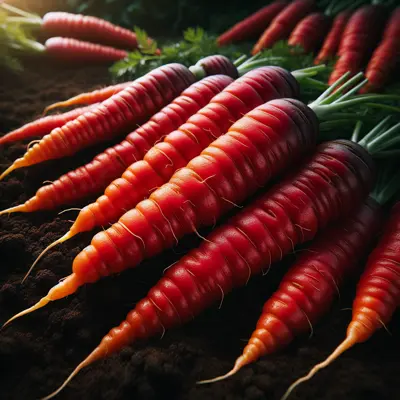
A stunning hybrid carrot that delivers both visual impact and exceptional flavor with its brilliant red-orange exterior and bright orange interior. These smooth, cylindrical roots grow uniformly and maintain their vibrant color when cooked, making them perfect for both fresh eating and culinary presentations. Gardeners love this variety for its reliable performance and the wow factor it brings to harvest baskets.
Harvest
70-75d
Days to harvest
Sun
Full sun to partial shade
Zones
4–11
USDA hardiness
Difficulty
Easy
Planting Timeline
Showing dates for Atomic Red Carrot in USDA Zone 7
All Zone 7 root-vegetable →Zone Map
Click a state to update dates
Atomic Red Carrot · Zones 4–11
Growing Details
Succession Planting
Direct sow Atomic Red every 3 weeks starting around March 1 in zone 7, continuing through early May for a summer harvest. Then pick back up around August 1 through mid-September for a fall and early winter pull. At 70-75 days to maturity, count backward from your first expected hard frost before committing to that last sowing.
Germination drops off sharply when soil temps climb above 85°F, so expect a gap in planting through June and most of July in zones 7-8 — you'll get thin, uneven stands if you push it. The fall sowing tends to produce better roots anyway; a few light frosts convert some of the starches to sugar, and Atomic Red's lycopene content holds well in cold storage.
Complete Growing Guide
This hybrid's 70–75-day timeline means it thrives in spring plantings where cool soil (50–60°F) accelerates germination without triggering premature bolting—avoid late-summer sowings in hot climates where heat stress causes the roots to split and lose their signature color saturation. Atomic Red performs best in loose, well-draining soil rich in organic matter, since compacted beds distort the cylindrical shape and create forked roots that mar presentation. Unlike pale varieties, this cultivar's intense pigmentation makes it slightly more susceptible to carrot rust fly and root-knot nematodes, so practice crop rotation and use floating row covers during the first four weeks after emergence. The variety rarely stretches or develops woody cores if harvested within the recommended window, but delay beyond 75 days risks cracking during autumn rains. For maximum visual impact and color retention, thin seedlings to 3–4 inches apart early and provide consistent moisture; this encourages uniform sizing that photographs beautifully and cooks evenly.
Light: Full sun (6 or more hours of direct sunlight a day), Partial Shade (Direct sunlight only part of the day, 2-6 hours). Soil: Clay, High Organic Matter, Loam (Silt), Sand, Shallow Rocky. Soil pH: Acid (<6.0), Alkaline (>8.0), Neutral (6.0-8.0). Drainage: Good Drainage, Moist, Occasionally Dry. Growth rate: Rapid. Maintenance: High. Propagation: Seed.
Harvesting
Harvest Atomic Red Carrots when their shoulders reach ¾ to 1 inch in diameter and the red-orange exterior displays full color saturation from crown to tip, which typically occurs around 70-75 days from sowing. Gently loosen soil around each root and pull firmly to check for the characteristic smooth, cylindrical shape and firm texture that indicate peak maturity. These carrots can be harvested all at once or continuously by selecting the largest roots first, allowing smaller ones to develop further in the garden bed. For optimal sweetness and crispness, harvest in the morning after soil moisture has stabilized overnight, as this timing ensures maximum sugar content and helps the roots maintain their vibrant color through storage and cooking.
Small, dry, and ribbed with bristly hairs. The compound umbel of fruits folds inward to form a roundish shape that can be blown by the wind and roll across the ground dropping seeds.
Color: Brown/Copper. Type: Achene. Length: < 1 inch. Width: < 1 inch.
Edibility: Leaves, roots, flowers, and seeds are edible. The young fleshy roots can be cooked or eaten raw, the flower clusters can be french-fried to produce a carrot-flavored dish, the aromatic seed is used as a flavoring in stews, etc. The dried roasted roots are ground into a powder and are used for making coffee.
Storage & Preservation
Remove green tops immediately after harvest, leaving ¼ inch of stem to prevent bleeding. Brush off excess soil but don't wash until ready to use. Store unwashed Atomic Red Carrots in perforated plastic bags in the refrigerator's crisper drawer at 32-35°F with high humidity. They'll maintain quality for 3-4 months when properly stored.
For longer preservation, blanch whole small carrots or cut larger ones into coins, blanch for 3 minutes, then freeze in sealed containers for up to 10 months. The brilliant color holds well when frozen. These carrots also excel in fermented preparations—their sweet flavor and firm texture make outstanding lacto-fermented carrot sticks. For dehydrating, slice into chips and dry at 125°F until crisp. The concentrated flavor and striking color make beautiful garnishes for soups and salads.
History & Origin
While comprehensive documentation on the Atomic Red Carrot's specific origins remains limited in publicly available sources, this variety represents the modern hybrid breeding tradition that emerged from seed companies' intensified work with colored carrot genetics in the late twentieth century. Red and purple carrot cultivars, largely forgotten in Western agriculture for decades, experienced a revival through both heirloom preservation efforts and contemporary breeding programs seeking novel market varieties. The Atomic Red likely descends from these rediscovered genetic lines, refined through controlled crossing to emphasize color stability, uniformity, and culinary appeal. Its parentage reflects decades of carrot breeding focused on expanding beyond the conventional orange, utilizing germplasm that traces back to wild Daucus carota populations and heritage cultivars maintained by seed companies and agricultural institutions.
Origin: Europe, Eastern Asia and northern Africa
Advantages
- +Brilliant red-orange color remains vibrant even after cooking
- +Sweet, crisp flavor with minimal core appeals to most palates
- +Fast maturity in 70-75 days fits most growing seasons
- +Easy difficulty level makes Atomic Red ideal for beginner gardeners
- +Uniform cylindrical shape ensures consistent harvest and presentation
Considerations
- -Susceptible to carrot rust fly and wireworm damage in some regions
- -Alternaria leaf blight and cavity spot require vigilant disease management
- -Multiple pest vulnerabilities demand proactive monitoring throughout growing season
Companion Plants
Chives, leeks, and rosemary are the companions most worth planting near Atomic Red. The alliums — chives and leeks — are thought to confuse carrot rust fly (Psila rosae) by masking the host scent; alternating rows or edging the bed with them is the practical way to deploy this. Rosemary's volatile oils work on a similar principle. Neither is a guaranteed barrier, but if you're already growing them elsewhere, it costs nothing to put them next door. Radishes pull double duty: sow them into the carrot bed about a week ahead, and they'll break the soil crust to help germination, then get pulled before they compete for space.
Fennel needs its own bed, full stop — it's allelopathic and suppresses root development in nearby plants, carrots included. Dill is a subtler problem: it's in the same family (Apiaceae) as carrots and shares key pest and disease pressure, including Alternaria dauci. Putting them side by side gives that pathogen two adjacent hosts. Parsnips have the same liability — same family, same insects, no compensating benefit.
Plant Together
Chives
Repels carrot flies and aphids with strong onion scent
Leeks
Deters carrot rust flies while carrots repel leek moths
Rosemary
Strong aromatic oils mask carrot scent from carrot flies
Sage
Repels carrot flies and other root pests with fragrant compounds
Lettuce
Shallow roots don't compete, provides ground cover and moisture retention
Radishes
Break up soil for carrot growth and mature quickly as companion crop
Tomatoes
Carrots improve soil structure while tomatoes provide beneficial shade
Marigolds
Release compounds that deter nematodes and other soil pests
Keep Apart
Dill
Attracts carrot flies when flowering and can stunt carrot growth
Parsnips
Compete for same soil nutrients and space, attract similar pests
Fennel
Releases allelopathic compounds that inhibit carrot germination and growth
Nutrition Facts
Per 100g serving. % Daily Value based on 2,000 calorie diet. Source: USDA FoodData Central (FDC #170393)
Pests & Disease Resistance
Resistance
Good resistance to Alternaria leaf blight and cavity spot
Common Pests
Carrot rust fly, wireworms, flea beetles, aphids
Diseases
Alternaria leaf blight, bacterial soft rot, cavity spot
Troubleshooting Atomic Red Carrot
What you'll see, why it happens, and what to do about it.
Forked, hairy, or stunted roots at harvest
Likely Causes
- Rocky or cloddy soil — roots hit an obstacle and split
- Fresh manure or high-nitrogen fertilizer applied directly to the bed before sowing
- Root-knot nematode (Meloidogyne spp.) causing swellings that distort growth
What to Do
- 1.Loosen the bed to at least 12 inches deep before sowing and remove any stones or hard clods
- 2.Amend with aged compost only — no fresh manure in the carrot bed
- 3.If nematodes are suspected, dig up a few roots and look for small galls; rotate this bed out of root crops for 3-4 years per NC State Extension's rotation guidance
Feathery carrot tops collapsing or dying back, with tunneling or rust-colored damage visible on the roots
Likely Causes
- Carrot rust fly (Psila rosae) — larvae tunnel into roots from below
- Wireworms (Agriotes spp.) — slender, hard-bodied beetle larvae that bore into roots
What to Do
- 1.Cover the bed with a floating row cover immediately after sowing and keep it on through harvest — carrot rust fly needs to lay eggs at the soil surface
- 2.Avoid planting into sod-converted beds, where wireworm populations are highest; if wireworms are a recurring problem, keep the bed fallow for a season to break the cycle
- 3.Rotate carrots out of the same row or bed each year; NC State Extension recommends using a site for related root crops only once every 3-4 years
Dark brown to black spots or lesions on the foliage, sometimes spreading to the crown, appearing in wet weather
Likely Causes
- Alternaria leaf blight (Alternaria dauci) — a fungal disease that spreads via water splash and infected seed
- Crowded planting with poor airflow between plants
What to Do
- 1.Thin seedlings to 2-3 inches apart once they're an inch tall — crowding makes this significantly worse
- 2.Water at the base, not overhead, and water in the morning so foliage dries before evening
- 3.Pull and trash (don't compost) any heavily infected tops; rotate this bed out of carrots and other Apiaceae crops for at least 3 years
Stored or freshly harvested roots turning slimy, soft, and foul-smelling, especially at the shoulder
Likely Causes
- Bacterial soft rot (Pectobacterium carotovorum) — enters through wounds or cracks, accelerates in warm, wet conditions
- Harvesting during or after heavy rain, or storing roots with tops still attached and wet
What to Do
- 1.Let harvested roots sit in a shaded spot for a few hours before storing — don't bag them wet
- 2.Trim tops to about 1 inch before storage and keep roots at 32-38°F with high humidity but good airflow
- 3.Pull any affected roots from the bin immediately; Pectobacterium spreads fast in a closed container
Frequently Asked Questions
How long does Atomic Red carrot take to grow?▼
Can you grow Atomic Red carrots in containers?▼
What does Atomic Red carrot taste like?▼
When should I plant Atomic Red carrot seeds?▼
Is Atomic Red carrot good for beginners?▼
Do Atomic Red carrots lose their color when cooked?▼
Zone-by-Zone Planting Calendar
| Zone | Indoor Start | Transplant | Direct Sow | Harvest |
|---|---|---|---|---|
| Zone 3 | — | — | May – June | July – October |
| Zone 4 | — | — | April – June | July – October |
| Zone 5 | — | — | April – May | June – November |
| Zone 6 | — | — | April – May | June – November |
| Zone 7 | — | — | March – May | May – November |
| Zone 8 | — | — | March – April | May – December |
| Zone 9 | — | — | February – March | April – December |
| Zone 10 | — | — | January – March | March – December |
| Zone 1 | — | — | June – July | August – September |
| Zone 2 | — | — | May – July | July – September |
| Zone 11 | — | — | January – February | February – December |
| Zone 12 | — | — | January – February | February – December |
| Zone 13 | — | — | January – February | February – December |
Growing Guides from Wind River Greens
Sources & References
External authority sources used in compiling this guide.
See the Methodology page for how this data is sourced, what's AI-assisted, and known limitations.