All Seasons White Daikon
Raphanus sativus var. longipinnatus 'All Seasons White'
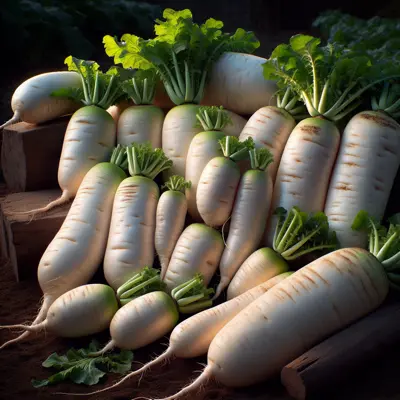
A versatile Japanese daikon radish that can be grown in both spring and fall, producing impressive 14-18 inch long white roots weighing up to 2 pounds each. This reliable variety offers the classic mild, crisp texture that makes daikon so popular in Asian cuisine, while being much easier to grow than many specialty varieties. Perfect for gardeners wanting to explore Asian vegetables or those seeking a substantial, storage-friendly root crop.
Harvest
60-70d
Days to harvest
Sun
Full sun
Zones
2–11
USDA hardiness
Height
0-3 feet
Planting Timeline
Showing dates for All Seasons White Daikon in USDA Zone 7
All Zone 7 root-vegetable →Zone Map
Click a state to update dates
All Seasons White Daikon · Zones 2–11
Growing Details
Succession Planting
Direct sow every 3 weeks starting when soil temps hit 45°F in spring — around March 1 in zone 7 — through early May. Stop spring sowings once daytime highs are consistently above 75°F; heat pushes daikon to bolt before the root fills out. Pick back up with fall sowings in late August through September, timing so roots mature before a hard freeze. At 60–70 days to harvest, a September 1 sowing should finish by early November in zone 7, which works fine.
Don't stagger plantings by less than 2–3 weeks — daikon holds reasonably well in the ground for a few weeks once mature, so tight successions just pile up at harvest. Two or three well-timed sowings per season gives you a steadier supply without the crunch.
Complete Growing Guide
Start by preparing your soil well before sowing—All Seasons White Daikon develops those impressive 14-18 inch roots only in deeply cultivated, obstacle-free ground. Work the soil to at least 20 inches deep, removing rocks, roots, and clay clumps that could cause forked or stunted roots. Mix in 2-3 inches of compost, but avoid fresh manure which encourages leafy growth at the expense of root development.
Direct sow only—daikon radishes develop taproots immediately and transplanting will result in deformed roots. In spring, plant 2-3 weeks before your last frost date when soil temperature reaches 45°F. For fall crops (often superior), sow 10-12 weeks before your first hard frost. Plant seeds ½ inch deep in rows spaced 12-18 inches apart. You'll be tempted to plant too densely, but resist—overcrowding leads to all tops and no roots.
Thin ruthlessly when seedlings reach 2 inches tall, leaving 4-6 inches between plants. This feels wasteful but is crucial for proper root development. Side-dress with balanced fertilizer (10-10-10) at thinning time, then switch to low-nitrogen fertilizer after 4 weeks—too much nitrogen creates leafy monsters with pencil-thin roots.
Maintain consistent moisture throughout the growing period, providing about 1 inch weekly. Irregular watering causes woody, cracked roots. Mulch around plants once established to retain moisture and suppress weeds, but keep mulch away from the crown to prevent rot.
Watch for flea beetle damage on young leaves—row covers for the first 3-4 weeks provide excellent protection. Remove covers once plants are established, as mature daikon can tolerate some leaf damage without affecting root quality.
Harvesting
Harvest All Seasons White Daikon when roots reach 12-18 inches long and 2-4 inches in diameter, typically 60-70 days from sowing. The shoulder (top portion) should be clearly visible above ground, appearing bright white and firm. Test readiness by gently brushing soil away from the shoulder—mature roots feel solid when pressed and the skin appears smooth and taut.
Harvest in morning when roots are fully hydrated and crisp. Loosen soil around each root with a spading fork, working 6 inches away from the root to avoid puncturing. Grasp the leaves close to the crown and pull straight up with steady pressure—properly grown daikon should lift cleanly. If you encounter resistance, loosen more soil rather than forcing the pull, which can snap the root.
Harvest before hard frost, though light frost actually improves flavor by converting starches to sugars. Remove tops immediately after harvest, leaving about an inch of stem to prevent moisture loss.
Storage & Preservation
Fresh daikon stores exceptionally well when handled properly. Remove tops immediately after harvest and brush off soil—don't wash until ready to use. Store unwashed roots in perforated plastic bags in the refrigerator crisper drawer, where they'll maintain quality for 2-3 months at 32-35°F with high humidity.
For longer storage, layer roots in damp sand or peat moss in a cool basement or root cellar (32-40°F). Properly stored this way, All Seasons White Daikon keeps 4-6 months. Traditional preservation includes lacto-fermentation into Korean-style kimchi or Japanese tsukemono pickles, which develop complex flavors over weeks. Daikon also dehydrates well when sliced thin—dried strips rehydrate perfectly for soups and stews. Grated fresh daikon can be frozen for cooked applications, though texture becomes softer after thawing.
History & Origin
All Seasons White Daikon represents a modern refinement of traditional Japanese daikon radish (Raphanus sativus var. longipinnatus), which has been cultivated in East Asia for over 1,000 years. The original daikon varieties were typically season-specific—spring types that bolted quickly in summer heat, and fall varieties that couldn't withstand spring temperature fluctuations.
This variety was developed in the late 20th century by Japanese breeders seeking to create a more adaptable daikon for both commercial and home garden production. By selecting for heat tolerance and bolt resistance, they created a variety that maintains the classic long white root form while offering the flexibility to plant in both spring and fall seasons—hence the 'All Seasons' designation.
The breeding program specifically focused on maintaining the traditional mild flavor profile while improving disease resistance, particularly to clubroot, which had been devastating daikon crops. This variety represents the successful marriage of traditional Japanese culinary requirements with modern agricultural needs for reliability and extended growing seasons.
Advantages
- +Exceptional bolt resistance allows reliable spring plantings even with temperature fluctuations
- +Impressive 14-18 inch roots with excellent uniformity and minimal forking in proper soil
- +Strong clubroot tolerance provides reliable harvests in problem soils
- +Extended harvest window—roots hold quality in ground for 2-3 weeks past maturity
- +Excellent storage life of 2-3 months refrigerated without quality loss
- +Mild flavor appeals to both Asian cuisine enthusiasts and newcomers to daikon
- +Heavy yields with individual roots reaching 2 pounds each when properly spaced
Considerations
- -Requires deep soil cultivation to at least 20 inches for proper root development
- -Cannot be transplanted—failed direct sowings mean starting over completely
- -Vulnerable to flea beetle damage on young seedlings requiring early protection
- -Takes up significant garden space with 4-6 inch spacing requirements
- -Root quality suffers dramatically in clay or rocky soils despite soil preparation
Companion Plants
Carrots, lettuce, and spinach work well next to daikon because the root zones don't overlap — daikon drives down 12–18 inches while lettuce and spinach feed at 6 inches or less, so they're drawing from different soil layers. Peas fix nitrogen at the root level, which helps a crop that's asking a lot from the soil over 60–70 days. Garlic and onions are worth tucking nearby: their sulfur compounds interfere with the host-finding behavior of aphids and cabbage root maggots, two pests that show up reliably on daikon.
Skip planting daikon next to broccoli, cabbage, or kale — not because they're chemically incompatible, but because they share every significant pest and disease on this list (clubroot, black rot, flea beetles). Concentrating them in the same bed just gives those problems a bigger runway. Fennel is allelopathic to most vegetables and should have its own isolated spot regardless of what you're growing nearby.
Plant Together
Carrots
Different root depths prevent competition, carrots help break up soil for daikon
Lettuce
Shallow roots don't compete with daikon, can be harvested before daikon needs full space
Spinach
Cool-season crop that complements daikon's growing period, doesn't compete for root space
Peas
Fix nitrogen in soil benefiting daikon growth, cool-season compatibility
Radishes
Help break up compacted soil for daikon root penetration, similar growing requirements
Onions
Repel root maggots and other soil pests that can damage daikon roots
Garlic
Natural pest deterrent for aphids and root flies, doesn't compete for space
Marigolds
Repel nematodes and other soil pests, attract beneficial insects
Keep Apart
Brassicas
Same family as daikon, compete for nutrients and attract similar pests like flea beetles
Fennel
Allelopathic effects inhibit growth of most vegetables including daikon
Tomatoes
Heavy feeders that compete for nutrients, different watering needs can stress daikon
Nutrition Facts
Per 100g serving. % Daily Value based on 2,000 calorie diet. Source: USDA FoodData Central (FDC #170393)
Pests & Disease Resistance
Resistance
Good general disease resistance, tolerant of clubroot
Common Pests
Flea beetles, cabbage root maggots, aphids
Diseases
Clubroot, black rot, bacterial soft rot
Troubleshooting All Seasons White Daikon
What you'll see, why it happens, and what to do about it.
Seedlings collapse at soil level, stems pinched and blackened, within the first week or two after germination
Likely Causes
- Damping off — a complex of soil-borne pathogens (Pythium, Rhizoctonia) that thrive in cold, wet, poorly-drained soil
- Overwatering or heavy clay soil that holds moisture too long after sowing
What to Do
- 1.Don't try to save collapsed seedlings — pull them and resow into fresh, well-draining soil
- 2.Let the top inch of soil dry slightly between waterings during germination; daikon doesn't need constant moisture to sprout
- 3.Avoid direct sowing into soil below 45°F, which slows germination past 10 days and extends the window for pathogen attack
Tiny round holes scattered across leaves, seedlings look shot through with a BB gun, especially in warm spells
Likely Causes
- Flea beetles (Phyllotreta spp.) — they overwinter in soil and leaf litter and hit young brassica-family crops hard in spring and fall
- Seedlings under heat or drought stress are more susceptible, as NC State Extension's IPM guidance notes
What to Do
- 1.Cover the bed with row cover (Reemay or similar) immediately after sowing — flea beetles find crops by sight and smell, so exclusion beats spraying
- 2.Keep irrigation consistent at 1–1.5 inches per week; stressed plants take longer to outgrow the vulnerable seedling stage
- 3.If damage is severe on established plants, spinosad-based organic sprays applied in the early morning can knock populations down
Roots are stunted, twisted, or swollen into knobby galls; tops look yellow and wilted despite adequate water
Likely Causes
- Clubroot (Plasmodiophora brassicae) — a soil-borne protist that persists for 20+ years in infected soil and attacks all brassica-family crops, including daikon
- Acidic soil below pH 6.0, which favors spore germination
What to Do
- 1.Pull and bag infected plants — do not compost them; the spores survive composting
- 2.Test your soil pH and lime to 6.5–7.0 if needed; NC State Extension notes that raising pH significantly reduces clubroot severity
- 3.Rotate daikon and all other brassicas out of that bed for at least 3–4 years — NC State Extension's IPM guidelines specifically flag this rotation window for diseases where spore loads build in the soil
Frequently Asked Questions
How long does All Seasons White Daikon take to grow?▼
Can you grow All Seasons White Daikon in containers?▼
What does All Seasons White Daikon taste like?▼
When should I plant All Seasons White Daikon for best results?▼
Is All Seasons White Daikon good for beginners?▼
Why are my All Seasons White Daikon roots small and woody?▼
Zone-by-Zone Planting Calendar
| Zone | Indoor Start | Transplant | Direct Sow | Harvest |
|---|---|---|---|---|
| Zone 1 | — | — | June – July | August – September |
| Zone 2 | — | — | May – July | July – September |
| Zone 11 | — | — | January – February | February – December |
| Zone 12 | — | — | January – February | February – December |
| Zone 13 | — | — | January – February | February – December |
| Zone 3 | — | — | May – June | July – October |
| Zone 4 | — | — | April – June | June – October |
| Zone 5 | — | — | April – May | June – November |
| Zone 6 | — | — | April – May | June – November |
| Zone 7 | — | — | March – May | May – November |
| Zone 8 | — | — | March – April | May – December |
| Zone 9 | — | — | February – March | April – December |
| Zone 10 | — | — | January – March | March – December |
Growing Guides from Wind River Greens
Sources & References
External authority sources used in compiling this guide.
See the Methodology page for how this data is sourced, what's AI-assisted, and known limitations.