Ailsa Craig Onion
Allium cepa
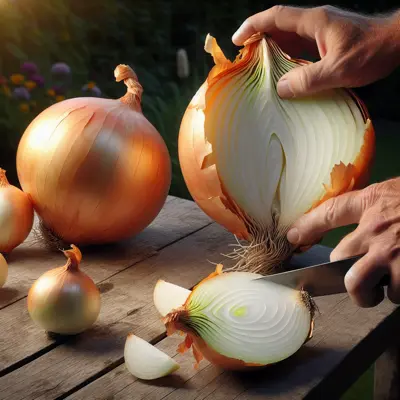
A distinct strain of the classic sweet and mild Ailsa Craig, this line has been specifically selected to perform in organic management systems. Mild onion with excellent size potential. Jumbo to colossal, round to teardrop-shaped bulbs with light yellow skins. Use fresh or for short-term storage. Adaptation: 38-60° latitude. Also available with NOP-compliant pelleting.
Harvest
110d
Days to harvest
Sun
Full sun
Zones
5–10
USDA hardiness
Height
12-18 inches
Planting Timeline
Showing dates for Ailsa Craig Onion in USDA Zone 7
All Zone 7 root-vegetable →Zone Map
Click a state to update dates
Ailsa Craig Onion · Zones 5–10
Growing Details
Succession Planting
Ailsa Craig is a long-day onion that needs a full 110 days in the ground, so you're not cycling it every two weeks the way you would radishes. You can still stagger sowing to spread out harvest pressure. In zone 7, direct sow from early March through mid-April — put in the first round in early March, then a second round 3–4 weeks later. Anything sown after May 1 is unlikely to size up before summer heat stalls bulb development.
Stop sowing once daytime highs are consistently hitting 80°F, which in Georgia usually falls between late April and early May. If you want fresh onions running into November, short-day sets like Yellow Granex sown in fall are a better fit for that slot — Ailsa Craig's genetics aren't built for it.
Complete Growing Guide
This organic-selected strain thrives in cooler climates between 38–60° latitude, so northern gardeners should start seeds indoors 8–10 weeks before the last frost to maximize the 110-day maturity window. Unlike smaller onion varieties, Ailsa Craig demands consistent moisture and well-draining, nitrogen-rich soil to achieve its signature jumbo size—inconsistent watering will cause splitting in these large bulbs. Watch for pink root and fusarium basal rot, which proliferate in wet conditions; ensure excellent air circulation and avoid overhead irrigation. This cultivar has a moderate tendency to bolt if exposed to temperature fluctuations or day-length stress, so maintain steady growing conditions once established. A practical tip: thin seedlings aggressively to 4–6 inches apart to reduce competition; these giant onions need substantial space and soil nutrients to develop their full potential rather than crowding into medium-sized bulbs.
Light: Full sun (6 or more hours of direct sunlight a day). Soil: High Organic Matter, Loam (Silt), Sand. Soil pH: Alkaline (>8.0), Neutral (6.0-8.0). Drainage: Good Drainage, Moist. Height: 1 ft. 0 in. - 1 ft. 6 in.. Spread: 0 ft. 6 in. - 1 ft. 0 in.. Spacing: Less than 12 inches, 12 inches-3 feet. Maintenance: Medium. Regions: Coastal, Mountains, Piedmont.
Harvesting
Ailsa Craig onions reach peak harvest readiness when their light yellow skins develop a papery texture and the bulbs achieve their characteristic round to teardrop shape, typically at 110 days. Watch for the tops to naturally yellow and fall over, signaling maturity and the onset of dormancy. At this point, the bulbs should feel firm and solid when gently squeezed. These onions support both continuous and single-harvest approaches—you can selectively pull larger specimens while leaving smaller ones to develop further, or wait for uniform maturity across the planting. For optimal storage potential despite their fresh-eating reputation, allow onions to cure in a warm, dry location for one to two weeks after pulling, which hardens the skins and extends their keeping quality beyond their typical short-term storage window.
Flowers wither and convert to bulblets
Type: Capsule.
Harvest time: Summer
Edibility: The bulb and tops are edible raw or cooked. However, the plant also has poisonous characteristics as noted in the "Poisonous to Humans" section of this record. Toxicity can depend on the age of the person or animal, the age of the plant, the part of the plant ingested, how much is ingested, whether the person or animal has sensitivities or allergies, whether it's eaten raw or cooked, and so forth. Consult with a medical professional for further details.
Storage & Preservation
After proper curing, store Ailsa Craig onions in a cool, dry location with good air circulation at 32-40°F with 65-70% humidity. Properly cured bulbs will keep 4-6 months in ideal conditions. Avoid storing in plastic bags or humid environments, which promote rot. Check stored onions monthly and remove any showing soft spots or sprouting.
For preservation, these large onions are excellent for freezing when diced – blanch for 2 minutes before freezing for best texture. They're also perfect for making French onion soup that can be frozen in portions. Due to their size and mild flavor, they're ideal for pickling in large chunks or rings. Avoid dehydrating unless sliced very thin, as their high moisture content makes drying challenging.
History & Origin
Originating in Scotland during the early 20th century, Ailsa Craig onions are named after the rocky island of Ailsa Craig in the Firth of Clyde. The variety emerged from Scottish horticultural tradition and gained prominence through exhibition and culinary use across the United Kingdom, becoming renowned for its exceptional size and mild flavor. While specific breeder documentation is limited, the variety became commercially established through British seed houses and has since been maintained through both conventional and organic breeding programs. This particular organic-selected strain represents modern adaptation of the heritage Ailsa Craig type, refined for contemporary organic production systems while preserving the characteristic mild sweetness and impressive bulb size for which the original variety became famous.
Origin: Central Asia and central Persia
Advantages
- +Surprisingly mild and sweet flavor makes Ailsa Craig excellent for fresh eating
- +Jumbo to colossal bulb size provides impressive yields per plant in gardens
- +Specifically bred for organic systems with NOP-compliant pelleting option available
- +Low sulfur content distinguishes it from typical pungent storage onion varieties
- +Moderate difficulty level makes it accessible for intermediate gardeners
Considerations
- -Susceptible to multiple serious diseases including downy mildew, white rot, and neck rot
- -Requires 110 days to maturity, limiting growing season in shorter climates
- -Poor long-term storage capability makes it unsuitable for winter preservation needs
- -Multiple pest pressures including onion thrips and maggots require active management
Companion Plants
Carrots and onions are about the most reliable pairing in the allium companion canon. The two crops occupy different root zones — carrots push 8–12 inches deep while onion bulbs sit near the surface — so they're not competing for the same water or nutrients. The sulfur compounds onions emit appear to confuse carrot fly (Psila rosae), and carrot foliage may reduce thrips pressure on the onions to some degree. Alternating rows 12 inches apart lets both crops breathe without either one getting crowded out.
French marigolds (Tagetes patula) are worth running along the bed edges, and not just for aesthetics. NC State Extension's IPM guidance cites dense Tagetes plantings as a tool for suppressing soil nematode populations — a real consideration for Ailsa Craig, which has to sit in the ground a full 110 days. In our zone 7 Georgia gardens, root-knot nematodes build up fast in sandy or repeatedly cropped beds, so anything that chips away at that pressure before bulb sizing begins is genuinely useful.
Beans and peas need to stay out of the picture entirely. Onions produce root exudates that inhibit the Rhizobium bacteria legumes depend on for nitrogen fixation — put beans within a foot or two of your onion rows and they'll yellow out and stall, while the onions get nothing from the deal either. Eighteen to 24 inches of separation is the minimum if they're sharing a bed system; different sections of the garden is cleaner.
Plant Together
Carrots
Onions repel carrot flies while carrots help break up soil for onion bulb development
Tomatoes
Onions deter tomato hornworms and aphids, while tomatoes don't compete for nutrients
Lettuce
Shallow-rooted lettuce doesn't compete with onions and benefits from onion's pest-repelling properties
Brassicas
Onions repel cabbage worms, flea beetles, and other brassica pests
Peppers
Onions deter aphids and other soft-bodied insects that attack pepper plants
Strawberries
Onions repel slugs and other pests while improving strawberry flavor
Marigolds
Both repel similar pests and marigolds add extra nematode control
Parsley
Attracts beneficial insects and doesn't compete for space or nutrients
Keep Apart
Beans
Onions can inhibit bean growth and nitrogen fixation by rhizobia bacteria
Peas
Onions stunt pea growth and interfere with their nitrogen-fixing capabilities
Asparagus
Both compete for similar soil nutrients and can inhibit each other's growth
Nutrition Facts
Per 100g serving. % Daily Value based on 2,000 calorie diet. Source: USDA FoodData Central (FDC #170000)
Pests & Disease Resistance
Resistance
Moderate resistance to downy mildew and neck rot
Common Pests
Onion thrips, onion maggot, cutworms
Diseases
Downy mildew, purple blotch, neck rot, white rot
Troubleshooting Ailsa Craig Onion
What you'll see, why it happens, and what to do about it.
Leaf tips silvering or streaking, tiny black specks on foliage, bulbs stunted at harvest
Likely Causes
- Onion thrips (Thrips tabaci) — rasping feeders that thrive in hot, dry weather; populations explode fast in July
- Dense planting that limits airflow and makes it harder to spot early infestations
What to Do
- 1.Spray foliage with spinosad or insecticidal soap, hitting leaf axils where thrips hide — repeat every 5–7 days for two to three cycles
- 2.Keep spacing at the wider end of the range (6 inches in-row) in summer plantings to reduce the microclimate thrips prefer
- 3.Remove and bag heavily infested leaves; don't compost them
Gray-purple fuzzy growth on leaf surfaces, leaves yellowing and flopping over, usually showing up in cool wet stretches in April or May
Likely Causes
- Downy mildew (Peronospora destructor) — a water mold that spreads via airborne spores and needs wet foliage for 6+ hours to establish
- Overhead irrigation late in the day that keeps leaves wet overnight
What to Do
- 1.Switch to drip irrigation or water early morning so foliage dries before dark
- 2.Strip and trash affected leaves; don't work in the bed when plants are wet or you'll spread spores on your hands and tools
- 3.Apply a copper-based fungicide as a preventive once conditions turn cool and rainy — curative sprays after infection is established do little
Bulbs soft and rotting at the neck after curing, sometimes a black powdery mass inside the outer scales
Likely Causes
- Neck rot (Botrytis allii) — enters through mechanical damage at harvest or through dead tissue left on the neck
- Pulling bulbs before tops have fully fallen and dried, or curing in humid conditions
What to Do
- 1.Wait until at least 80–90% of the tops have naturally fallen before pulling — with Ailsa Craig's 110-day maturity, that's usually mid-to-late July in zone 7
- 2.Cure bulbs in a single layer in a dry spot with good airflow for 3–4 weeks minimum before storage; a covered porch or barn with a box fan works fine
- 3.Don't trim the neck until after curing, and cut it to at least 1 inch above the bulb to leave a dry seal
Frequently Asked Questions
How big do Ailsa Craig onions actually get?▼
Can you grow Ailsa Craig onions in containers?▼
Is Ailsa Craig good for beginners?▼
When should I start Ailsa Craig onion seeds?▼
What does Ailsa Craig onion taste like?▼
Ailsa Craig vs Walla Walla onions - what's the difference?▼
Zone-by-Zone Planting Calendar
| Zone | Indoor Start | Transplant | Direct Sow | Harvest |
|---|---|---|---|---|
| Zone 1 | — | — | June – July | September – September |
| Zone 2 | — | — | May – July | September – September |
| Zone 11 | — | — | January – February | April – December |
| Zone 12 | — | — | January – February | April – December |
| Zone 13 | — | — | January – February | April – December |
| Zone 3 | — | — | May – June | August – October |
| Zone 4 | — | — | April – June | August – October |
| Zone 5 | — | — | April – May | August – November |
| Zone 6 | — | — | April – May | July – November |
| Zone 7 | — | — | March – May | July – November |
| Zone 8 | — | — | March – April | June – December |
| Zone 9 | — | — | February – March | May – December |
| Zone 10 | — | — | January – March | May – December |
Growing Guides from Wind River Greens
Sources & References
External authority sources used in compiling this guide.
See the Methodology page for how this data is sourced, what's AI-assisted, and known limitations.