Feathertop
Cenchrus longisetus
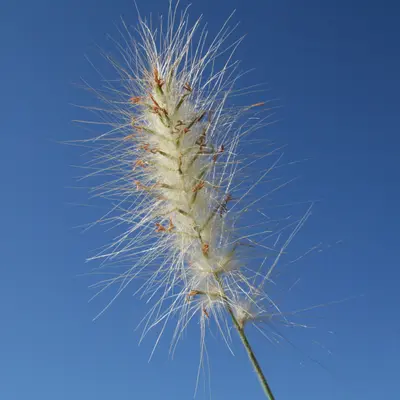
Masses of white, woolly, nodding, 6" plumes on graceful plants forming 12" clumps. Showy accent in any landscape. Tender perennial in Zones 9-10, but grow as hardy annual.
Harvest
100-120d
Days to harvest
Sun
Full sun
Zones
3–11
USDA hardiness
Height
12-18 inches
Planting Timeline
Showing dates for Feathertop in USDA Zone 7
All Zone 7 grass →Zone Map
Click a state to update dates
Feathertop · Zones 3–11
Growing Details
Complete Growing Guide
Growing Feathertop (Cenchrus longisetus) grass. Light: Full sun. Days to maturity: 100. Difficulty: Moderate.
Harvesting
Feathertop reaches harvest at 100 - 120 days from sowing per Johnny's Selected Seeds. Expect 6" at peak.
This is an ornamental variety — not grown for harvest. Enjoy in the garden landscape.
Storage & Preservation
Feathertop is an ornamental grass prized for its dried plumes rather than fresh storage. Cut plumes at peak fluffiness and hang upside down in a cool, dry location away from direct sunlight to preserve their white color and texture. Dried plumes maintain quality for 1-2 years when stored in airtight containers in a cool, humidity-controlled environment. For long-term preservation, keep in sealed bags with silica gel packets to prevent moisture absorption. Alternative preservation includes pressing plumes between parchment paper or spraying lightly with clear acrylic sealer to stabilize the delicate structure. Store away from direct heat and damp conditions to prevent mold and maintain the characteristic woolly appearance.
History & Origin
Cenchrus longisetus, previously Pennisetum villosum, is a species of flowering plant in the family Poaceae, known by the common name feathertop grass or just feathertop. It is native to northeastern Africa and parts of the Arabian Peninsula, and it is grown elsewhere as an ornamental plant. It can sometimes be found growing wild where it has escaped cultivation. This is a perennial grass growing in rhizomatous clumps, producing erect stems up to about 75 centimeters tall. The inflorescence is a panicle of clustered spikelets surrounded by a cloudlike mass of plumose white bristles up to 5 centimeters long.
Considerations
- -Moderate difficulty — some growing experience helpful
- -Long season — needs 100 days to mature
Companion Plants
The drought-tolerant companions — Sedum, Yarrow, Russian Sage, and Lamb's Ear — are the best fits here because they share Feathertop's preference for lean, well-drained soil and won't compete for water once established. Purple Coneflower and Black-eyed Susan work well too, with similar light requirements and root depths that don't crowd the grass's shallow crown. Black Walnut is a hard no — its juglone exudate moves through soil far enough to hit nearby plantings, and grasses aren't immune. Mint and Bamboo are problems for a different reason: both spread by underground runners and will physically overtake a clump of Feathertop within a season or two.
Plant Together
Purple Coneflower
Provides structural contrast and attracts beneficial pollinators that help nearby plants
Black-eyed Susan
Complements ornamental grasses and attracts beneficial insects while sharing similar growing conditions
Sedum
Provides ground cover and contrasting texture while thriving in similar well-draining soil conditions
Russian Sage
Creates beautiful textural contrast and deters pests with aromatic foliage
Lamb's Ear
Provides silvery foliage contrast and helps suppress weeds around the grass base
Catmint
Repels rodents and insects while providing complementary blue-purple flowers
Yarrow
Attracts beneficial insects and improves soil health through deep root system
Ornamental Alliums
Natural pest deterrent that complements grass texture with spherical flower heads
Keep Apart
Black Walnut
Produces juglone toxin that inhibits growth of many grasses and ornamental plants
Mint
Aggressive spreading habit can overwhelm and crowd out ornamental grasses
Bamboo
Extremely invasive root system competes aggressively for space and nutrients
Troubleshooting Feathertop
What you'll see, why it happens, and what to do about it.
Clumps flopping over or growing thin and floppy rather than upright, especially in a bed that gets afternoon shade
Likely Causes
- Insufficient light — Feathertop needs 6+ hours of direct sun to hold its form
- Overly rich or consistently wet soil causing lush, weak growth
What to Do
- 1.Move or transplant young divisions to a full-sun spot before the clump gets too large
- 2.Cut back on irrigation once the plant is established — it handles dry spells well and doesn't need regular watering after the first season
- 3.Avoid side-dressing with nitrogen-heavy fertilizer; this grass doesn't need it and it'll make the problem worse
Plant fails to return in spring after overwintering, even in zone 7 or 8
Likely Causes
- Feathertop is a tender perennial — it reliably overwinters only in zones 9–11; north of that, cold wet soil kills the crown
- Crown rot from standing water in a poorly drained bed over winter
What to Do
- 1.In zones 7–8, treat it as an annual or dig the clump in October, pot it up, and keep it in a frost-free garage or greenhouse until late April
- 2.If you want to try overwintering in-ground, plant in a raised bed or slope where water drains away from the crown, and mulch with 3–4 inches of dry straw after the first frost
- 3.Direct sow fresh seed in spring (March–May) rather than fighting to overwinter marginal plants — germination runs 7–14 days and a new plant reaches full size by midsummer
Frequently Asked Questions
How long does it take Feathertop grass to produce plumes?▼
Can you grow Feathertop grass in containers?▼
Is Feathertop grass good for beginners?▼
When should I plant Feathertop grass?▼
What's the difference between Feathertop and similar ornamental grasses?▼
How much water does Feathertop grass need?▼
Zone-by-Zone Planting Calendar
| Zone | Indoor Start | Transplant | Direct Sow | Harvest |
|---|---|---|---|---|
| Zone 3 | — | June – August | May – July | — |
| Zone 4 | — | June – July | April – June | — |
| Zone 5 | — | May – July | April – June | — |
| Zone 6 | — | May – July | April – June | — |
| Zone 7 | — | May – June | March – May | — |
| Zone 8 | — | April – June | March – May | — |
| Zone 9 | — | March – May | February – April | — |
| Zone 10 | — | March – April | January – March | — |
| Zone 11 | — | February – March | January – February | — |
Growing Guides from Wind River Greens
Sources & References
External authority sources used in compiling this guide.
- BreederJohnny's Selected Seeds
See the Methodology page for how this data is sourced, what's AI-assisted, and known limitations.