Hare's Tail Grass
Lagurus ovatus
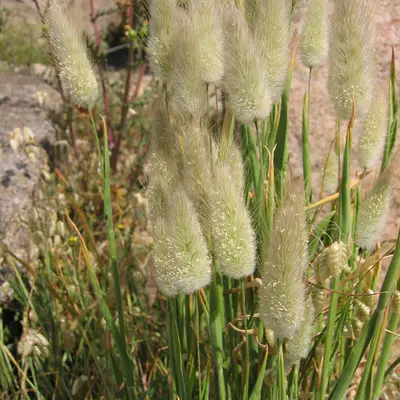
Charming, annual ornamental grass grown for its fuzzy, "bunny tail" blooms. 1 1/2-2" long oval, woolly blooms resemble a rabbit's tail. Flowers sit well above a clump of compact, light green grass. Very easy to dry. Holds well when dried; accepts dye readily. Developing flower heads are light green, maturing creamy white to soft wheat in color. Also known as bunny tail grass and rabbit tail grass.
Harvest
90-110d
Days to harvest
Sun
Full sun
Zones
4–10
USDA hardiness
Height
12-24 inches
Planting Timeline
Showing dates for Hare's Tail Grass in USDA Zone 7
All Zone 7 grass →Zone Map
Click a state to update dates
Hare's Tail Grass · Zones 4–10
Growing Details
Succession Planting
Hare's Tail is a warm-season annual grown primarily for its seed heads, and each plant produces one main flush — there's no deadheading trick that keeps it churning out new ones the way a cutting flower does. A single follow-up sowing, about 3–4 weeks after your first, can extend the harvest window for dried arrangements and gives you a backup if the first round germinates poorly. Direct sow the first batch when soil hits 55°F (roughly March in zones 7–8, late April in zone 5), then a second round 3–4 weeks later.
Beyond two sowings, the payoff drops sharply. Later plantings often catch up to earlier ones once summer heat accelerates growth, so a third sowing rarely buys you a meaningfully different harvest date — just more crowding to manage.
Complete Growing Guide
Light: Full sun (6 or more hours of direct sunlight a day). Soil: Loam (Silt), Sand. Drainage: Good Drainage. Height: 1 ft. 0 in. - 2 ft. 0 in.. Spread: 0 ft. 10 in. - 1 ft. 0 in.. Growth rate: Rapid. Propagation: Seed.
Harvesting
Hare's Tail Grass reaches harvest at 90 - 110 days from sowing per Johnny's Selected Seeds. Expect 1 1/2-2" at peak. As an annual, harvest continues until frost ends the season.
Type: Caryopsis.
Storage & Preservation
Hare's Tail Grass is prized for drying rather than fresh storage. Once blooms reach full maturity (creamy white to wheat color), cut stems and hang upside down in a cool, dry location with good air circulation for 1-2 weeks. Dried stems maintain their shape and softness indefinitely when kept in a dry environment away from humidity and direct sunlight. Store in airtight containers or vases. Preservation methods: air-drying (most common), pressing between newspaper layers, or drying with silica gel for accelerated drying. Dried bunny tails accept dye readily, allowing customization for floral arrangements and crafts. Fresh stems in water last 1-2 weeks.
History & Origin
Origin: Macaronesia, Mediterranean to Arabian Peninsula
Advantages
- +Produces charming fuzzy blooms that resemble adorable rabbit tails.
- +Excellent for dried flower arrangements and crafts with great longevity.
- +Accepts dyes readily, allowing creative color customization for decorative uses.
- +Compact growth habit makes it suitable for small garden spaces.
- +Blooms develop beautiful color progression from green to creamy white.
Considerations
- -Annual plant requires replanting each year, not a perennial option.
- -Prefers well-drained soil and struggles in wet or poorly drained areas.
- -Moderate difficulty level means less forgiving than easier ornamental grasses.
- -Can self-seed aggressively in warm climates, potentially becoming invasive.
Companion Plants
The best companions for Hare's Tail are plants that share its preference for lean, well-drained soil and full sun without competing aggressively for water. Lavender, Catmint, and Russian Sage all fit that profile. They have similarly modest water needs, their roots don't scramble into the same shallow zone, and their upright, airy habits contrast well with the pale, bobble-headed seed heads without blocking light. Sedum and Lamb's Ear work for the same reasons — low water demand, a spreading habit that stays low enough to leave the grass unshaded, and a texture that plays off the fluffy heads. Black-eyed Susan and Echinacea add a practical benefit: both attract hoverflies and parasitic wasps that keep aphid pressure down across the whole planting, and their bloom times overlap enough with Hare's Tail's late-season display that the combination isn't just functional — it actually looks intentional.
Mint is the obvious problem plant. It spreads by underground rhizomes and will physically take over the root zone of anything nearby within a single season, and it wants consistently moist soil — the opposite of what Hare's Tail needs. Hostas and Impatiens fail for a different reason: both are shade-and-moisture plants, so pairing either one with Hare's Tail means one of them is going to be in the wrong conditions entirely. No allelopathic chemistry at play with those two — it's a straight cultural mismatch, and no amount of creative placement fixes it.
Plant Together
Lavender
Both thrive in well-draining soil and create complementary textures in ornamental gardens
Sedum
Similar drought tolerance and low maintenance requirements, excellent for rock gardens
Black-eyed Susan
Provides colorful contrast while sharing similar sun and soil requirements
Ornamental Alliums
Complementary growth habits and bloom times, both attractive to beneficial insects
Catmint
Similar drought tolerance and creates nice textural contrast with grass plumes
Russian Sage
Both prefer dry conditions and create beautiful late-season garden interest
Lamb's Ear
Contrasting foliage textures work well together in xeriscape designs
Echinacea
Provides structural contrast and both attract beneficial pollinators
Keep Apart
Mint
Aggressive spreading nature can overwhelm ornamental grasses and compete for space
Hostas
Conflicting moisture and light requirements - hostas need shade and consistent moisture
Impatiens
Require consistently moist soil conditions that conflict with grass's drought preferences
Troubleshooting Hare's Tail Grass
What you'll see, why it happens, and what to do about it.
Seedlings damping off at soil level — stems pinching and collapsing within the first 2 weeks after germination
Likely Causes
- Pythium or Fusarium damping-off fungi, usually triggered by overwatering or poor drainage
- Sowing too thickly so stems can't dry between waterings
What to Do
- 1.Water only when the top inch of soil is dry; don't keep seedlings consistently moist
- 2.Thin to at least 2 inches apart as soon as the first true leaves appear — crowded stems stay wet too long
- 3.If you're starting in trays, use a soilless seed-starting mix and make sure containers drain freely
Established plants flopping over or lodging — stems leaning heavily by midsummer
Likely Causes
- Excess nitrogen from over-fertilizing, which pushes soft, weak stem growth
- Shade from nearby taller plants reducing light below the 6-hour minimum
What to Do
- 1.Don't fertilize Hare's Tail in lean soil unless plants are visibly stunted — it doesn't need feeding the way vegetables do
- 2.Move neighboring plants or cut back any overhang so the grass gets direct sun for at least 6 hours
- 3.If lodging happens every year in the same spot, stake with bamboo canes or resite the planting
Fluffy seed heads turning brown and shriveling before fully forming, typically around day 80–90
Likely Causes
- Powdery mildew (Erysiphe graminis) — common in warm, humid conditions with poor airflow
- Spider mite feeding on the stems and developing heads during hot, dry spells
What to Do
- 1.Space plants at least 12 inches apart to keep air moving between them
- 2.Check the undersides of leaves for fine webbing — if spider mites are present, knock them off with a strong water spray on two or three consecutive mornings
- 3.Cut heads for drying around day 80 if mildew is a recurring problem; they hold their shape well at that stage
Poor germination — sparse or no sprouts after 14 days from direct sow
Likely Causes
- Soil temperature below 55°F at sowing time, which slows germination significantly
- Seed buried too deep — Lagurus ovatus needs light to germinate and shouldn't be covered more than 1/8 inch
- Old seed stock losing viability
What to Do
- 1.Wait until soil temps reliably hit 55–65°F before sowing; in most zones that means late March at the earliest
- 2.Press seed lightly into the surface and cover with just a dusting of fine soil or vermiculite — no more than 1/8 inch
- 3.Test any seed older than 2 years: wrap 10 seeds in a damp paper towel, seal in a bag, and check after 10 days
Frequently Asked Questions
How long does it take Hare's Tail Grass to flower from planting?▼
Is Hare's Tail Grass good for beginners?▼
Can you grow Hare's Tail Grass in containers?▼
When should I plant Hare's Tail Grass seeds?▼
What makes Hare's Tail Grass so good for dried arrangements?▼
How should I harvest Hare's Tail Grass for drying?▼
Zone-by-Zone Planting Calendar
Growing Guides from Wind River Greens
Sources & References
External authority sources used in compiling this guide.
- ExtensionNC State Extension
- BreederJohnny's Selected Seeds
See the Methodology page for how this data is sourced, what's AI-assisted, and known limitations.