Vitaverde
Brassica oleracea var. botrytis
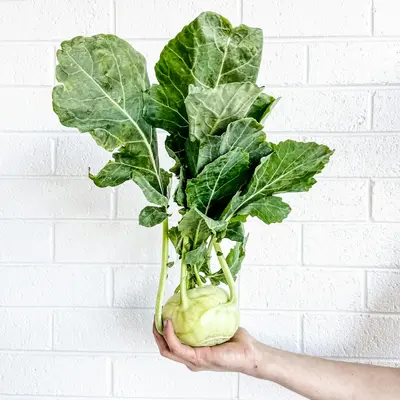
Big, heavy, green heads mature early on large plants. Can be grown for traditional harvest in fall, but is also suitable for summer production in areas with moderate heat, and winter production in mild areas.
Harvest
71d
Days to harvest
Sun
Full sun to partial shade
Zones
6–9
USDA hardiness
Height
10-24 inches
Planting Timeline
Showing dates for Vitaverde in USDA Zone 7
All Zone 7 brassica →Zone Map
Click a state to update dates
Vitaverde · Zones 6–9
Growing Details
Succession Planting
Cauliflower doesn't lend itself to tight succession the way lettuce or radishes do — each plant gives you one head, and at 71 days per crop, you need to think in 3–4 week intervals rather than weekly plantings. Start the first round indoors in late February, transplant in April, and you'll be cutting heads in late May or June. For a fall run, start a second round indoors in late June or early July and transplant in August for harvest from October into November.
The main constraint is heat. Cauliflower curds will button — form tiny, premature heads — or turn grainy and loose if temperatures climb above 80°F during head development. Time your transplants so the 71-day window falls in the cooler shoulder seasons. In most of zone 7, that means two windows per year with a hard stop on spring planting if you're past mid-April.
Complete Growing Guide
Big, heavy, green heads mature early on large plants. Can be grown for traditional harvest in fall, but is also suitable for summer production in areas with moderate heat, and winter production in mild areas. According to Johnny's Selected Seeds, Vitaverde is 71 days to maturity, annual, hybrid (f1).
Light: Full sun (6 or more hours of direct sunlight a day), Partial Shade (Direct sunlight only part of the day, 2-6 hours). Soil: Clay, Loam (Silt), Sand. Soil pH: Acid (<6.0), Neutral (6.0-8.0). Drainage: Good Drainage, Moist. Height: 0 ft. 10 in. - 2 ft. 0 in.. Spread: 1 ft. 0 in. - 2 ft. 0 in.. Spacing: 12 inches-3 feet. Growth rate: Medium. Maintenance: Medium. Propagation: Seed, Stem Cutting. Regions: Coastal, Mountains, Piedmont.
Harvesting
Vitaverde reaches harvest at 71 days from sowing per Johnny's Selected Seeds. As an annual, harvest continues until frost ends the season.
The fruits dry and split when ripe.
Color: Brown/Copper, Green. Type: Siliqua. Length: > 3 inches.
Garden value: Edible
Harvest time: Fall, Summer
Edibility: The foliage is edible raw or cooked but when cooked can emit an unpleasant odor.
Storage & Preservation
Harvest Vitaverde heads when they reach full size but before florets begin to separate. Store freshly cut heads in a perforated plastic bag in the refrigerator's crisper drawer at 32–40°F with 95% humidity; they'll keep for up to two weeks. For longer preservation, blanch florets for three minutes, then freeze in airtight containers for up to eight months. Alternatively, steam until tender and pickle in vinegar brine for a crisp, tangy product lasting several months in cool storage. Drying is less common but possible—slice heads thinly and dry at 140°F until brittle. Vitaverde's compact head structure means florets stay tightly bound longer than looser varieties, making it particularly well-suited for freezing without significant texture loss during thawing.
History & Origin
Vitaverde is an F1 hybrid developed through controlled cross-pollination. Listed in the Johnny's Selected Seeds catalog.
Origin: W. Europe
Advantages
- +Early maturity at 71 days allows multiple harvests per growing season
- +Large, heavy heads produce substantial yields for market or storage
- +Versatile production window suits fall, summer, and winter growing regions
- +Easy difficulty rating makes Vitaverde accessible to beginner gardeners
- +Big plants utilize space efficiently while producing premium-sized heads
Considerations
- -Large plant size requires significant spacing, limiting density in small gardens
- -Heavy heads may need staking support in windy or exposed locations
- -Susceptible to typical brassica pests like cabbage worms and aphids
Companion Plants
Marigolds and garlic get recommended constantly for brassicas, and they're not wrong choices — but NC State Extension's IPM guidance is honest that the repellent evidence is mixed. The more reliable principle behind interplanting is dilution: spreading Vitaverde through a bed with unrelated plants like lettuce or carrots means a cabbageworm colony has to work harder to find the next cauliflower head. Lettuce is a practical pairing specifically because it fills the low space between 18–24 inch cauliflower plants without competing for the same root depth, and you'll harvest it before the canopy closes in.
Thyme, dill, and nasturtiums pull in predatory and parasitic insects that feed on aphids and caterpillar eggs. Dill in flower is especially good at attracting the parasitic wasps that target imported cabbageworm (Pieris rapae) larvae. Plant it nearby but not right up against the cauliflower — mature dill gets tall enough to shade a developing curd at exactly the wrong time.
Tomatoes and pole beans are the ones to keep out of the same bed. Tomatoes are heavy nitrogen feeders that compete directly for soil nutrients, and they share fusarium wilt pressure with brassicas — two problems in one neighbor. Pole beans fix nitrogen through root bacteria, which sounds useful, but the release is slow and tends to push Vitaverde toward vegetative growth rather than tight head development. Give cauliflower its space, or fill it with genuinely low-competition plants like carrots and onions, which occupy a different soil layer entirely.
Plant Together
Marigolds
Repel nematodes and various flying insects that damage brassica crops
Garlic
Natural fungicide properties help prevent clubroot and other soil-borne diseases
Lettuce
Provides ground cover and efficient use of garden space with different root depths
Carrots
Help break up soil for brassica roots and don't compete for nutrients
Thyme
Repels cabbage worms and provides natural pest deterrent through aromatic compounds
Dill
Attracts beneficial insects like parasitic wasps that control cabbage worms and aphids
Onions
Repel cabbage root fly, aphids, and other brassica pests with their strong scent
Nasturtiums
Act as trap crop for flea beetles and aphids, drawing pests away from brassicas
Keep Apart
Tomatoes
Compete for similar nutrients and may stunt brassica growth through allelopathic effects
Strawberries
Both are heavy feeders that compete for nutrients, leading to reduced yields
Pole Beans
Can shade brassicas and compete for nitrogen, inhibiting proper head formation
Nutrition Facts
Per 100g serving. % Daily Value based on 2,000 calorie diet. Source: USDA FoodData Central (FDC #747447)
Pests & Disease Resistance
Common Pests
Cabbage worms, cabbage loopers, flea beetles, aphids, diamondback moths
Diseases
Clubroot, black rot, yellows, downy mildew, fusarium wilt
Troubleshooting Vitaverde
What you'll see, why it happens, and what to do about it.
Ragged holes chewed through leaves, often with visible green caterpillars or frass on the surface
Likely Causes
- Imported cabbageworm (Pieris rapae) — white butterfly lays eggs on brassica leaves
- Cabbage looper (Trichoplusia ni) — arches its body as it moves, feeds heavily on outer leaves
- Diamondback moth larvae (Plutella xylostella) — tiny, wriggles when disturbed
What to Do
- 1.Spray Bacillus thuringiensis var. kurstaki (Bt) every 5–7 days while larvae are small — it stops working once they're big
- 2.Check the undersides of leaves for egg clusters and crush them by hand before they hatch
- 3.Cover transplants with floating row cover immediately after planting; secure the edges so moths can't get underneath
Tiny round pits or shot-holes across young leaves, worst on seedlings in warm spells
Likely Causes
- Flea beetles (Phyllotreta spp.) — jump when disturbed, most damaging to seedlings under 4 inches tall
- Dry or stressed soil that slows the plant's ability to outgrow damage
What to Do
- 1.Row cover at transplant is your best defense — flea beetles locate plants by smell and sight, and exclusion beats any spray
- 2.Keep soil consistently moist (1–1.5 inches per week); stressed plants take two to three times longer to push past the damage
- 3.If populations are heavy on uncovered plants, kaolin clay applied to the leaf surface creates a physical barrier they dislike
Plants wilting and yellowing despite adequate water; roots are swollen, distorted, or club-shaped when pulled
Likely Causes
- Clubroot (Plasmodiophora brassicae) — a soil-borne pathogen that can persist for 10–20 years
- Low soil pH (below 6.0), which favors spore germination
What to Do
- 1.Pull and bag affected plants immediately — do not compost them
- 2.Lime the bed to raise pH to 7.0–7.2, which suppresses spore activity; get a soil test first to know how much lime to apply
- 3.NC State Extension recommends rotating brassicas out of that bed for at least 3 years — longer if the infestation was heavy
V-shaped yellow lesions on leaf edges that turn brown and papery; dark streaking inside the stem when cut
Likely Causes
- Black rot (Xanthomonas campestris pv. campestris) — a bacterial disease that enters through leaf margins and moves through the vascular system
- Overhead irrigation or rain splash that carries bacteria from plant to plant
- Infected transplants brought into the garden at purchase
What to Do
- 1.Remove and trash (not compost) affected leaves or whole plants immediately — black rot spreads fast once it's in the vascular tissue
- 2.Switch to drip irrigation if you're running overhead; keeping leaves dry slows transmission significantly
- 3.Inspect transplants before buying and refuse anything with yellowed or water-soaked leaf margins
Frequently Asked Questions
How long does Vitaverde cabbage take to mature?▼
Is Vitaverde a good cabbage variety for beginners?▼
Can you grow Vitaverde cabbage in summer?▼
What does Vitaverde cabbage taste like?▼
When should I plant Vitaverde cabbage?▼
How much space does Vitaverde cabbage need?▼
Zone-by-Zone Planting Calendar
| Zone | Indoor Start | Transplant | Direct Sow | Harvest |
|---|---|---|---|---|
| Zone 3 | March – April | May – June | May – June | July – October |
| Zone 4 | March – April | May – June | April – June | July – October |
| Zone 5 | February – March | April – May | April – May | June – November |
| Zone 6 | February – March | April – May | April – May | June – November |
| Zone 7 | February – March | April – May | March – May | May – November |
| Zone 8 | January – February | March – April | March – April | May – December |
| Zone 9 | January – January | February – March | February – March | April – December |
| Zone 10 | January – January | February – March | January – March | March – December |
| Zone 1 | April – May | June – July | June – July | August – September |
| Zone 2 | April – May | June – July | May – July | July – September |
| Zone 11 | January – January | January – February | January – February | February – December |
| Zone 12 | January – January | January – February | January – February | February – December |
| Zone 13 | January – January | January – February | January – February | February – December |
Growing Guides from Wind River Greens
Sources & References
External authority sources used in compiling this guide.
- BreederJohnny's Selected Seeds
- USDAUSDA FoodData Central
See the Methodology page for how this data is sourced, what's AI-assisted, and known limitations.