Kale 'Winterbor F1'
Brassica oleracea var. acephala 'Winterbor F1'
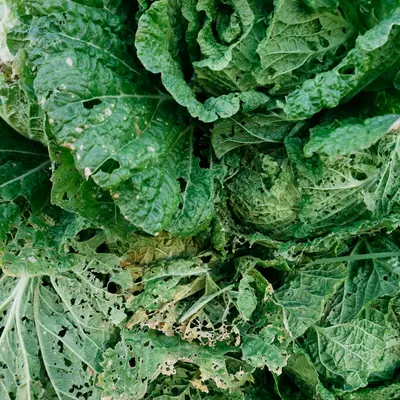
The ultimate winter kale that actually improves in flavor after frost exposure, becoming sweeter and more tender. This vigorous hybrid produces masses of deeply curled, blue-green leaves that can withstand temperatures down to 10°F while continuing to grow. It's the go-to variety for gardeners wanting fresh greens throughout winter.
Harvest
60-65d
Days to harvest
Sun
Full sun to partial shade
Zones
6–9
USDA hardiness
Height
10-24 inches
Planting Timeline
Showing dates for Kale 'Winterbor F1' in USDA Zone 7
All Zone 7 brassica →Zone Map
Click a state to update dates
Kale 'Winterbor F1' · Zones 6–9
Growing Details
Succession Planting
Start 'Winterbor F1' indoors in late February or early March and transplant out in April after a week of hardening off. That first planting carries you through spring harvest. Don't stack multiple spring sowings — kale bolts once daytime highs consistently clear 80°F, so you'd be racing the same deadline with every batch.
The fall succession is where this variety pays off. Direct sow every 3–4 weeks from late July through mid-August; those plants hit full size right as temperatures drop below 60°F, which is when the flavor sharpens noticeably. 'Winterbor F1' handles light frost without flinching and can hold in the garden down into the mid-20s°F, so a well-timed August sowing can stretch your harvest into November without any protection.
Complete Growing Guide
Time Winterbor F1 for a late-summer or early-fall sowing to maximize its cold-season advantage—this hybrid's 60-65 day maturity means an August sowing in most zones delivers harvestable plants before first frost, then extends productivity through winter while other greens fail. Unlike tender spring kales, Winterbor actually requires cool temperatures to trigger its signature sweetness, so resist harvesting until after a hard frost if possible. Space plants 12-15 inches apart in full sun with rich, well-draining soil amended with compost, as vigorous F1 hybrids demand consistent nitrogen. Watch for cabbage loopers and flea beetles in fall plantings, which can accelerate leaf damage on young plants; row covers during establishment provide organic control without the pest pressures of spring growth. This variety rarely bolts when treated as a winter crop rather than spring succession, but avoid heat stress by never planting in summer heat—timing is everything with this cold-loving cultivar. Pinch off older lower leaves regularly to encourage the dense, deeply curled growth this hybrid produces best.
Light: Full sun (6 or more hours of direct sunlight a day), Partial Shade (Direct sunlight only part of the day, 2-6 hours). Soil: Clay, Loam (Silt), Sand. Soil pH: Acid (<6.0), Neutral (6.0-8.0). Drainage: Good Drainage, Moist. Height: 0 ft. 10 in. - 2 ft. 0 in.. Spread: 1 ft. 0 in. - 2 ft. 0 in.. Spacing: 12 inches-3 feet. Growth rate: Medium. Maintenance: Medium. Propagation: Seed, Stem Cutting. Regions: Coastal, Mountains, Piedmont.
Harvesting
Winterbor F1 kale reaches peak harvest readiness when its deeply curled leaves develop their characteristic blue-green color and feel firm yet tender to the touch, typically at 8–10 inches long. This variety responds exceptionally well to continuous harvesting: pinch or cut outer leaves from the base upward, leaving the growing crown intact for repeated pickings throughout winter. For best results, harvest in the morning after frost has melted, as this is when leaves are most crisp and sweet. Single harvesting of the entire plant is possible at maturity, but the continuous-pick method extends productivity and encourages tenderness. Even light frosts trigger additional sweetness, making late-season harvests superior to early ones.
The fruits dry and split when ripe.
Color: Brown/Copper, Green. Type: Siliqua. Length: > 3 inches.
Garden value: Edible
Harvest time: Fall, Summer
Edibility: The foliage is edible raw or cooked but when cooked can emit an unpleasant odor.
Storage & Preservation
Fresh Winterbor leaves store best unwashed in perforated plastic bags in your refrigerator's crisper drawer, maintaining quality for 7-10 days. The thick, curled leaves hold up better than smooth kale varieties, making this excellent for meal prep.
For longer storage, blanch leaves in boiling water for 2 minutes, shock in ice water, then freeze in portions. Frozen Winterbor retains its texture better than most kales and works perfectly in smoothies and cooked dishes for up to 8 months.
Dehydrating creates excellent kale chips – massage leaves with olive oil and salt, then dehydrate at 115°F until crisp. The naturally sweet flavor of frost-touched Winterbor makes superior chips compared to summer-harvested kale. You can also ferment chopped Winterbor as part of sauerkraut blends, where its sturdy leaves maintain texture throughout the fermentation process.
History & Origin
Winterbor F1 emerged from European kale breeding programs in the late twentieth century, developed as a modern hybrid to combine winter hardiness with improved leaf texture and flavor. The variety belongs to the Brassica oleracea acephala lineage, which encompasses traditional curly kales with deep roots in Northern European cultivation. While specific breeder attribution and exact introduction year remain obscure in readily available documentation, Winterbor F1 represents the deliberate selection within established seed companies' winter kale breeding lines for enhanced cold tolerance and sweetness. The F1 designation confirms its hybrid status, indicating careful crossing of selected parent lines to achieve superior vigor and uniformity compared to open-pollinated ancestors.
Origin: W. Europe
Advantages
- +Flavor improves dramatically after frost exposure, becoming noticeably sweeter.
- +Extremely cold-hardy, surviving temperatures down to 10°F reliably.
- +Deeply curled blue-green leaves provide excellent visual appeal and texture.
- +Fast maturity at 60-65 days enables successive plantings for winter harvests.
- +Vigorous hybrid produces abundant leaves with minimal gardening experience required.
Considerations
- -Susceptible to multiple serious diseases including clubroot and black rot.
- -Cabbage worms and flea beetles require consistent pest management throughout season.
- -Requires well-draining soil to prevent clubroot and downy mildew problems.
- -Downy mildew pressure increases in cool, humid winter growing conditions.
Companion Plants
Nasturtiums and marigolds pull real weight near kale. Nasturtiums get colonized by cabbage aphids before the kale does — you'll see clusters massing on the nasturtium stems while your kale stays cleaner. French marigolds go a step further: NC State Extension recommends dense plantings of them as a cultural tool against root-knot nematodes, suppressing nematode populations in surrounding soil over the course of a full growing season. A token border plant at each corner won't do it; you need a solid block, 12 inches on center or tighter.
Garlic and onions are worth tucking in along row edges at 6-inch intervals. The sulfur compounds alliums emit appear to disrupt the host-finding behavior of cabbage moths and aphids — not a silver bullet, but enough to reduce pressure when combined with row cover during the seedling stage. Dill is useful for a different reason: it draws parasitic wasps that prey on imported cabbageworm (Pieris rapae) larvae, and unlike some of these companion claims, you can actually watch the wasps working the dill flowers. Lettuce and spinach fit in underneath kale purely on logistics — they share the cool-season window, max out around 6–8 inches tall, and don't compete for the same root depth.
Tomatoes and pole beans belong on the far side of the garden. Tomatoes are heavy calcium and nitrogen feeders that push soil pH preferences in a different direction, and they'll shade kale out physically once they're past 3 feet. Pole beans are the subtler problem: the nitrogen they fix and release into the soil pushes kale toward soft, sappy new growth — exactly the tissue that cabbage aphids and downy mildew prefer. Run legumes as a follow-on rotation crop in that bed the next season, not a same-bed neighbor.
Plant Together
Nasturtiums
Acts as trap crop for aphids and flea beetles, protecting kale from pest damage
Onions
Repels cabbage worms, aphids, and flea beetles with strong sulfur compounds
Marigolds
Deters cabbage worms and aphids while attracting beneficial predatory insects
Dill
Attracts beneficial wasps that parasitize cabbage worms and improves kale flavor
Carrots
Utilizes different soil depths and nutrients, maximizing garden space efficiency
Lettuce
Benefits from kale's shade in hot weather and has compatible root systems
Garlic
Natural fungicide properties help prevent clubroot and other soil-borne diseases
Spinach
Similar growing conditions and acts as living mulch to retain soil moisture
Keep Apart
Strawberries
Competes for similar nutrients and attracts slugs that also damage kale leaves
Tomatoes
Heavy feeder that competes for nutrients and may stunt kale growth
Pole Beans
Can shade kale excessively and compete for nitrogen despite nitrogen-fixing ability
Nutrition Facts
Per 100g serving. % Daily Value based on 2,000 calorie diet. Source: USDA FoodData Central (FDC #168421)
Pests & Disease Resistance
Resistance
Excellent cold tolerance, good resistance to downy mildew
Common Pests
Cabbage worms, aphids, flea beetles, leaf miners
Diseases
Downy mildew, black rot, white rust, clubroot
Troubleshooting Kale 'Winterbor F1'
What you'll see, why it happens, and what to do about it.
Gray-purple fuzzy coating on undersides of leaves, with yellow patches on the upper surface — usually shows up after a stretch of cool, wet weather
Likely Causes
- Downy mildew (Peronospora parasitica) — thrives in temps between 45–65°F with high humidity or leaf wetness
- Overhead watering that keeps foliage wet overnight
What to Do
- 1.Pull off heavily infected leaves and bin them — don't compost
- 2.Switch to drip or base watering so foliage stays dry
- 3.Increase spacing to 18 inches to open up airflow between plants
V-shaped yellow lesions on leaf edges that turn brown and papery, sometimes with dark veins underneath
Likely Causes
- Black rot (Xanthomonas campestris pv. campestris) — a bacterial disease that enters through leaf margins and moves inward along the veins
- Contaminated seed or transplants brought in from elsewhere
What to Do
- 1.Remove and trash infected leaves immediately — black rot spreads fast in wet conditions
- 2.Avoid working the bed when leaves are wet, which splashes the bacteria plant to plant
- 3.Rotate brassicas out of that bed for at least 2 seasons; the pathogen persists in soil debris
Tiny round holes scattered across young leaves, worst on seedlings just after transplant or direct sow
Likely Causes
- Flea beetles (Phyllotreta species) — small, jumping beetles that chew shot-hole damage, especially on stressed or newly emerged plants
- Dry soil conditions, which stress seedlings and make them more vulnerable
What to Do
- 1.Cover transplants immediately with row cover (Agribon AG-19 or similar) and seal the edges — flea beetles will find any gap
- 2.Keep soil consistently moist; well-watered plants at 1–1.5 inches per week outgrow the damage faster
- 3.Once plants hit 6–8 inches tall, they're usually tough enough that flea beetle pressure matters less
Frequently Asked Questions
How cold can Winterbor F1 kale tolerate?▼
When should I plant Winterbor kale for winter harvest?▼
Can you grow Winterbor F1 in containers?▼
What does Winterbor kale taste like compared to other varieties?▼
How long does Winterbor F1 take to grow to harvest size?▼
Is Winterbor F1 kale good for beginners?▼
Zone-by-Zone Planting Calendar
| Zone | Indoor Start | Transplant | Direct Sow | Harvest |
|---|---|---|---|---|
| Zone 1 | April – May | June – July | June – July | August – September |
| Zone 2 | April – May | June – July | May – July | July – September |
| Zone 11 | January – January | January – February | January – February | February – December |
| Zone 12 | January – January | January – February | January – February | February – December |
| Zone 13 | January – January | January – February | January – February | February – December |
| Zone 3 | March – April | May – June | May – June | July – October |
| Zone 4 | March – April | May – June | April – June | June – October |
| Zone 5 | February – March | April – May | April – May | June – November |
| Zone 6 | February – March | April – May | April – May | June – November |
| Zone 7 | February – March | April – May | March – May | May – November |
| Zone 8 | January – February | March – April | March – April | May – December |
| Zone 9 | January – January | February – March | February – March | April – December |
| Zone 10 | January – January | February – March | January – March | March – December |
Growing Guides from Wind River Greens
Sources & References
External authority sources used in compiling this guide.
See the Methodology page for how this data is sourced, what's AI-assisted, and known limitations.