Vates Dwarf Blue Curled Kale
Brassica oleracea var. acephala 'Vates Dwarf Blue Curled'
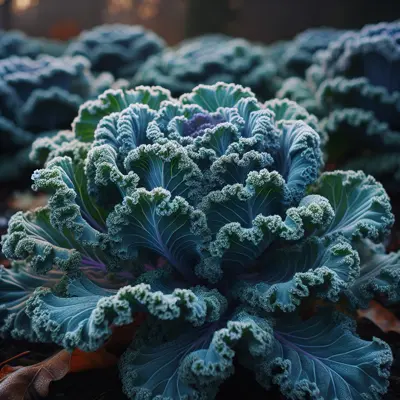
A compact, cold-hardy kale variety that was specifically bred for both home gardens and commercial production, winning an AAS award for its reliability. The tightly curled, blue-green leaves pack incredible nutrition into a space-saving plant that actually improves in flavor after frost touches the leaves.
Harvest
55-60d
Days to harvest
Sun
Full sun to partial shade
Zones
6–9
USDA hardiness
Height
10-24 inches
Planting Timeline
Showing dates for Vates Dwarf Blue Curled Kale in USDA Zone 7
All Zone 7 brassica →Zone Map
Click a state to update dates
Vates Dwarf Blue Curled Kale · Zones 6–9
Growing Details
Succession Planting
Start successions indoors in February, then direct-sow every 3 weeks from late March through early May for a spring run. Vates handles light frost well — down to around 20°F — so you'll get a long harvest window, but it turns bitter once daytime temps are consistently above 80°F. Stop spring sowings by mid-May or you'll be nursing heat-stressed plants through summer with little to show for it.
Fall is the better season for kale in zone 7. Direct-sow again from late July through mid-August — plants need to be established before first frost but benefit from several hard frosts, which convert starches to sugars and noticeably improve the flavor. A fall planting sown by August 15 can carry through November and often into December without any protection.
Complete Growing Guide
This award-winning compact cultivar thrives in cool-season gardens and reaches harvest maturity in just 55-60 days, making it ideal for both spring and fall planting windows with successive sowings. Unlike taller kale varieties, Vates stays manageable at 10-24 inches, reducing wind damage and fitting smaller garden spaces without requiring aggressive staking. Plant in full sun with well-draining, fertile soil rich in organic matter, and space plants 12-18 inches apart to ensure adequate air circulation that prevents fungal diseases common in dense foliage. While generally hardy, watch for cabbage worms and flea beetles in spring plantings by using row covers early. The cultivar's main strength is its cold hardiness—delay harvest until after the first frost, when starches convert to sugars and flavor noticeably sweetens. A practical approach: succession plant every two weeks from midsummer through early fall to ensure continuous harvests through winter in most zones.
Light: Full sun (6 or more hours of direct sunlight a day), Partial Shade (Direct sunlight only part of the day, 2-6 hours). Soil: Clay, Loam (Silt), Sand. Soil pH: Acid (<6.0), Neutral (6.0-8.0). Drainage: Good Drainage, Moist. Height: 0 ft. 10 in. - 2 ft. 0 in.. Spread: 1 ft. 0 in. - 2 ft. 0 in.. Spacing: 12 inches-3 feet. Growth rate: Medium. Maintenance: Medium. Propagation: Seed, Stem Cutting. Regions: Coastal, Mountains, Piedmont.
Harvesting
Vates Dwarf Blue Curled Kale reaches peak harvest when the tightly curled leaves develop their characteristic deep blue-green color and feel firm and crisp to the touch, typically occurring 55-60 days after planting. Individual leaves are ready when they reach 8-10 inches long, though the entire plant rarely exceeds 24 inches in height. For continuous harvesting, pinch off outer leaves from the base upward, allowing the central crown to keep producing fresh growth throughout the season. Alternatively, cut the entire plant 2 inches above soil level for a single harvest, which may trigger regrowth. A crucial timing tip: delay your first substantial harvest until after the first light frost, as cold exposure triggers the plant's natural sweetening process, transforming the mild flavor into noticeably sweeter leaves that represent the variety's peak eating quality.
The fruits dry and split when ripe.
Color: Brown/Copper, Green. Type: Siliqua. Length: > 3 inches.
Garden value: Edible
Harvest time: Fall, Summer
Edibility: The foliage is edible raw or cooked but when cooked can emit an unpleasant odor.
Storage & Preservation
Fresh kale stores best unwashed in perforated plastic bags in the refrigerator crisper drawer, maintaining quality for 5-7 days at 32-35°F. Remove any damaged leaves before storing as they accelerate spoilage. For longer storage, blanch leaves in boiling water for 2 minutes, shock in ice water, drain thoroughly, and freeze in portions for up to 8 months—perfect for smoothies and soups. Dehydrate young, tender leaves at 125°F for crispy kale chips that store in airtight containers for weeks. Vates' sturdy texture also makes it excellent for lacto-fermentation; massage chopped leaves with salt and ferment like sauerkraut for a nutritious, probiotic-rich preserve that keeps refrigerated for months.
History & Origin
This variety emerged from the broader development of dwarf kale cultivars in the mid-twentieth century, though specific breeder attribution and exact origin year remain poorly documented in readily available sources. The "Vates" designation suggests connection to breeding work during the post-World War II era when commercial seed companies intensified efforts to develop compact, cold-hardy brassicas suited to both home and market gardening. The variety likely descends from traditional curly kale lines, selectively bred for reduced height, improved cold tolerance, and enhanced sweetness after frost exposure—traits that align with horticultural priorities of that period. Its All-America Selections award recognition confirms its establishment as a reliable cultivar by the time formal AAS judging became prominent, though the complete genealogy connecting Vates Dwarf Blue Curled to specific parent varieties or breeding institutions awaits detailed historical documentation.
Origin: W. Europe
Advantages
- +Award-winning AAS variety bred for reliable performance in home and commercial gardens
- +Compact size makes it ideal for small spaces and container growing
- +Frost improves flavor naturally, eliminating need for artificial sweetening methods
- +Tightly curled leaves pack exceptional nutrition into minimal garden footprint
- +Quick 55-60 day harvest means multiple plantings per season possible
Considerations
- -Susceptible to four major pests including cabbage worms and flea beetles
- -Vulnerable to three fungal diseases: black rot, downy mildew, white rust
- -Requires consistent pest management and disease prevention throughout growing season
Companion Plants
Nasturtiums are probably the most useful thing you can plant near Vates kale. They draw aphids — especially cabbage aphids (Brevicoryne brassicae) — away from the kale and onto themselves, acting as a trap crop you can pull and discard when they get heavily infested. Plant them at the row ends or in a border 12–18 inches out. French marigolds (Tagetes patula) do double duty: their root exudates suppress soil nematodes over a full season, and the flowers pull in beneficial insects that predate on caterpillars and aphid colonies.
Alliums — onions, garlic, chives — are solid neighbors. Their sulfur compounds interfere with the scent-based host-finding of cabbage moths and aphids, and they occupy a shallow root zone that doesn't compete with kale's deeper feeders. Carrots work well for the same structural reason: different root depth, different family, no shared pathogens. Dill is worth including because it attracts parasitic wasps that lay eggs in imported cabbageworm (Pieris rapae) caterpillars — but let it flower rather than harvesting it hard, or it won't do much for you.
Keep tomatoes and pole beans well separated. Tomatoes are heavy feeders that compete aggressively for water, and repeated close planting in the same space pulls soil pH below kale's preferred range of 6.0–7.5. Pole beans fix nitrogen, which sounds like a benefit, but the resulting flush of available N pushes kale toward soft, lush new growth that cabbage worms and aphids find more attractive — exactly the wrong direction.
Plant Together
Nasturtiums
Acts as trap crop for aphids and cabbage worms, repels cucumber beetles
Onions
Repels cabbage worms, aphids, and cabbage maggots with strong scent
Garlic
Deters cabbage loopers, aphids, and flea beetles
Carrots
Helps break up soil for kale roots, minimal competition for nutrients
Lettuce
Provides ground cover to retain soil moisture, harvested before kale needs full space
Dill
Attracts beneficial wasps that parasitize cabbage worms
Marigolds
Repels nematodes and general garden pests, attracts beneficial insects
Chives
Repels aphids and improves growth and flavor of brassicas
Keep Apart
Tomatoes
May stunt kale growth and both plants compete for similar nutrients
Strawberries
Kale can inhibit strawberry growth and both attract similar pests
Pole Beans
Can shade kale excessively and compete for soil nutrients
Nutrition Facts
Per 100g serving. % Daily Value based on 2,000 calorie diet. Source: USDA FoodData Central (FDC #168421)
Pests & Disease Resistance
Resistance
Excellent cold tolerance, good resistance to bolting
Common Pests
Aphids, cabbage worms, flea beetles
Diseases
Black rot, downy mildew, white rust
Troubleshooting Vates Dwarf Blue Curled Kale
What you'll see, why it happens, and what to do about it.
Leaves covered in small, ragged holes — especially on young foliage — with tiny dark beetles jumping when disturbed
Likely Causes
- Flea beetles (Phyllotreta spp.) — particularly bad on seedlings and transplants in warm, dry spells
- Stressed or slow-growing plants that can't outpace the damage
What to Do
- 1.Cover transplants immediately with row cover (Agribon AG-19 or similar) and seal the edges — flea beetles are fast and will find gaps
- 2.Side-dress with compost and water consistently at 1 inch per week; plants growing vigorously shrug off moderate flea beetle pressure better than stressed ones
- 3.If pressure is heavy, apply kaolin clay (Surround WP) as a physical barrier, reapplying after rain
Yellow, angular patches on upper leaf surface with white to gray-purple fuzzy sporulation on the underside, showing up in cool, wet weather
Likely Causes
- Downy mildew (Peronospora parasitica) — a fungus-like oomycete that thrives when nights are cool and humidity is high
- Poor airflow from crowded spacing or a dense canopy
What to Do
- 1.Thin plants to at least 8 inches apart so air can move between them
- 2.Water at the base — drip or soaker hose — and avoid wetting foliage, especially in the evening
- 3.Remove and bag (don't compost) any heavily affected leaves; rotate out of brassicas for at least 2 seasons in that bed
V-shaped yellow lesions on leaf margins that turn brown and papery, sometimes with dark bacterial ooze visible on cut stems
Likely Causes
- Black rot (Xanthomonas campestris pv. campestris) — a bacterial disease that enters through leaf margins and water pores, spreads fast in warm, wet weather
- Infected transplants or seed, and overhead irrigation that splashes bacteria between plants
What to Do
- 1.Pull and dispose of infected plants immediately — black rot moves through a planting fast once established
- 2.Switch to drip irrigation and stop working in the bed when foliage is wet
- 3.Start with certified disease-free seed next season and keep that bed free of all brassicas — kale, cabbage, broccoli, turnips — for at least 3 years
Frequently Asked Questions
How long does Vates Dwarf Blue Curled Kale take to grow?▼
Is Vates Dwarf Blue Curled Kale good for beginners?▼
Can you grow Vates Dwarf Blue Curled Kale in containers?▼
What does Vates Dwarf Blue Curled Kale taste like?▼
When should I plant Vates Dwarf Blue Curled Kale?▼
Vates vs Winterbor Kale—what's the difference?▼
Zone-by-Zone Planting Calendar
| Zone | Indoor Start | Transplant | Direct Sow | Harvest |
|---|---|---|---|---|
| Zone 1 | April – May | June – July | June – July | July – September |
| Zone 2 | April – May | June – July | May – July | July – September |
| Zone 11 | January – January | January – February | January – February | February – December |
| Zone 12 | January – January | January – February | January – February | February – December |
| Zone 13 | January – January | January – February | January – February | February – December |
| Zone 3 | March – April | May – June | May – June | June – October |
| Zone 4 | March – April | May – June | April – June | June – October |
| Zone 5 | February – March | April – May | April – May | June – November |
| Zone 6 | February – March | April – May | April – May | May – November |
| Zone 7 | February – March | April – May | March – May | May – November |
| Zone 8 | January – February | March – April | March – April | April – December |
| Zone 9 | January – January | February – March | February – March | March – December |
| Zone 10 | January – January | February – March | January – March | March – December |
Growing Guides from Wind River Greens
Sources & References
External authority sources used in compiling this guide.
See the Methodology page for how this data is sourced, what's AI-assisted, and known limitations.