Synergy
Brassica oleracea var. botrytis
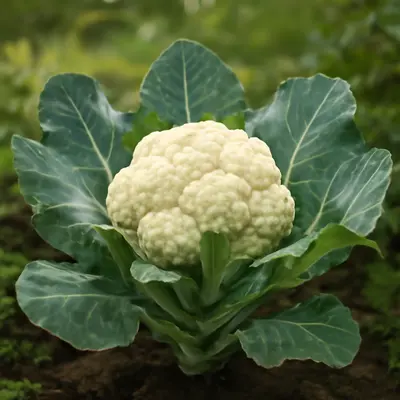
Large, sturdy plants produce big, well-domed heads. Performs exceptionally well in fall trials and is also suitable for spring production.
Harvest
60d
Days to harvest
Sun
Full sun to partial shade
Zones
6–9
USDA hardiness
Height
10-24 inches
Planting Timeline
Showing dates for Synergy in USDA Zone 7
All Zone 7 brassica →Zone Map
Click a state to update dates
Synergy · Zones 6–9
Growing Details
Succession Planting
In zone 7, start Synergy seeds indoors in late February and transplant out in April, after your last frost (typically mid-March in north Georgia). For a fall head, count back 60 days from your first expected frost — usually mid-October — start seeds indoors around late July and get transplants in the ground by mid-August. That gives you two production windows with a hard stop on spring planting once daytime highs are consistently above 80°F; heat pushes cauliflower to button rather than form a proper head.
Don't try to stagger multiple sowings the way you would with lettuce or radishes. Each plant gives you one head, and the harvest window is short once the curd starts forming. Nail the timing on both seasonal plantings rather than spreading energy across a lot of small successions.
Complete Growing Guide
Large, sturdy plants produce big, well-domed heads. Performs exceptionally well in fall trials and is also suitable for spring production. According to Johnny's Selected Seeds, Synergy is 60 days to maturity, annual, hybrid (f1).
Light: Full sun (6 or more hours of direct sunlight a day), Partial Shade (Direct sunlight only part of the day, 2-6 hours). Soil: Clay, Loam (Silt), Sand. Soil pH: Acid (<6.0), Neutral (6.0-8.0). Drainage: Good Drainage, Moist. Height: 0 ft. 10 in. - 2 ft. 0 in.. Spread: 1 ft. 0 in. - 2 ft. 0 in.. Spacing: 12 inches-3 feet. Growth rate: Medium. Maintenance: Medium. Propagation: Seed, Stem Cutting. Regions: Coastal, Mountains, Piedmont.
Harvesting
Synergy reaches harvest at 60 days from sowing per Johnny's Selected Seeds. As an annual, harvest continues until frost ends the season.
The fruits dry and split when ripe.
Color: Brown/Copper, Green. Type: Siliqua. Length: > 3 inches.
Garden value: Edible
Harvest time: Fall, Summer
Edibility: The foliage is edible raw or cooked but when cooked can emit an unpleasant odor.
Storage & Preservation
Store freshly harvested Synergy heads in perforated plastic bags at 32–40°F with 90–95% humidity; a refrigerator crisper drawer works well and maintains quality for 2–3 weeks. For longer storage, keep heads intact and unwrapped on shallow trays in a cool cellar or root storage area, checking weekly for decay.
Freezing is the most practical method for home gardeners: blanch florets in boiling water for 3 minutes, cool immediately in ice water, drain thoroughly, and freeze in airtight containers or freezer bags for up to 10 months. Pickling also works beautifully—small florets take well to vinegar-based brines with spices.
Because Synergy's curds are notably dense and compact, they dry faster than looser varieties when dehydrated at 130–140°F, reducing processing time by roughly 25% and yielding excellent texture for soups and stir-fries.
History & Origin
Synergy is an F1 hybrid developed through controlled cross-pollination. Listed in the Johnny's Selected Seeds catalog.
Origin: W. Europe
Advantages
- +Large, well-domed heads provide excellent yields and visual appeal
- +Performs exceptionally well in fall production, ideal for autumn harvests
- +Sturdy plant structure resists wind damage and lodging issues
- +Suitable for both spring and fall planting extends growing seasons
- +Easy difficulty rating makes it accessible for beginner gardeners
Considerations
- -60-day maturity requires consistent temperatures; late plantings may fail
- -Fall success means spring performance may be less reliable overall
- -Large plant size demands adequate spacing and fertile soil requirements
- -Susceptible to cabbage worms and common Brassica pests without management
Companion Plants
Dill and thyme do the most work. Dill draws in parasitic wasps that prey on cabbage loopers and diamondback moth larvae — two of the most consistent pest problems on Synergy cauliflower. Thyme is low-growing and deters flea beetles and cabbage worms; tuck it along the bed edges rather than between plants where it might compete. If you've had nematode trouble in that spot, marigolds are most useful planted as a solid cover crop the season before — a handful scattered nearby won't move the needle. Nasturtiums act as a trap crop for aphids, pulling them away from the curds. Lettuce fills space well between heads: shallow roots, harvested 30–40 days before Synergy needs the room.
Tomatoes and pole beans are the ones to separate out. Here in zone 7 Georgia, tomatoes and Brassicas overlap in the spring planting window and compete hard for nitrogen while sharing soilborne disease cycles that can pass between them. Pole beans are allelopathic toward Brassicas — plant them on the far end of the garden, not just a row over.
Plant Together
Dill
Attracts beneficial wasps that parasitize cabbage worms and aphids
Onions
Strong scent deters cabbage moths, aphids, and flea beetles
Marigolds
Repels cabbage worms, aphids, and other brassica pests with their pungent aroma
Nasturtiums
Acts as trap crop for aphids and flea beetles, drawing them away from brassicas
Celery
Repels cabbage white butterflies and improves growth through root zone compatibility
Lettuce
Provides ground cover and efficient space use without competing for nutrients
Garlic
Natural fungicide properties help prevent clubroot and other soil-borne diseases
Thyme
Deters cabbage worms and flea beetles while attracting beneficial pollinators
Keep Apart
Strawberries
Compete for similar nutrients and may inhibit brassica growth through root competition
Tomatoes
Can stunt brassica growth and both plants compete for similar soil nutrients
Pole Beans
Heavy nitrogen fixation can cause excessive leaf growth in brassicas at expense of head formation
Nutrition Facts
Per 100g serving. % Daily Value based on 2,000 calorie diet. Source: USDA FoodData Central (FDC #747447)
Pests & Disease Resistance
Common Pests
Cabbage loopers, diamondback moths, flea beetles, cabbage worms
Diseases
Clubroot, black rot, powdery mildew, yellows
Troubleshooting Synergy
What you'll see, why it happens, and what to do about it.
Irregular holes chewed in leaves, sometimes down to the midrib, on plants of any age
Likely Causes
- Cabbage loopers (Trichoplusia ni) — green caterpillars that arch their backs when moving
- Imported cabbageworm (Pieris rapae) — velvety green larvae from white butterflies you'll see fluttering around the bed
- Diamondback moth larvae (Plutella xylostella) — smaller, pale green, wiggle when disturbed
What to Do
- 1.Spray Bt (Bacillus thuringiensis) on the undersides of leaves every 5–7 days while larvae are small — it stops working once they're full-grown
- 2.Hand-pick caterpillars in the early morning when they're easier to spot
- 3.Cover transplants with row cover immediately at planting and leave it on through head formation if pressure is high
Plants wilting and stunted despite adequate water; roots show swollen, distorted galls when pulled
Likely Causes
- Clubroot (Plasmodiophora brassicae) — a soilborne pathogen that can persist for 20+ years in infected soil
- Repeated Brassica plantings in the same bed, which lets spore loads accumulate over seasons
What to Do
- 1.Pull and trash infected plants — do not compost them
- 2.Raise soil pH to 7.2 or above by liming; clubroot thrives below 6.5 and struggles at higher pH
- 3.Rotate Brassicas out of that bed for at least 4 seasons — the pathogen survives long enough that shorter rotations don't help much
White powdery coating on outer leaves, usually appearing in late summer or early fall
Likely Causes
- Powdery mildew — a fungal disease that spreads by airborne spores and does not need wet leaves to establish
- Crowded spacing that cuts airflow; Synergy needs 18–24 inches between plants
What to Do
- 1.Mix 1 tablespoon baking soda plus 1 tablespoon summer horticultural oil per gallon of water and spray every 3–5 days as a preventive — NC State Extension notes this combination works against powdery mildew, with the oil serving as a sticker-spreader
- 2.Sulfur-based fungicides (OMRI-listed) are also effective; skip applications when temps exceed 90°F to avoid leaf scorch
- 3.Strip and trash the worst-affected outer leaves before spraying to cut the spore load down first
Frequently Asked Questions
How long does Synergy Brassica take to mature?▼
Is Synergy Brassica good for beginners?▼
Can you grow Synergy Brassica in containers?▼
When should I plant Synergy Brassica for fall and spring harvests?▼
How much sun does Synergy Brassica need?▼
What makes Synergy different from other Brassica hybrids?▼
Zone-by-Zone Planting Calendar
| Zone | Indoor Start | Transplant | Direct Sow | Harvest |
|---|---|---|---|---|
| Zone 1 | April – May | June – July | June – July | August – September |
| Zone 2 | April – May | June – July | May – July | July – September |
| Zone 11 | January – January | January – February | January – February | February – December |
| Zone 12 | January – January | January – February | January – February | February – December |
| Zone 13 | January – January | January – February | January – February | February – December |
| Zone 3 | March – April | May – June | May – June | July – October |
| Zone 4 | March – April | May – June | April – June | June – October |
| Zone 5 | February – March | April – May | April – May | June – November |
| Zone 6 | February – March | April – May | April – May | June – November |
| Zone 7 | February – March | April – May | March – May | May – November |
| Zone 8 | January – February | March – April | March – April | May – December |
| Zone 9 | January – January | February – March | February – March | April – December |
| Zone 10 | January – January | February – March | January – March | March – December |
Growing Guides from Wind River Greens
Sources & References
External authority sources used in compiling this guide.
- BreederJohnny's Selected Seeds
- USDAUSDA FoodData Central
See the Methodology page for how this data is sourced, what's AI-assisted, and known limitations.