Graffiti
Brassica oleracea var. botrytis
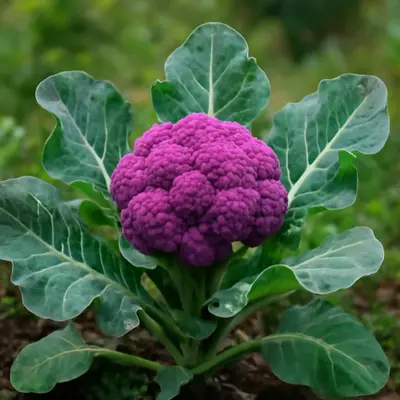
Graffiti's brilliant purple heads are a great draw at farm stands and excellent for CSAs and restaurants. The colorful florets are attractive served raw with dip or as a cooked vegetable. Graffiti produces a true cauliflower head on large plants. Best for fall harvest, but can also be sown in spring.
Harvest
80d
Days to harvest
Sun
Full sun to partial shade
Zones
6–9
USDA hardiness
Height
10-24 inches
Planting Timeline
Showing dates for Graffiti in USDA Zone 7
All Zone 7 brassica →Zone Map
Click a state to update dates
Graffiti · Zones 6–9
Growing Details
Succession Planting
Graffiti takes about 80 days from transplant, so plan backward from your expected heat cutoff. In zone 7, start seeds indoors in late February to early March, transplant in April, and aim for a June harvest before daytime highs lock in above 85°F — cauliflower heads get bitter and loose past that point. For a fall crop, start a second round indoors in late July, transplant in mid-August, and you can harvest from October into November. That fall window is often the better one; the heads come in cleaner and Graffiti's purple pigment stays more vivid in cooler temps.
There's no real benefit to staggering plantings every two weeks the way you would with lettuce or radishes — cauliflower doesn't hold well in the ground once mature, but the heads all come in within a couple weeks of each other anyway. Two distinct rounds per year (spring and fall) is the practical approach. Keep at least 3 seasons between brassica plantings in the same bed to stay ahead of clubroot pressure.
Complete Growing Guide
Graffiti's brilliant purple heads are a great draw at farm stands and excellent for CSAs and restaurants. The colorful florets are attractive served raw with dip or as a cooked vegetable. Graffiti produces a true cauliflower head on large plants. Best for fall harvest, but can also be sown in spring. According to Johnny's Selected Seeds, Graffiti is 80 days to maturity, annual, hybrid (f1).
Light: Full sun (6 or more hours of direct sunlight a day), Partial Shade (Direct sunlight only part of the day, 2-6 hours). Soil: Clay, Loam (Silt), Sand. Soil pH: Acid (<6.0), Neutral (6.0-8.0). Drainage: Good Drainage, Moist. Height: 0 ft. 10 in. - 2 ft. 0 in.. Spread: 1 ft. 0 in. - 2 ft. 0 in.. Spacing: 12 inches-3 feet. Growth rate: Medium. Maintenance: Medium. Propagation: Seed, Stem Cutting. Regions: Coastal, Mountains, Piedmont.
Harvesting
Graffiti reaches harvest at 80 days from sowing per Johnny's Selected Seeds. As an annual, harvest continues until frost ends the season.
The fruits dry and split when ripe.
Color: Brown/Copper, Green. Type: Siliqua. Length: > 3 inches.
Garden value: Edible
Harvest time: Fall, Summer
Edibility: The foliage is edible raw or cooked but when cooked can emit an unpleasant odor.
Storage & Preservation
Store freshly harvested Graffiti heads in a perforated plastic bag in the refrigerator at 32–40°F with 90–95% humidity; they'll keep for two to three weeks. Handle carefully, as the purple curds bruise easily and brown noticeably when damaged. For longer preservation, blanch florets for three minutes, chill in ice water, then freeze in airtight containers for up to ten months. Graffiti also freezes exceptionally well compared to green varieties, retaining its distinctive color and firm texture. Alternatively, roast the florets with olive oil until caramelized for excellent flavor concentration, then freeze. Pickling works well too—pack blanched florets into jars with vinegar, spices, and garlic for a crisp condiment lasting several months. The purple pigment from anthocyanins is fairly stable through most preservation methods, though some dulling occurs with extended freezing.
History & Origin
Graffiti is an F1 hybrid developed through controlled cross-pollination. Listed in the Johnny's Selected Seeds catalog.
Origin: W. Europe
Advantages
- +Striking purple heads attract customers at farm stands and markets
- +Versatile for raw consumption or cooking with excellent visual appeal
- +Large plant size produces true, substantial cauliflower heads reliably
- +Well-suited for fall harvest with manageable 80-day growing period
- +Easy difficulty level makes it accessible for beginning gardeners
Considerations
- -Requires consistent moisture and rich soil for optimal head development
- -Purple coloring may fade during cooking or extended storage
- -Spring sowings less reliable than fall plantings in most climates
- -Large plants need significant spacing, reducing planting density per bed
Companion Plants
Marigolds (Tagetes spp.) are worth planting around Graffiti cauliflower for a straightforward reason: they confuse and deter aphids and cabbage moths through scent, and a solid planting of French marigolds can help suppress soilborne pressure over time. They don't compete aggressively for root space, which matters since cauliflower wants consistent, unimpeded moisture uptake. Nasturtiums pull double duty — they attract aphids away from your brassica heads, acting as a trap crop you can pull and discard mid-season when the load gets heavy. Onions and garlic tucked along the border add another scent layer that tends to discourage cabbage worms and flea beetles, though I wouldn't call it a guarantee — you'll still need to check undersides of leaves every few days regardless.
Lettuce and spinach are genuinely useful fillers between cauliflower plants in the early weeks. They're shallow-rooted, don't compete for the same moisture depth, and you'll harvest them before the cauliflower canopy closes in and shades them out around week 6 or 7.
Tomatoes and pole beans are the ones to avoid sharing a bed with. Tomatoes share several soilborne disease vectors with brassicas and will compete hard for water and nutrients. Pole beans fix nitrogen, which sounds helpful, but excess nitrogen pushes brassicas toward leafy growth at the expense of head development — and in our zone 7 Georgia garden, where you're often racing a heat deadline in June, anything that delays curd set costs you the crop.
Plant Together
Marigolds
Repel flea beetles and aphids that commonly attack brassicas
Nasturtiums
Act as trap crops for aphids and flea beetles, drawing pests away from brassicas
Onions
Repel cabbage worms, root maggots, and aphids with their strong scent
Garlic
Deters cabbage loopers and aphids while improving soil health
Dill
Attracts beneficial wasps that parasitize cabbage worms and aphids
Lettuce
Makes efficient use of space as a low-growing companion, different root depths
Spinach
Compatible growth habits and helps maximize garden space utilization
Carrots
Different root zones reduce competition and carrots help break up soil
Keep Apart
Strawberries
Compete for similar nutrients and can stunt brassica growth
Tomatoes
Can inhibit brassica growth and both plants compete for similar soil nutrients
Pole Beans
Can shade brassicas excessively and compete for nitrogen in soil
Nutrition Facts
Per 100g serving. % Daily Value based on 2,000 calorie diet. Source: USDA FoodData Central (FDC #747447)
Pests & Disease Resistance
Common Pests
Cabbage moth, cabbage worms, flea beetles, aphids
Diseases
Clubroot, black rot, downy mildew
Troubleshooting Graffiti
What you'll see, why it happens, and what to do about it.
Leaves develop yellow, angular patches — then a white to grayish-purple fuzzy growth appears on the undersides, usually after a stretch of cool, wet nights
Likely Causes
- Downy mildew (Peronospora parasitica) — a water mold that thrives when nighttime temps drop below 60°F and humidity stays high
- Overcrowded planting blocking airflow between heads
What to Do
- 1.Remove and bag (don't compost) any heavily infected leaves immediately
- 2.Space transplants at least 18 inches apart — 24 is better in a humid Georgia fall — to keep air moving through the canopy
- 3.Avoid overhead watering in the evening; switch to drip or water early morning so foliage dries before dark
Plants wilt during the day even when soil is moist, and when you pull one up the roots are swollen into lumpy, distorted knobs
Likely Causes
- Clubroot (Plasmodiophora brassicae) — a soil-borne pathogen that persists for 20 or more years in acidic soil
- Planting brassicas in the same bed two years in a row, which lets spore loads build
What to Do
- 1.Pull and trash infected plants — don't compost them or move that soil around the garden
- 2.Raise soil pH to 7.2 or above with lime before the next brassica planting; Plasmodiophora is far less active above 7.0
- 3.Rotate out of brassicas for at least 3 seasons in that bed; a cover crop of French marigolds (Tagetes patula) in the interim can help reduce overall soilborne pressure
Frequently Asked Questions
How long does Graffiti cauliflower take to harvest?▼
Is Graffiti cauliflower good for beginners?▼
Can you grow Graffiti cauliflower in containers?▼
What does Graffiti cauliflower taste like?▼
When should I plant Graffiti cauliflower?▼
Why is Graffiti cauliflower popular at farmers markets?▼
Zone-by-Zone Planting Calendar
| Zone | Indoor Start | Transplant | Direct Sow | Harvest |
|---|---|---|---|---|
| Zone 3 | March – April | May – June | May – June | July – October |
| Zone 4 | March – April | May – June | April – June | July – October |
| Zone 5 | February – March | April – May | April – May | July – November |
| Zone 6 | February – March | April – May | April – May | June – November |
| Zone 7 | February – March | April – May | March – May | June – November |
| Zone 8 | January – February | March – April | March – April | May – December |
| Zone 9 | January – January | February – March | February – March | April – December |
| Zone 10 | January – January | February – March | January – March | April – December |
| Zone 1 | April – May | June – July | June – July | August – September |
| Zone 2 | April – May | June – July | May – July | August – September |
| Zone 11 | January – January | January – February | January – February | March – December |
| Zone 12 | January – January | January – February | January – February | March – December |
| Zone 13 | January – January | January – February | January – February | March – December |
Growing Guides from Wind River Greens
Sources & References
External authority sources used in compiling this guide.
- BreederJohnny's Selected Seeds
- USDAUSDA FoodData Central
See the Methodology page for how this data is sourced, what's AI-assisted, and known limitations.