Radish 'Daikon 'Miyashige'
Raphanus sativus var. longipinnatus 'Miyashige'
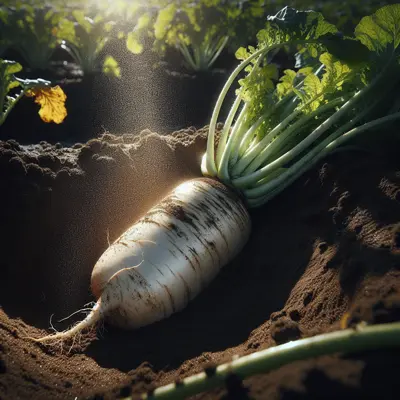
A premium Japanese daikon variety prized for its exceptionally sweet, crisp flesh and smooth white skin. These impressively large roots can reach 14-18 inches long while maintaining perfect tenderness throughout. This variety is particularly valued for its ability to stay mild and juicy even when large, making it perfect for fresh eating and traditional Asian preparations.
Harvest
60-70d
Days to harvest
Sun
Full sun to partial shade
Zones
2–11
USDA hardiness
Height
0-3 feet
Planting Timeline
Showing dates for Radish 'Daikon 'Miyashige' in USDA Zone 7
All Zone 7 brassica →Zone Map
Click a state to update dates
Radish 'Daikon 'Miyashige' · Zones 2–11
Growing Details
Succession Planting
Miyashige turns pithy, hot, and hollow once daytime temperatures consistently hit 75-80°F, so succession timing is less about extending harvest and more about fitting two windows — spring and fall. Direct sow every 14-18 days from March 1 through mid-April for a spring run, then stop; summer sowings will bolt or go woody. Pick back up with direct sowing around late August through early October for fall roots, which often have better texture because the roots size up as temperatures drop rather than climb.
Don't try to squeeze more than 2-3 successions per season — at 60-70 days to harvest, there aren't as many slots as you'd have with a 25-day Cherry Belle type. Each sowing needs a realistic frost-free runway: count back 70 days from your first hard frost to find your last safe direct-sow date, then stick to it.
Complete Growing Guide
Start by preparing deep, loose soil at least 18 inches down — compacted soil will cause forked or stunted roots that disappoint at harvest. Work in 2-3 inches of compost and ensure excellent drainage, as waterlogged soil leads to root rot. Remove every stone, clod, and debris piece you can find; even small obstacles will deform your beautiful straight roots.
Direct sow seeds only — daikon roots are notoriously sensitive to transplant shock and will bolt prematurely if disturbed. Plant seeds ½ inch deep and 2 inches apart in late summer, timing your planting so roots mature during cool fall weather. In zones 6-8, sow in mid to late August. Zones 9-10 can plant into September for winter harvest. Cool weather sweetens the roots and prevents the pithiness that develops in hot conditions.
Thin seedlings to 6 inches apart once they reach 3 inches tall — overcrowding produces spindly, weak roots. The thinned greens make excellent salad additions, so don't waste them. Side-dress with balanced fertilizer (10-10-10) three weeks after germination, focusing on phosphorus to encourage strong root development rather than excessive leaf growth.
Maintain consistent soil moisture throughout the growing period, providing about 1 inch weekly through deep, infrequent watering. Fluctuating moisture levels cause roots to crack or develop woody cores. Mulch around plants to retain moisture and suppress weeds, but keep mulch 2 inches away from stems to prevent pest issues.
Avoid high-nitrogen fertilizers after the first month, as they encourage leafy growth at the expense of root quality. The most common mistake is harvesting too early — while you can pull small roots, Miyashige's exceptional sweetness develops fully only in the final 2-3 weeks. Another frequent error is planting too early; hot weather makes roots bitter and tough.
Harvesting
Harvest Miyashige daikon 60-70 days after sowing, when roots reach 14-18 inches long and 2-3 inches in diameter at the shoulder. The best indicator is when the white root shoulder emerges 1-2 inches above soil level — this exposed portion should be bright white and feel firm when gently pressed. Avoid harvesting when soil is wet, as muddy conditions make extraction difficult and messy.
Harvest in cool morning temperatures when roots are fully hydrated and crisp. Loosen soil around each root with a spading fork, working 6 inches away from the root to avoid damage. Grasp the leaves close to the crown and pull straight up with steady pressure — properly grown Miyashige should lift cleanly without breaking. If resistance occurs, loosen more soil rather than forcing the pull. Immediately brush off excess soil but don't wash until ready to use, as wet roots deteriorate quickly in storage.
Storage & Preservation
Store freshly harvested Miyashige daikon in the refrigerator crisper drawer, wrapped loosely in perforated plastic bags to maintain humidity while allowing air circulation. Properly stored roots remain crisp and sweet for 2-3 weeks. Remove greens before storage, as they continue drawing moisture from roots.
For longer preservation, Miyashige excels in traditional fermentation — slice thin for quick kimchi or cut into chunks for slower lacto-fermentation. The variety's natural sweetness and firm texture make superior pickles using rice vinegar and mirin. Grated daikon freezes reasonably well for cooked applications, though texture softens considerably. Dehydrating thin slices creates excellent soup additions that rehydrate beautifully while retaining the variety's characteristic mild heat and sweetness.
History & Origin
Miyashige daikon represents generations of careful selection within Japan's rich radish breeding tradition, originating from the Miyagi Prefecture region of northern Honshu. This variety emerged during the mid-20th century as Japanese farmers sought to develop daikon cultivars that could maintain exceptional eating quality even when grown to impressive sizes — a significant achievement in radish breeding.
The variety name honors the Miyashige family lineage of seed savers who preserved and refined this particular strain through decades of careful selection for sweetness, texture, and storage qualities. Traditional Japanese agriculture emphasized developing regionally adapted varieties, and Miyashige was specifically selected for its ability to thrive in the cooler climate conditions of northern Japan while producing consistently mild, crisp roots.
Miyashige gained recognition among Western gardeners relatively recently, introduced through specialty seed companies focusing on authentic Japanese varieties during the growing interest in Asian vegetables in the 1990s. Its reputation for reliability and exceptional eating quality has made it a standard recommendation for gardeners seeking to grow restaurant-quality daikon at home.
Advantages
- +Exceptional sweetness that intensifies with size rather than becoming bitter like most radishes
- +Remarkably uniform, straight root development with minimal forking in proper soil conditions
- +Superior crisp texture maintained even in large 18-inch roots without developing woody cores
- +Extended harvest window — roots hold quality in ground for 2-3 weeks past maturity in cool weather
- +Excellent bolt resistance during unexpected warm spells that ruin other daikon varieties
- +Natural pest deterrent qualities reduce flea beetle damage compared to other brassicas
- +Outstanding storage life with proper handling maintains crispness for weeks
Considerations
- -Requires exceptionally deep, stone-free soil preparation or roots will fork and deform
- -Cannot be transplanted successfully — direct seeding only limits growing season flexibility
- -Long maturation period makes it unsuitable for quick succession plantings
- -Large root size requires significant garden space allocation — minimum 6-inch spacing
- -Sensitive to inconsistent watering which causes cracking and reduces storage life
Companion Plants
Carrots and daikon slot together well because they occupy different soil depths — carrots work the top 6-8 inches while Miyashige drives down 12-16 inches, so neither one is crowding the other for moisture or nutrients. Shallow-rooted greens like lettuce and spinach fill the horizontal space without competing below ground at all. Chives at the row edge put off a scent that disrupts aphid host-finding behavior, and marigolds planted nearby can reduce soil nematode pressure over a full season — though NC State Extension is clear that this is a multi-year strategy, not a quick turnaround.
Skip broccoli as a neighbor. It shares every vulnerability Miyashige carries — clubroot (Plasmodiophora brassicae), flea beetles, cabbage root maggots — so pairing two brassicas concentrates pest pressure in one spot rather than spreading it. Fennel is allelopathic and will slow germination and root development on most vegetables within a foot or two; it doesn't play well with anything in this bed.
Plant Together
Carrots
Daikon's deep taproot breaks up soil for shallow carrot roots, while carrots don't compete for space
Lettuce
Fast-growing lettuce can be harvested before daikon needs full space, maximizing garden efficiency
Spinach
Cool-season companion that can be interplanted and harvested before daikon matures
Chives
Repels aphids and flea beetles that commonly attack brassicas
Marigolds
Deters nematodes and attracts beneficial insects that prey on brassica pests
Dill
Attracts beneficial wasps that parasitize cabbage worms and other brassica pests
Nasturtiums
Acts as trap crop for flea beetles and aphids, protecting daikon from these pests
Peas
Fixes nitrogen in soil which benefits heavy-feeding daikon radishes
Keep Apart
Broccoli
Competes for same nutrients and attracts identical pests like cabbage worms and flea beetles
Fennel
Produces allelopathic compounds that inhibit growth of brassicas including radishes
Turnips
Same family crop that depletes identical soil nutrients and shares common diseases like clubroot
Nutrition Facts
Per 100g serving. % Daily Value based on 2,000 calorie diet. Source: USDA FoodData Central (FDC #169276)
Pests & Disease Resistance
Resistance
Good general disease resistance, less prone to clubroot than other brassicas
Common Pests
Flea beetles, cabbage root maggots, aphids
Diseases
Clubroot, black root, downy mildew, white rust
Troubleshooting Radish 'Daikon 'Miyashige'
What you'll see, why it happens, and what to do about it.
Roots are stunted, forked, or barely formed at harvest — pulled the root and it's a sad little nub instead of a 12-16 inch taper
Likely Causes
- Rocky or compacted soil that physically blocks root elongation
- Clubroot (Plasmodiophora brassicae) — a soil-borne pathogen that distorts brassica roots and thrives in acidic soil below pH 6.0
- Cabbage root maggots (Delia radicum) tunneling into the developing root
What to Do
- 1.Double-dig or broadfork to at least 18 inches before sowing — Miyashige roots will push that deep given the 60-70 day window
- 2.Test soil pH and lime to 6.5-7.0 if clubroot is suspected; don't replant brassicas in that bed for at least 4 years
- 3.Use row cover from day 1 to block adult cabbage root maggot flies from laying eggs at the soil line
Tiny round holes punched all over the leaves, especially on seedlings in the first 2-3 weeks
Likely Causes
- Flea beetles (Phyllotreta spp.) — worst on young seedlings and peak during warm, dry spells
- Population buildup in beds where brassica crop debris was left in place from a previous season
What to Do
- 1.Cover with row cover immediately after direct sowing — flea beetles find plants fast, so don't wait until you see damage
- 2.Spread a thick mulch layer around plants; flea beetles prefer bare, warm soil for egg-laying
- 3.Knock back heavy infestations with spinosad, applied in the evening to minimize bee contact
White to gray fuzzy sporulation on the undersides of leaves, with yellow patches on top — appearing in cool, wet weather
Likely Causes
- Downy mildew — NC State Extension describes this group of diseases as producing white, bluish, or gray sporulation on leaf undersides, spreading fast under cool, humid conditions
- Spacing tighter than 4 inches that traps moisture and cuts airflow between plants
What to Do
- 1.Pull and trash (not compost) any badly infected leaves as soon as you spot them
- 2.Thin to the 4-6 inch spacing recommendation so air moves through the row — cheap and effective
- 3.Switch to drip or morning watering; evening overhead irrigation extends the leaf-wetness period that downy mildew needs to sporulate
Frequently Asked Questions
How long does Daikon Miyashige take to grow?▼
Can you grow Daikon Miyashige in containers?▼
What does Miyashige daikon taste like?▼
When should I plant Daikon Miyashige?▼
Is Daikon Miyashige good for beginners?▼
Miyashige vs regular daikon — what's the difference?▼
Zone-by-Zone Planting Calendar
| Zone | Indoor Start | Transplant | Direct Sow | Harvest |
|---|---|---|---|---|
| Zone 1 | April – May | June – July | June – July | August – September |
| Zone 2 | April – May | June – July | May – July | July – September |
| Zone 11 | January – January | January – February | January – February | February – December |
| Zone 12 | January – January | January – February | January – February | February – December |
| Zone 13 | January – January | January – February | January – February | February – December |
| Zone 3 | March – April | May – June | May – June | July – October |
| Zone 4 | March – April | May – June | April – June | June – October |
| Zone 5 | February – March | April – May | April – May | June – November |
| Zone 6 | February – March | April – May | April – May | June – November |
| Zone 7 | February – March | April – May | March – May | May – November |
| Zone 8 | January – February | March – April | March – April | May – December |
| Zone 9 | January – January | February – March | February – March | April – December |
| Zone 10 | January – January | February – March | January – March | March – December |
Growing Guides from Wind River Greens
Sources & References
External authority sources used in compiling this guide.
See the Methodology page for how this data is sourced, what's AI-assisted, and known limitations.