Purple Vienna Kohlrabi
Brassica oleracea var. gongylodes 'Purple Vienna'
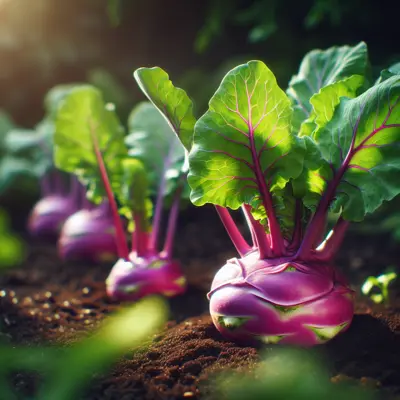
An eye-catching heirloom kohlrabi with striking purple-red skin and crisp white interior that tastes like a cross between cabbage and turnip. This unique vegetable is perfect for gardeners wanting to try something different, and it's surprisingly easy to grow with a sweet, mild flavor when harvested young.
Harvest
60-70d
Days to harvest
Sun
Full sun to partial shade
Zones
6–9
USDA hardiness
Height
10-24 inches
Planting Timeline
Showing dates for Purple Vienna Kohlrabi in USDA Zone 7
All Zone 7 brassica →Zone Map
Click a state to update dates
Purple Vienna Kohlrabi · Zones 6–9
Growing Details
Succession Planting
Direct sow every 14-21 days starting March 1 through early May in zone 7, then stop — kohlrabi turns pithy and sharp-tasting when daytime highs hold consistently above 80°F. Restart around August 1 for a fall run; the 60-70 day window puts harvest in October and November, and bulbs that size up after the first light frost tend to be noticeably milder than spring ones. Staggering the sowings by two weeks keeps any single harvest from burying you.
Complete Growing Guide
Purple Vienna Kohlrabi thrives in cool-season conditions, so time plantings for spring and fall harvests, avoiding peak summer heat which accelerates bolting and toughens the bulbs. This cultivar prefers consistently moist, well-draining soil rich in organic matter, with full sun and temperatures between 50–70°F for optimal tenderness and color development. Unlike some kohlrabi varieties, Purple Vienna is notably compact and won't stretch excessively even in slightly crowded conditions, making it ideal for small spaces. Watch for typical brassica pests like cabbage worms and flea beetles, which are particularly attracted to young transplants; row covers applied immediately after planting provide effective protection without chemical intervention. The key to maximizing this variety's sweet flavor is harvesting when bulbs reach 2–3 inches in diameter, as larger specimens become woody and lose their delicate taste. Direct seed or transplant seedlings 6 inches apart, and thin ruthlessly to prevent competition that stresses plants.
Light: Full sun (6 or more hours of direct sunlight a day), Partial Shade (Direct sunlight only part of the day, 2-6 hours). Soil: Clay, Loam (Silt), Sand. Soil pH: Acid (<6.0), Neutral (6.0-8.0). Drainage: Good Drainage, Moist. Height: 0 ft. 10 in. - 2 ft. 0 in.. Spread: 1 ft. 0 in. - 2 ft. 0 in.. Spacing: 12 inches-3 feet. Growth rate: Medium. Maintenance: Medium. Propagation: Seed, Stem Cutting. Regions: Coastal, Mountains, Piedmont.
Harvesting
Harvest Purple Vienna kohlrabi when the bulbs reach 2-3 inches in diameter, at which point their purple-red skin darkens to a rich, deep hue and the flesh feels firm and dense to the touch. At this young stage, the flavor remains sweetest and most tender, though bulbs can grow larger if preferred. Unlike single-harvest crops, kohlrabi produces continuously throughout the growing season, allowing you to pick mature bulbs while leaving smaller ones to develop further. A critical timing tip: harvest in the early morning when soil moisture is highest, as this ensures maximum crispness and helps the plant recover quickly for subsequent harvests from the same root system.
The fruits dry and split when ripe.
Color: Brown/Copper, Green. Type: Siliqua. Length: > 3 inches.
Garden value: Edible
Harvest time: Fall, Summer
Edibility: The foliage is edible raw or cooked but when cooked can emit an unpleasant odor.
Storage & Preservation
Fresh Purple Vienna kohlrabi stores best in the refrigerator for 2-3 weeks when properly handled. Remove all leaves except the smallest center ones, then wrap bulbs in perforated plastic bags or store in the crisper drawer. Don't wash before storing – clean just before use to prevent moisture-related decay.
For longer storage, kohlrabi keeps well in a cool basement or root cellar at 32-40°F with high humidity for up to 2 months. Layer bulbs in damp sand or peat moss, ensuring they don't touch each other.
To freeze, peel and cut into ½-inch cubes, blanch for 2 minutes in boiling water, then cool immediately in ice water before packaging. Frozen kohlrabi maintains quality for 8-12 months and works well in soups and stews. Purple Vienna also makes excellent fermented vegetables – slice thin and ferment like sauerkraut for a colorful, crunchy addition to winter meals.
History & Origin
The Purple Vienna kohlrabi belongs to the Vienna kohlrabi family, a classic European heirloom lineage that emerged during the 19th century when kohlrabi breeding intensified across Central Europe, particularly in Vienna and surrounding regions. While specific documentation of when the purple variety was selected from the original Vienna stock remains thin, the purple-skinned types became established as distinct cultivars by the early 20th century, likely through ongoing selection by European seed companies and gardeners seeking visual diversity alongside the reliable performance of Vienna genetics. The variety represents a natural color mutation within the kohlrabi breeding tradition, perpetuated through traditional seed-saving practices across generations of heirloom gardeners and commercial seed houses that recognized its ornamental appeal and culinary merit.
Origin: W. Europe
Advantages
- +Striking purple-red skin adds unique visual appeal to garden and kitchen.
- +Fast-maturing variety produces harvestable bulbs in just 60-70 days.
- +Crisp, sweet mild flavor tastes excellent raw or lightly cooked.
- +Easy to grow makes this heirloom accessible to beginner gardeners.
- +White interior provides appealing contrast when sliced or displayed.
Considerations
- -Vulnerable to multiple pests including flea beetles, cabbage worms, and aphids.
- -Susceptible to clubroot disease which persists in contaminated soil indefinitely.
- -Must harvest young to achieve best texture; older bulbs become woody.
- -Requires consistent moisture and well-draining soil to prevent disease issues.
Companion Plants
Onions and garlic are worth planting close by — their sulfur compounds disrupt the scent cues that aphids and imported cabbageworm moths (Pieris rapae) use to locate brassicas. Lettuce and spinach make practical row-fillers between plants spaced 6-8 inches apart: both are shallow-rooted and gone before kohlrabi needs the space, and their canopy suppresses weeds during the slow first 3 weeks after germination. A border of nasturtiums will draw aphid colonies away from the bulbs — check those plants first on your morning walk. Tomatoes don't belong in the same bed; they're heavy nitrogen consumers that go in after the soil warms past 60°F, which is exactly when kohlrabi is finishing up, and the overlapping transition creates more scheduling headaches than it's worth.
Plant Together
Onions
Repel cabbage worms, aphids, and flea beetles that commonly attack brassicas
Garlic
Deters cabbage loopers and aphids while improving soil health
Dill
Attracts beneficial wasps that parasitize cabbage worms and aphids
Lettuce
Acts as living mulch, conserving soil moisture and maximizing garden space
Spinach
Complements root depth and nutrient uptake without competing directly
Nasturtiums
Trap crop for aphids and flea beetles, draws pests away from kohlrabi
Marigolds
Repel nematodes and general garden pests while attracting beneficial insects
Celery
Repels cabbage white butterflies and other brassica pests
Keep Apart
Tomatoes
Compete for similar nutrients and may stunt kohlrabi growth
Pole Beans
Can shade kohlrabi and compete for nitrogen in soil
Strawberries
May inhibit brassica growth and attract slugs that damage young kohlrabi
Nutrition Facts
Per 100g serving. % Daily Value based on 2,000 calorie diet. Source: USDA FoodData Central (FDC #168424)
Pests & Disease Resistance
Resistance
Generally disease resistant, good bolt tolerance
Common Pests
Flea beetles, cabbage worms, aphids
Diseases
Clubroot, black rot, downy mildew
Troubleshooting Purple Vienna Kohlrabi
What you'll see, why it happens, and what to do about it.
Small, irregular holes punched through leaves on young transplants or seedlings, often appearing within the first 2-3 weeks after transplant
Likely Causes
- Flea beetles (Phyllotreta spp.) — tiny, fast-jumping beetles that feed heavily on stressed or newly transplanted brassicas
- Dry soil stress, which makes plants slower to outgrow the damage
What to Do
- 1.Cover transplants immediately with row cover (Agribon AG-19 or similar) and seal the edges — flea beetles are fast and will find any gap
- 2.Keep soil consistently moist at 1 inch per week; plants that size up quickly shrug off light flea beetle pressure
- 3.If pressure is heavy, spinosad-based spray (Entrust SC is the OMRI-listed option) applied in the evening can knock populations back
Plants wilting and yellowing despite adequate water, with roots showing rough, warty galls when you pull them at day 30-40
Likely Causes
- Clubroot (Plasmodiophora brassicae) — a soilborne pathogen that persists in soil for 20+ years and thrives in acidic conditions below pH 6.0
- Poor drainage that keeps the root zone saturated and speeds pathogen spread
What to Do
- 1.Pull and bag affected plants immediately — do not compost them; the resting spores survive decomposition
- 2.Lime the bed to raise soil pH to at least 7.0-7.2, which significantly suppresses clubroot activity according to NC State Extension guidance
- 3.Rotate out of all brassicas — cabbage, broccoli, kale, kohlrabi — for a minimum of 4 years in that bed
Frequently Asked Questions
How long does Purple Vienna kohlrabi take to grow?▼
Can you grow Purple Vienna kohlrabi in containers?▼
What does Purple Vienna kohlrabi taste like?▼
Is Purple Vienna kohlrabi good for beginners?▼
When should I plant Purple Vienna kohlrabi?▼
Purple Vienna vs white kohlrabi – what's the difference?▼
Zone-by-Zone Planting Calendar
| Zone | Indoor Start | Transplant | Direct Sow | Harvest |
|---|---|---|---|---|
| Zone 3 | March – April | May – June | May – June | July – October |
| Zone 4 | March – April | May – June | April – June | June – October |
| Zone 5 | February – March | April – May | April – May | June – November |
| Zone 6 | February – March | April – May | April – May | June – November |
| Zone 7 | February – March | April – May | March – May | May – November |
| Zone 8 | January – February | March – April | March – April | May – December |
| Zone 9 | January – January | February – March | February – March | April – December |
| Zone 10 | January – January | February – March | January – March | March – December |
| Zone 1 | April – May | June – July | June – July | August – September |
| Zone 2 | April – May | June – July | May – July | July – September |
| Zone 11 | January – January | January – February | January – February | February – December |
| Zone 12 | January – January | January – February | January – February | February – December |
| Zone 13 | January – January | January – February | January – February | February – December |
Growing Guides from Wind River Greens
Sources & References
External authority sources used in compiling this guide.
See the Methodology page for how this data is sourced, what's AI-assisted, and known limitations.