Green Goliath Broccoli
Brassica oleracea var. italica 'Green Goliath'
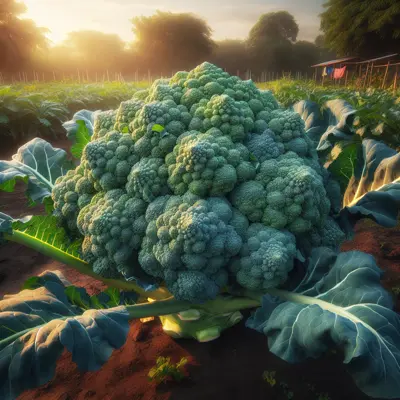
A hybrid powerhouse that produces massive 6-8 inch heads on sturdy plants that tower over other broccoli varieties. Green Goliath lives up to its name with exceptional heat tolerance and the ability to produce substantial side shoots after the main head is harvested, extending your harvest season significantly.
Harvest
55-65d
Days to harvest
Sun
Full sun to partial shade
Zones
6–9
USDA hardiness
Height
10-24 inches
Planting Timeline
Showing dates for Green Goliath Broccoli in USDA Zone 7
All Zone 7 brassica →Zone Map
Click a state to update dates
Green Goliath Broccoli · Zones 6–9
Growing Details
Succession Planting
In zone 7, start Green Goliath indoors in late February and transplant out in April once nighttime lows are reliably above 28°F. For a fall run — which is honestly the better crop around here in the Southeast, since the heads develop in cooling weather rather than warming — start seeds indoors in early to mid-July and move transplants to the garden in August, targeting harvest before hard frost in November. At 55–65 days to maturity, two clean successions per year are achievable if you don't let the July start date slip.
Green Goliath keeps throwing side shoots after the main head is cut, so there's no need for a third mid-season sowing — harvest the central head promptly and let the plant run on its own. Stop spring succession plantings by late May; anything transplanted after that will produce poor, loose heads as daytime highs push past 75–80°F.
Complete Growing Guide
This heat-tolerant hybrid thrives in full sun with consistent soil moisture and benefits from succession planting every two weeks to maximize its exceptional side-shoot production. Unlike typical broccoli varieties that peter out after the main harvest, Green Goliath's vigor means you'll enjoy extended yields if you cut the central head when it reaches 6-8 inches but before it begins flowering—timing this correctly prevents premature bolting in warm climates. Plant in spring or early summer, targeting harvest during cooler periods since heat can trigger earlier flowering despite the variety's tolerance. Watch for cabbage worms and loopers on the large heads; row covers during seedling stages reduce pest pressure significantly. The cultivar's height (10-24 inches) means plants may stretch in insufficient light, so ensure at least six hours of direct sun daily and avoid crowding. A practical strategy: pinch out the central growing tip when seedlings reach 4-5 inches to encourage bushier plants that produce more lateral shoots, effectively multiplying your harvest from each plant.
Light: Full sun (6 or more hours of direct sunlight a day), Partial Shade (Direct sunlight only part of the day, 2-6 hours). Soil: Clay, Loam (Silt), Sand. Soil pH: Acid (<6.0), Neutral (6.0-8.0). Drainage: Good Drainage, Moist. Height: 0 ft. 10 in. - 2 ft. 0 in.. Spread: 1 ft. 0 in. - 2 ft. 0 in.. Spacing: 12 inches-3 feet. Growth rate: Medium. Maintenance: Medium. Propagation: Seed, Stem Cutting. Regions: Coastal, Mountains, Piedmont.
Harvesting
Harvest Green Goliath heads when they reach 6-8 inches in diameter with tightly clustered, deep green florets that feel firm to the touch and show no signs of yellowing or flowering. Cut the main head at its base using a sharp knife when the buds are still compact, typically around 55-65 days from transplanting. Unlike single-harvest varieties, Green Goliath excels at producing abundant secondary shoots after the main harvest, allowing multiple pickings throughout the season if you leave at least 8-10 inches of stem intact. For extended productivity, harvest side shoots when they reach 3-4 inches to encourage continued branching, and time your main head harvest in early morning when temperatures are cool to maximize tenderness and shelf life.
The fruits dry and split when ripe.
Color: Brown/Copper, Green. Type: Siliqua. Length: > 3 inches.
Garden value: Edible
Harvest time: Fall, Summer
Edibility: The foliage is edible raw or cooked but when cooked can emit an unpleasant odor.
Storage & Preservation
Fresh Green Goliath heads store best unwashed in perforated plastic bags in your refrigerator's crisper drawer, maintaining quality for 7-10 days at 32-35°F with high humidity. The large, dense heads hold their texture better than many varieties, making them excellent for meal planning.
For freezing, blanch florets in boiling water for 3-4 minutes (slightly longer than standard broccoli due to the denser texture), then plunge into ice water before draining and freezing in portions. Green Goliath's substantial structure makes it particularly suitable for roasted vegetable medleys after thawing. The variety also excels in fermented preparations – try lacto-fermenting florets with garlic and spices for a probiotic-rich condiment that maintains much of the original crunch. Dehydrating works well too, though slice thick stems thinly for even drying.
History & Origin
Green Goliath Broccoli emerged from commercial hybrid breeding programs in the mid-twentieth century, though specific breeder attribution and exact origin year remain poorly documented in accessible sources. The variety represents the lineage of heat-tolerant broccoli developments that accelerated during the 1960s-1970s, when seed companies intensified selection for larger heads and improved side-shoot production. Its parentage likely draws from Italian broccoli germplasm crossed with heat-tolerant breeding lines, a common strategy in developing varieties suited to warm-season cultivation. The "Goliath" designation reflects the naming conventions popular among seed catalogs emphasizing size and vigor, though the variety's precise institutional origin—whether a major seed house like Burpee, Harris, or a regional breeder—remains unclear in standard horticultural records.
Origin: W. Europe
Advantages
- +Produces massive 6-8 inch heads that yield substantial harvests per plant
- +Exceptional heat tolerance allows successful growing in warm climates
- +Abundant side shoots extend harvest season well beyond initial head cutting
- +Sweet, mild, tender flavor appeals to most palates without bitterness
- +Fast maturity in 55-65 days provides relatively quick returns
Considerations
- -Susceptible to multiple serious diseases including black rot and clubroot
- -Attracts multiple pest species requiring consistent monitoring and management
- -Tall plant structure may require staking in windy growing conditions
- -Clubroot soil contamination can persist for years, limiting future crop rotation
Companion Plants
Nasturtiums act as a trap crop for aphids — colonies pile onto the nasturtium and mostly leave the broccoli heads alone, which means you're redirecting the pest rather than just watching it. French marigolds (Tagetes patula) produce root exudates that suppress soil nematode populations, a bigger deal than most people realize once you've had a nematode problem in a Georgia clay bed. Dill draws in parasitic wasps that prey on cabbage loopers and imported cabbageworm; let it bolt and flower and those wasps will do real work for you. Onions and garlic tucked nearby produce enough sulfur-compound odor to confuse aphids and cabbage moths trying to locate the crop by scent. Lettuce and spinach fill the 6–8 inch understory without competing for the same root depth as broccoli — useful spacing, not filler.
Tomatoes are the one to keep separated. They're heavy feeders that draw down calcium and nitrogen in ways that put brassicas under stress, and they share susceptibility to several soilborne pathogens that persist in the bed across seasons. Pole beans are allelopathic toward brassicas in close quarters — broccoli planted within 12 inches shows measurable stunting — so put them on the opposite end of the garden regardless of how tempting the nitrogen-fixing argument sounds.
Plant Together
Nasturtiums
Acts as trap crop for aphids and flea beetles, repels cabbage worms
Marigolds
Repels cabbage moths, whiteflies, and nematodes with strong scent
Onions
Repels cabbage worms, aphids, and flea beetles with sulfur compounds
Garlic
Deters cabbage loopers and aphids, may reduce fungal diseases
Dill
Attracts beneficial wasps that parasitize cabbage worms
Lettuce
Utilizes space efficiently as ground cover, doesn't compete for nutrients
Spinach
Shallow roots don't compete, matures quickly before broccoli needs full space
Carrots
Deep taproot breaks up soil, doesn't compete with shallow broccoli roots
Keep Apart
Tomatoes
Competes for similar nutrients and may stunt broccoli growth
Strawberries
May inhibit broccoli growth and both are susceptible to similar fungal diseases
Pole Beans
Can shade broccoli and compete for nitrogen despite being nitrogen-fixing
Nutrition Facts
Per 100g serving. % Daily Value based on 2,000 calorie diet. Source: USDA FoodData Central (FDC #747447)
Pests & Disease Resistance
Resistance
Good resistance to clubroot and downy mildew
Common Pests
Cabbage worms, aphids, flea beetles, cabbage loopers
Diseases
Black rot, clubroot, downy mildew, white rust
Troubleshooting Green Goliath Broccoli
What you'll see, why it happens, and what to do about it.
V-shaped yellow lesions on older leaves, starting at leaf margins, with dark brown veins visible when you cut the stem near the base
Likely Causes
- Black rot (Xanthomonas campestris pv. campestris) — bacterial disease that enters through leaf margins and spreads through the vascular system
- Infected transplants or seed brought in from outside
What to Do
- 1.Pull and bag infected plants immediately — don't compost them
- 2.Avoid overhead irrigation; switch to drip or soaker hose to keep foliage dry
- 3.Rotate this bed out of all brassicas (broccoli, cabbage, kale, turnips) for at least 2 full seasons
Gray-purple fuzzy growth on the undersides of leaves, with yellow patches showing on the upper surface
Likely Causes
- Downy mildew (Peronospora parasitica) — thrives in cool, wet conditions between 50–65°F, exactly what you get in early spring and fall
- Poor airflow from crowded spacing or weedy beds
What to Do
- 1.Space transplants at least 18 inches apart so air can move between plants
- 2.Strip affected leaves and dispose of them in the trash
- 3.Apply a copper-based fungicide early if you catch sporulation just starting — it won't reverse damage already done, but it slows spread
Small, irregular holes punched through leaves on young transplants within the first 2 weeks after setting out
Likely Causes
- Flea beetles (Phyllotreta spp.) — worst on transplants under stress and nearly invisible unless you look closely in early morning
- Cabbage loopers (Trichoplusia ni) or imported cabbageworm (Pieris rapae) if the holes are larger and ragged with frass present
What to Do
- 1.Cover transplants immediately with row cover (Reemay or similar) and seal the edges — floating row cover is the single most reliable fix for both flea beetle and cabbageworm pressure
- 2.For loopers and worms already on the plant, apply Bacillus thuringiensis (Bt) according to label; it's effective on caterpillar larvae and won't harm beneficials
- 3.Check under leaves daily — imported cabbageworm eggs are small pale ovals laid singly; crush them before they hatch
Frequently Asked Questions
How long does Green Goliath broccoli take to grow?▼
Can you grow Green Goliath broccoli in containers?▼
Is Green Goliath broccoli good for beginners?▼
What does Green Goliath broccoli taste like?▼
When should I plant Green Goliath broccoli for fall harvest?▼
How do you harvest Green Goliath side shoots?▼
Zone-by-Zone Planting Calendar
| Zone | Indoor Start | Transplant | Direct Sow | Harvest |
|---|---|---|---|---|
| Zone 1 | April – May | June – July | June – July | August – September |
| Zone 2 | April – May | June – July | May – July | July – September |
| Zone 11 | January – January | January – February | January – February | February – December |
| Zone 12 | January – January | January – February | January – February | February – December |
| Zone 13 | January – January | January – February | January – February | February – December |
| Zone 3 | March – April | May – June | May – June | July – October |
| Zone 4 | March – April | May – June | April – June | June – October |
| Zone 5 | February – March | April – May | April – May | June – November |
| Zone 6 | February – March | April – May | April – May | June – November |
| Zone 7 | February – March | April – May | March – May | May – November |
| Zone 8 | January – February | March – April | March – April | May – December |
| Zone 9 | January – January | February – March | February – March | April – December |
| Zone 10 | January – January | February – March | January – March | March – December |
Growing Guides from Wind River Greens
Sources & References
External authority sources used in compiling this guide.
See the Methodology page for how this data is sourced, what's AI-assisted, and known limitations.