Golden Acre Cabbage
Brassica oleracea var. capitata 'Golden Acre'
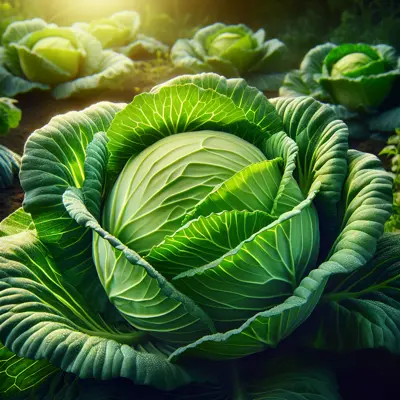
A compact, early-maturing cabbage that's perfect for small gardens and beginning gardeners seeking reliable results. This variety produces perfectly round, solid heads with sweet, crisp leaves and has the advantage of maturing quickly without taking up excessive garden space. An excellent choice for succession planting and container growing.
Harvest
65-75d
Days to harvest
Sun
Full sun to partial shade
Zones
6–9
USDA hardiness
Height
10-24 inches
Planting Timeline
Showing dates for Golden Acre Cabbage in USDA Zone 7
All Zone 7 brassica →Zone Map
Click a state to update dates
Golden Acre Cabbage · Zones 6–9
Growing Details
Succession Planting
Golden Acre runs 65–75 days, which gives you two clear windows in zone 7: a spring planting transplanted in April and harvested by late June, and a fall planting started indoors in late July and set out in late August for an October–November pull. For the spring run, sow indoors every 14 days from late February through mid-March if you want a staggered harvest — two or three rounds will keep heads from splitting on you all at once. Stop spring successions once daytime highs are consistently above 80°F; cabbage won't form tight heads in that heat and the flavor turns sharp.
The fall succession is often the more reliable one. Transplant into a bed that's had a light compost side-dress, and plan to finish harvest before a sustained hard freeze below 28°F. A brief dip to 26°F will actually sweeten the heads — cold converts starches to sugars — so don't rush the fall pull the moment frost hits the forecast.
Complete Growing Guide
Golden Acre's early maturity means you should time plantings for cool-season conditions, as this compact variety is prone to bolting if exposed to prolonged heat above 75°F, making spring and fall your ideal windows rather than summer succession planting. Unlike larger cabbage varieties, Golden Acre's small, dense heads are less susceptible to splitting but more vulnerable to flea beetles and cabbage loopers due to their tender, sweet leaves—monitor closely during establishment. This cultivar performs exceptionally well in containers and raised beds where soil warmth can be controlled, though it still demands consistent moisture and rich, well-draining soil with adequate nitrogen for tight head formation. A practical tip: thin seedlings to 12-15 inches apart rather than the typical 18 inches for larger varieties, since Golden Acre's compact growth habit allows closer spacing without sacrificing head quality or air circulation, maximizing yields in small spaces.
Light: Full sun (6 or more hours of direct sunlight a day), Partial Shade (Direct sunlight only part of the day, 2-6 hours). Soil: Clay, Loam (Silt), Sand. Soil pH: Acid (<6.0), Neutral (6.0-8.0). Drainage: Good Drainage, Moist. Height: 0 ft. 10 in. - 2 ft. 0 in.. Spread: 1 ft. 0 in. - 2 ft. 0 in.. Spacing: 12 inches-3 feet. Growth rate: Medium. Maintenance: Medium. Propagation: Seed, Stem Cutting. Regions: Coastal, Mountains, Piedmont.
Harvesting
Golden Acre cabbage heads are ready for harvest when they feel firm and dense to the touch, typically reaching 4-6 inches in diameter with a pale yellow-green color characteristic of this variety. Visual confirmation includes tight, compact heads with no visible gaps between leaves, and the entire plant should feel heavy for its size. This cultivar supports both single harvesting of mature heads and continuous cutting of outer leaves from younger plants, allowing extended productivity from fewer plants. For optimal timing, harvest in the morning after dew dries but before afternoon heat, as this ensures maximum crispness and sweetness in the leaves while the plant's moisture content remains highest.
The fruits dry and split when ripe.
Color: Brown/Copper, Green. Type: Siliqua. Length: > 3 inches.
Garden value: Edible
Harvest time: Fall, Summer
Edibility: The foliage is edible raw or cooked but when cooked can emit an unpleasant odor.
Storage & Preservation
Fresh Golden Acre cabbages store exceptionally well when harvested with outer wrapper leaves intact. Remove damaged outer leaves but keep 2-3 clean ones for protection. Store in your refrigerator's crisper drawer at 32-40°F with high humidity—they'll maintain quality for 3-4 months, longer than most early varieties.
For longer preservation, Golden Acre's tender leaves excel in sauerkraut and kimchi fermentation. The sweet, mild flavor develops beautifully during fermentation. Blanch and freeze quartered heads for 8-10 months of storage, though texture becomes softer. Dehydrate thinly sliced leaves for soup mixes and seasoning blends. The compact heads also work perfectly for small-batch pickled cabbage, maintaining their crisp texture better than larger varieties when processed in pint jars.
History & Origin
Golden Acre Cabbage emerged in the early 20th century as a compact cabbage variety bred to meet the needs of home gardeners and market growers with limited space. While specific breeder attribution remains unclear in accessible records, the variety is believed to have been developed through selective breeding programs focused on early maturity and head uniformity, characteristics that made it commercially valuable. The name "Golden Acre" likely references its ability to produce marketable heads from a minimal plot of land, making efficient use of garden space. By mid-century, the variety had become widely distributed among seed companies across North America, establishing itself as a reliable standard for small-scale cultivation that remains popular today.
Origin: W. Europe
Advantages
- +Matures in just 65-75 days, ideal for quick harvests and succession planting
- +Compact heads perfect for small gardens and container growing
- +Sweet, crisp flavor and tender leaves appeal to most palates
- +Easy difficulty level makes it excellent for beginner gardeners
- +Perfectly round, solid heads provide reliable, consistent results
Considerations
- -Susceptible to multiple pests including cabbage worms and flea beetles
- -Vulnerable to clubroot and fusarium yellows in poor soil conditions
- -Smaller head size limits total yield per plant compared to larger varieties
- -Requires consistent moisture and cool temperatures for optimal quality
Companion Plants
Onions and garlic planted at 6-inch intervals around the perimeter genuinely confuse aphids and cabbage moths — the sulfur compounds mask the brassica scent enough to reduce egg-laying. Nasturtiums pull double duty: they draw aphids away from the heads and bring in predatory wasps that hit cabbageworm populations hard. Dill is worth tucking at the row ends for the same parasitic wasp reason, but let it bolt — flowering umbels are what actually recruit beneficial insects. Keep tomatoes and strawberries out; in our zone 7 Georgia garden both compete aggressively for moisture during the April–May overlap window, and tomatoes release root exudates that stunt young brassica seedlings.
Plant Together
Dill
Attracts beneficial insects like parasitic wasps that control cabbage worms
Onions
Repels cabbage moths, aphids, and other brassica pests with strong sulfur compounds
Marigolds
Deters cabbage worms, aphids, and nematodes while attracting beneficial predatory insects
Nasturtiums
Acts as trap crop for aphids and flea beetles, drawing pests away from cabbage
Celery
Repels cabbage white butterflies and improves growth through complementary root systems
Thyme
Deters cabbage worms and flea beetles while attracting beneficial pollinators
Spinach
Provides living mulch and utilizes different soil nutrients without competing
Garlic
Natural fungicide properties help prevent clubroot and black rot diseases
Keep Apart
Tomatoes
Compete for similar nutrients and may stunt cabbage growth through root competition
Strawberries
Cabbage can inhibit strawberry growth and both attract similar soil-borne diseases
Pole Beans
Tall growth creates excessive shade and competes for nitrogen that cabbage needs
Rue
Allelopathic compounds inhibit brassica growth and development
Nutrition Facts
Per 100g serving. % Daily Value based on 2,000 calorie diet. Source: USDA FoodData Central (FDC #169975)
Pests & Disease Resistance
Resistance
Good splitting resistance, moderate disease tolerance
Common Pests
Cabbage worms, aphids, flea beetles, root maggots
Diseases
Clubroot, black rot, downy mildew, fusarium yellows
Troubleshooting Golden Acre Cabbage
What you'll see, why it happens, and what to do about it.
Leaves showing yellow V-shaped lesions starting at the leaf margins, with dark veins underneath — often appearing around day 30-50 after transplant
Likely Causes
- Black rot (Xanthomonas campestris pv. campestris) — a bacterial disease that enters through leaf margins and spreads through the vascular tissue
- Overhead watering or heavy rain splashing contaminated soil onto lower leaves
What to Do
- 1.Pull and bag affected leaves or whole plants if the infection is advanced — don't compost them
- 2.Switch to drip irrigation or water at the base; wet foliage speeds transmission fast
- 3.Rotate this bed out of all brassicas (cabbage, kale, broccoli, turnips) for at least 2 full seasons
Ragged holes in leaves — sometimes down to the midrib — with small pale green caterpillars visible on the undersides, usually from mid-spring onward
Likely Causes
- Imported cabbageworm (Pieris rapae) — the larva of that small white butterfly you see hovering around the bed
- Cabbage looper (Trichoplusia ni) — slightly larger, moves with that characteristic looping motion
What to Do
- 1.Spray Bacillus thuringiensis var. kurstaki (Bt-k) directly on the leaves, hitting the undersides — reapply after rain
- 2.Cover transplants with row cover immediately after setting out; Golden Acre doesn't need insect pollination, so you can leave it on the whole season
- 3.Hand-pick egg clusters (pale yellow, bullet-shaped, on leaf undersides) when you have time — it makes a real dent in the population
Frequently Asked Questions
How long does Golden Acre cabbage take to grow from seed?▼
Can you grow Golden Acre cabbage in containers?▼
Is Golden Acre cabbage good for beginners?▼
What does Golden Acre cabbage taste like?▼
When should I plant Golden Acre cabbage for fall harvest?▼
How big do Golden Acre cabbage heads get?▼
Zone-by-Zone Planting Calendar
| Zone | Indoor Start | Transplant | Direct Sow | Harvest |
|---|---|---|---|---|
| Zone 3 | March – April | May – June | May – June | July – October |
| Zone 4 | March – April | May – June | April – June | July – October |
| Zone 5 | February – March | April – May | April – May | June – November |
| Zone 6 | February – March | April – May | April – May | June – November |
| Zone 7 | February – March | April – May | March – May | May – November |
| Zone 8 | January – February | March – April | March – April | May – December |
| Zone 9 | January – January | February – March | February – March | April – December |
| Zone 10 | January – January | February – March | January – March | March – December |
| Zone 1 | April – May | June – July | June – July | August – September |
| Zone 2 | April – May | June – July | May – July | July – September |
| Zone 11 | January – January | January – February | January – February | February – December |
| Zone 12 | January – January | January – February | January – February | February – December |
| Zone 13 | January – January | January – February | January – February | February – December |
Growing Guides from Wind River Greens
Sources & References
External authority sources used in compiling this guide.
See the Methodology page for how this data is sourced, what's AI-assisted, and known limitations.