Copenhagen Market Cabbage
Brassica oleracea var. capitata 'Copenhagen Market'
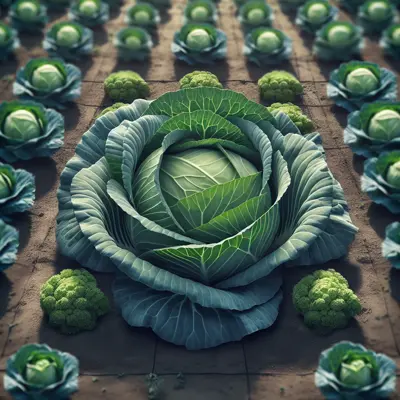
A classic early-maturing cabbage that's been a gardener favorite since 1909, prized for its reliability and compact growth habit. This Danish heirloom produces perfectly round, solid heads with crisp, sweet leaves that are ideal for fresh eating or quick cooking. Its ability to mature quickly while maintaining excellent quality makes it perfect for successive plantings.
Harvest
65-75d
Days to harvest
Sun
Full sun to partial shade
Zones
6–9
USDA hardiness
Height
10-24 inches
Planting Timeline
Showing dates for Copenhagen Market Cabbage in USDA Zone 7
All Zone 7 brassica →Zone Map
Click a state to update dates
Copenhagen Market Cabbage · Zones 6–9
Growing Details
Succession Planting
In zone 7, start Copenhagen Market indoors in late February through early March, then transplant out in April once nighttime lows stay reliably above 28°F. For a fall crop, count back 75 days from your first expected frost — typically mid-October to early November in central Georgia — and start a second round of transplants in late July to early August; direct-seeded fall crops can go in the ground around the same time. Don't push a third succession. Copenhagen Market needs sustained cool temperatures to form tight heads, and anything transplanted after mid-August in zone 7 is racing the heat on one side and the frost on the other with very little room to spare.
Complete Growing Guide
Copenhagen Market's 65-75 day window demands precise timing: start seeds indoors 4-6 weeks before your target harvest, as this cultivar won't tolerate late planting and will bolt prematurely in sustained summer heat. Plant transplants in cool-season windows—spring or late summer—and provide consistent moisture and rich soil amended with nitrogen, as this variety performs poorly under stress. Unlike slower-maturing cabbages, Copenhagen Market's compact heads are prone to splitting when rainfall arrives after dry periods, so water evenly and mulch to regulate soil moisture. Cabbage moths present the main pest pressure; use floating row covers immediately after planting and monitor for diamondback moth damage on inner leaves. A practical strategy: succession plant every 2-3 weeks in spring and again 10-12 weeks before your first fall frost to capture multiple harvests while avoiding the heat-induced bolting that weakens this otherwise reliable variety.
Light: Full sun (6 or more hours of direct sunlight a day), Partial Shade (Direct sunlight only part of the day, 2-6 hours). Soil: Clay, Loam (Silt), Sand. Soil pH: Acid (<6.0), Neutral (6.0-8.0). Drainage: Good Drainage, Moist. Height: 0 ft. 10 in. - 2 ft. 0 in.. Spread: 1 ft. 0 in. - 2 ft. 0 in.. Spacing: 12 inches-3 feet. Growth rate: Medium. Maintenance: Medium. Propagation: Seed, Stem Cutting. Regions: Coastal, Mountains, Piedmont.
Harvesting
Harvest Copenhagen Market Cabbage when heads reach 4-6 inches in diameter and feel firm and dense to gentle pressure, displaying their characteristic blue-green color with no soft spots. The heads are ready when the outer leaves begin to pale slightly, indicating peak maturity around 65-75 days from transplanting. For a continuous supply, harvest outer leaves selectively while leaving the central head to develop further, or cut entire heads at soil level for a single harvest followed by regrowth of smaller secondary heads. Time your harvest in early morning when heads are crisp and full of moisture, as afternoon heat can diminish their crispness and shelf life.
The fruits dry and split when ripe.
Color: Brown/Copper, Green. Type: Siliqua. Length: > 3 inches.
Garden value: Edible
Harvest time: Fall, Summer
Edibility: The foliage is edible raw or cooked but when cooked can emit an unpleasant odor.
Storage & Preservation
Fresh Copenhagen Market cabbage stores exceptionally well when properly handled. Remove any damaged outer leaves and store unwashed heads in perforated plastic bags in the refrigerator crisper drawer at 32-40°F with high humidity. Properly stored heads maintain quality for 3-4 weeks.
For longer storage, wrap individual heads in newspaper and store in a cool, humid basement or root cellar at 32-35°F – they'll keep for 2-3 months under these conditions.
Copenhagen Market's tender leaves excel at fermentation – make sauerkraut by shredding heads and fermenting with salt at room temperature. The variety's sweet flavor produces excellent results. For freezing, blanch shredded cabbage for 90 seconds, then ice bath before freezing in portions. Avoid canning whole leaves as they become mushy, but the variety works well in mixed vegetable relishes and pickled preparations.
History & Origin
Copenhagen Market Cabbage emerged from Danish horticultural traditions in the early twentieth century, introduced commercially around 1909 as part of the broader wave of European cabbage refinement during that era. While the specific breeder remains undocumented in readily available sources, the variety reflects the Danish breeding expertise that made Denmark a global leader in vegetable seed production. The variety likely descended from earlier European heading cabbage lines, developing through sustained selection for early maturity, compact plant structure, and uniform head formation—traits highly valued by both commercial growers and home gardeners. Its enduring popularity suggests successful adaptation across diverse growing regions, cementing its status as a reliable heirloom that has maintained genetic integrity through over a century of cultivation.
Origin: W. Europe
Advantages
- +Classic heirloom variety with over 100 years of proven garden success
- +Matures in just 65-75 days, enabling multiple successive plantings per season
- +Produces perfectly round, compact heads ideal for small garden spaces
- +Crisp, sweet flavor excellent for fresh eating and quick cooking
- +Reliable performer with solid heads and consistent quality across conditions
Considerations
- -Highly susceptible to clubroot, black rot, and fusarium yellows diseases
- -Vulnerable to multiple cabbage pests including worms, root maggots, and flea beetles
- -Requires consistent soil moisture and well-draining, fertile soil conditions
Companion Plants
Onions planted nearby disrupt the host-finding of cabbage moths — their scent interferes with Pieris rapae females looking for a landing spot. Nasturtiums act as a sacrificial crop: aphids pile onto them first, pulling pressure away from your Copenhagen Market heads, and the dense low growth physically breaks up the rows enough to slow pest movement between plants. Dill draws in parasitic wasps (Cotesia glomerata among them) that parasitize cabbageworm larvae before they can do serious damage. NC State Extension's IPM guidance credits that kind of plant diversity with slowing disease spread too — in our zone 7 Georgia gardens, where black rot and downy mildew can move through a wet April fast, that matters. Tomatoes are the companion to skip: they want drier soil, compete hard for calcium, and a shared bed tends to amplify disease pressure on both crops.
Plant Together
Dill
Attracts beneficial wasps that parasitize cabbage worms and aphids
Onions
Repel cabbage maggots, aphids, and flea beetles with their strong sulfur compounds
Nasturtiums
Act as trap crop for aphids and flea beetles, drawing pests away from cabbage
Thyme
Repels cabbage worms and flea beetles while attracting beneficial predatory insects
Marigolds
Deter cabbage moths and other flying pests with their strong scent
Carrots
Break up soil for shallow cabbage roots and don't compete for nutrients
Celery
Repels cabbage white butterflies and helps deter cabbage worms
Lettuce
Provides ground cover and efficient space use without competing for nutrients
Keep Apart
Tomatoes
Compete for similar nutrients and may stunt cabbage growth through root competition
Strawberries
Both are heavy feeders that compete for nutrients, leading to poor growth in both crops
Pole Beans
Can shade cabbage and compete for space, while nitrogen fixing may cause excess leafy growth
Nutrition Facts
Per 100g serving. % Daily Value based on 2,000 calorie diet. Source: USDA FoodData Central (FDC #169975)
Pests & Disease Resistance
Resistance
Good resistance to splitting and bolting. Moderate disease resistance typical of heirlooms.
Common Pests
Cabbage worms, cutworms, aphids, flea beetles, cabbage root maggots
Diseases
Clubroot, black rot, fusarium yellows, downy mildew
Troubleshooting Copenhagen Market Cabbage
What you'll see, why it happens, and what to do about it.
Ragged holes chewed in outer leaves, with greenish frass (droppings) visible on the leaf surface
Likely Causes
- Imported cabbageworm (Pieris rapae) — larvae of the white butterfly you see hovering around the bed
- Cabbage looper (Trichoplusia ni) — look for the characteristic inchworm-style movement
What to Do
- 1.Spray Bt (Bacillus thuringiensis var. kurstaki) every 5-7 days while larvae are small — it stops working once they're full-grown
- 2.Check the undersides of leaves for pale yellow eggs and crush them before they hatch
- 3.Cover transplants with row cover immediately after planting; remove only to weed or harvest
V-shaped yellow-to-brown lesions spreading inward from leaf margins, sometimes with blackened veins visible when you slice the head open
Likely Causes
- Black rot (Xanthomonas campestris pv. campestris) — a bacterium that enters through leaf margins and water pores
- Infected transplants or contaminated seed are the most common entry points
What to Do
- 1.Pull and bag affected plants immediately — NC State Extension flags black rot as high-destructive-potential, and it moves fast in wet weather
- 2.Trash all brassica debris from an infected bed, don't compost it
- 3.Rotate out of brassicas (cabbage, broccoli, collards, mustard) for at least 3 years in that spot, per NC State Extension's vegetable IPM recommendations
Stunted, wilting plants that don't recover after watering; roots are swollen and club-shaped when you pull the plant
Likely Causes
- Clubroot (Plasmodiophora brassicae) — a soil-borne pathogen that thrives in acidic soils below pH 6.0
- Infected transplants, or moving contaminated soil between beds on boots or tools
What to Do
- 1.Test soil pH and lime up to 6.5-6.8 — clubroot is substantially suppressed above pH 6.5
- 2.Remove infected plants roots and all, and put them in the trash, not the compost
- 3.Keep that bed out of any brassica family crop for a minimum of 3 years; spores can persist for up to 20 years
Heads split open after a dry stretch followed by heavy rain or a deep irrigation
Likely Causes
- Uneven moisture — rapid cell expansion after water stress causes the head to burst
- Heads left in the ground past maturity; Copenhagen Market is ready at 65-75 days and doesn't hold long once it firms up
What to Do
- 1.Keep soil moisture steady at 1-1.5 inches per week through head formation — a 2-inch straw mulch buffers the swings considerably
- 2.Harvest once heads feel dense and solid, usually around 6-8 inches across; waiting for a larger head is how you end up with a split one
- 3.If rain is coming after a dry period, twist each head a quarter-turn to sever some feeder roots and slow uptake temporarily
Frequently Asked Questions
How long does Copenhagen Market cabbage take to grow from seed?▼
Can you grow Copenhagen Market cabbage in containers?▼
Is Copenhagen Market cabbage good for beginners?▼
What does Copenhagen Market cabbage taste like?▼
When should I plant Copenhagen Market cabbage for fall harvest?▼
Copenhagen Market vs Golden Acre cabbage - what's the difference?▼
Zone-by-Zone Planting Calendar
| Zone | Indoor Start | Transplant | Direct Sow | Harvest |
|---|---|---|---|---|
| Zone 1 | April – May | June – July | June – July | August – September |
| Zone 2 | April – May | June – July | May – July | July – September |
| Zone 11 | January – January | January – February | January – February | February – December |
| Zone 12 | January – January | January – February | January – February | February – December |
| Zone 13 | January – January | January – February | January – February | February – December |
| Zone 3 | March – April | May – June | May – June | July – October |
| Zone 4 | March – April | May – June | April – June | July – October |
| Zone 5 | February – March | April – May | April – May | June – November |
| Zone 6 | February – March | April – May | April – May | June – November |
| Zone 7 | February – March | April – May | March – May | May – November |
| Zone 8 | January – February | March – April | March – April | May – December |
| Zone 9 | January – January | February – March | February – March | April – December |
| Zone 10 | January – January | February – March | January – March | March – December |
Growing Guides from Wind River Greens
Sources & References
External authority sources used in compiling this guide.
See the Methodology page for how this data is sourced, what's AI-assisted, and known limitations.