Champion Collards
Brassica oleracea var. viridis 'Champion'
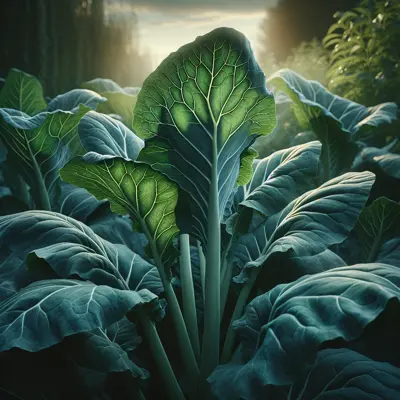
A heat and cold tolerant hybrid collard that produces large, smooth, blue-green leaves perfect for traditional Southern cooking. This variety is exceptionally slow to bolt and continues producing tender leaves through both summer heat and winter cold, making it ideal for year-round harvests in mild climates.
Harvest
60-75d
Days to harvest
Sun
Full sun to partial shade
Zones
6–9
USDA hardiness
Height
10-24 inches
Planting Timeline
Showing dates for Champion Collards in USDA Zone 7
All Zone 7 brassica →Zone Map
Click a state to update dates
Champion Collards · Zones 6–9
Growing Details
Succession Planting
Champion Collards produce continuously once established, so you don't need to stagger plantings the way you would with lettuce or radishes — but timing your main successions around heat and frost gives you a much longer harvest window. Start transplants indoors in February to March and get them in the ground by April to May for a spring crop. For fall, the UGA Vegetable Garden Calendar recommends starting brassica transplants in a half-shaded area in August for setting out in September, which lines up well with collards' preference for cool weather and their solid frost tolerance.
Stop direct-sowing once daytime highs are consistently above 85°F — germination stalls and young seedlings struggle to establish. The fall planting is often the better one; a few light frosts sweeten the flavor noticeably. In zone 7, harvest runs well into November, and Champion's heat tolerance means spring plants stay productive longer than open-pollinated collard varieties before the heat shuts them down.
Complete Growing Guide
Champion Collards distinguishes itself through exceptional bolt resistance, allowing you to extend harvests well beyond typical spring and fall windows—plant in late summer for winter production or early spring for continuous summer yields without premature flowering. This hybrid thrives in full sun with consistently moist, nitrogen-rich soil, though its cold tolerance means it actually sweetens after frost, making late-season harvests superior to early ones. Unlike more delicate brassicas, Champion rarely suffers from cabbage loopers or flea beetles at problematic levels, but monitor for harlequin bugs in warm months by inspecting leaf undersides regularly. The smooth leaves resist the toughness that plagues some collard varieties, so avoid over-fertilizing with nitrogen, which encourages excessive vegetative growth and delays tenderness. Harvest outer leaves individually rather than cutting the entire plant to maintain continuous production throughout your growing season.
Light: Full sun (6 or more hours of direct sunlight a day), Partial Shade (Direct sunlight only part of the day, 2-6 hours). Soil: Clay, Loam (Silt), Sand. Soil pH: Acid (<6.0), Neutral (6.0-8.0). Drainage: Good Drainage, Moist. Height: 0 ft. 10 in. - 2 ft. 0 in.. Spread: 1 ft. 0 in. - 2 ft. 0 in.. Spacing: 12 inches-3 feet. Growth rate: Medium. Maintenance: Medium. Propagation: Seed, Stem Cutting. Regions: Coastal, Mountains, Piedmont.
Harvesting
Harvest Champion Collards when their blue-green leaves reach 8 to 10 inches long and feel tender yet sturdy to the touch, signaling peak nutritional content and mild flavor. The leaves should display a slight waxy coating characteristic of this cultivar and maintain a vibrant color without yellowing or browning. For continuous production throughout the season, employ a cut-and-come-again method by removing outer leaves from the base while allowing the central growing point to remain undisturbed, encouraging new leaf development. Alternatively, harvest the entire plant when it reaches full maturity at 60 to 75 days. A key timing advantage: pick leaves in early morning after dew dries but before intense heat sets in, ensuring maximum crispness and optimal flavor for traditional Southern preparations.
The fruits dry and split when ripe.
Color: Brown/Copper, Green. Type: Siliqua. Length: > 3 inches.
Garden value: Edible
Harvest time: Fall, Summer
Edibility: The foliage is edible raw or cooked but when cooked can emit an unpleasant odor.
Storage & Preservation
Fresh Champion collard leaves store best in the refrigerator wrapped in damp paper towels inside plastic bags, maintaining quality for 5-7 days. Don't wash leaves until ready to use, as excess moisture accelerates decay.
For longer storage, blanch whole leaves in boiling water for 2-3 minutes, then shock in ice water before freezing in airtight containers. Frozen collards maintain nutritional value for 10-12 months and work perfectly for cooked dishes. Remove thick stems before freezing to save space and improve texture.
Dehydrating works well for collard chips—remove stems, massage leaves with oil and salt, then dehydrate at 115°F for 6-8 hours. Properly dried collard chips stay crisp for several months in airtight containers. Lacto-fermentation creates tangy preserved collards that last 3-4 months refrigerated and adds beneficial probiotics.
History & Origin
Champion Collards emerged from modern hybrid breeding programs focused on extending the traditional Southern collard's growing season across temperature extremes. While specific breeder attribution and introduction year remain undocumented in readily available sources, this variety represents the continuation of collard improvement work undertaken by major seed companies during the late twentieth century. The development builds upon the agricultural heritage of collard cultivation in the American South, where these hardy brassicas have been staple crops for centuries, combined with contemporary hybrid vigor techniques that enhance heat and cold tolerance while maintaining the mild flavor profile valued in traditional cooking applications.
Origin: W. Europe
Advantages
- +Exceptional heat and cold tolerance enables year-round harvesting in mild climates.
- +Large, smooth blue-green leaves are ideal for traditional Southern cooking applications.
- +Remarkably slow to bolt, producing tender leaves consistently through summer heat.
- +Mild, sweet flavor profile contains less bitterness than most other collards.
- +Fast maturity at 60-75 days provides relatively quick harvests for gardeners.
Considerations
- -Vulnerable to multiple pests including cabbage worms, aphids, flea beetles, harlequin bugs.
- -Susceptible to serious diseases like black rot, clubroot, and downy mildew.
- -Requires consistent moisture and well-draining soil to prevent clubroot development.
- -Large leaf size may require more space between plants than compact varieties.
Companion Plants
Nasturtiums and marigolds are worth planting close to Champion Collards for a practical reason: both act as trap crops for aphids, pulling infestations away from the collard leaves before they get established. French marigolds have a documented suppressive effect on soil nematode populations — NC State Extension recommends dedicating entire beds to them after heavy nematode pressure. Dill draws in parasitic wasps that target cabbage worm larvae (Pieris rapae), which will skeletonize a collard leaf in a few days if left unchecked. Onions and garlic work by disrupting the host-finding behavior of several brassica pests through sulfur compounds, and they stay shallow-rooted enough that they're not competing for the same soil depth.
Tomatoes are the main one to keep separated. Both are feeding heavily in the same pH range (6.0–7.5), and in close quarters they'll fight for calcium and magnesium at the same time of season. Pole beans fix nitrogen, which sounds like a gift, but the resulting flush of soft, lush growth on nearby collards tends to attract more aphid pressure than the plants would otherwise see.
Plant Together
Nasturtiums
Trap crop for aphids and flea beetles, repels cucumber beetles
Marigolds
Repel cabbage worms, aphids, and other brassica pests
Dill
Attracts beneficial insects like parasitic wasps that control cabbage worms
Onions
Repel cabbage maggots, aphids, and other soil-dwelling pests
Garlic
Natural fungicide properties, repels aphids and cabbage loopers
Carrots
Improve soil structure, attract beneficial insects, compatible root depths
Lettuce
Efficient space usage as ground cover, similar nutrient requirements
Thyme
Repels cabbage worms and flea beetles through aromatic compounds
Keep Apart
Tomatoes
Compete for nutrients and may stunt collard growth through root competition
Strawberries
Both are heavy feeders competing for similar nutrients, especially nitrogen
Pole Beans
May shade collards excessively and compete for growing space
Nutrition Facts
Per 100g serving. % Daily Value based on 2,000 calorie diet. Source: USDA FoodData Central (FDC #170406)
Pests & Disease Resistance
Resistance
Good heat and cold tolerance, slow to bolt
Common Pests
Cabbage worms, aphids, flea beetles, harlequin bugs
Diseases
Black rot, clubroot, downy mildew
Troubleshooting Champion Collards
What you'll see, why it happens, and what to do about it.
Leaves develop yellow V-shaped lesions starting at the margins, with brown, water-soaked tissue along the veins — visible around day 30–45 after transplant
Likely Causes
- Black rot (Xanthomonas campestris pv. campestris) — a bacterial disease that enters through leaf margins and spreads down the vascular tissue
- Infected transplants or seed carrying the pathogen in
What to Do
- 1.Pull and trash any heavily infected leaves — don't compost them
- 2.Stop overhead watering; switch to drip or ground-level irrigation to keep foliage dry
- 3.Rotate this bed out of all brassicas (broccoli, cabbage, kale, collards) for at least 2 seasons
Small, irregular holes scattered across young leaves, worst on seedlings and new transplants
Likely Causes
- Flea beetles (Phyllotreta spp.) — tiny, fast-jumping beetles that feed heavily on brassica seedlings, especially in warm, dry spells
- Plants stressed by drought or poor establishment are hit harder
What to Do
- 1.Cover transplants immediately with row cover (Reemay or similar) and keep edges sealed until plants reach 8–10 inches tall and can handle the feeding pressure
- 2.Interplant with nasturtiums or thyme — both can draw flea beetles away from the collards
- 3.Hold soil moisture at 1 inch per week; flea beetles hit drought-stressed brassicas harder than well-watered ones
Frequently Asked Questions
How long does Champion collards take to grow?▼
Can you grow Champion collards in containers?▼
What does Champion collards taste like?▼
When should I plant Champion collards?▼
Is Champion collards good for beginners?▼
Champion collards vs Georgia collards - what's the difference?▼
Zone-by-Zone Planting Calendar
| Zone | Indoor Start | Transplant | Direct Sow | Harvest |
|---|---|---|---|---|
| Zone 1 | April – May | June – July | June – July | August – September |
| Zone 2 | April – May | June – July | May – July | July – September |
| Zone 11 | January – January | January – February | January – February | February – December |
| Zone 12 | January – January | January – February | January – February | February – December |
| Zone 13 | January – January | January – February | January – February | February – December |
| Zone 3 | March – April | May – June | May – June | July – October |
| Zone 4 | March – April | May – June | April – June | July – October |
| Zone 5 | February – March | April – May | April – May | June – November |
| Zone 6 | February – March | April – May | April – May | June – November |
| Zone 7 | February – March | April – May | March – May | May – November |
| Zone 8 | January – February | March – April | March – April | May – December |
| Zone 9 | January – January | February – March | February – March | April – December |
| Zone 10 | January – January | February – March | January – March | March – December |
Growing Guides from Wind River Greens
Sources & References
External authority sources used in compiling this guide.
See the Methodology page for how this data is sourced, what's AI-assisted, and known limitations.