Blueray Blueberry
Vaccinium corymbosum 'Blueray'
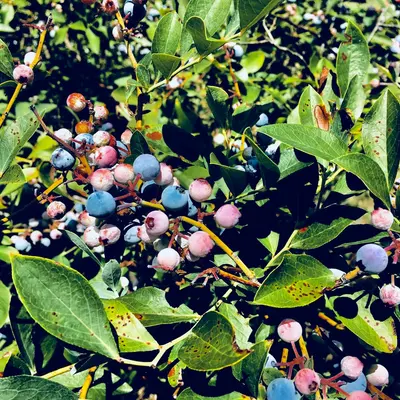
A premier northern highbush blueberry developed by the USDA, prized for its exceptionally large, firm berries and outstanding flavor. This vigorous grower produces heavy crops of light blue berries with excellent storage quality, making it a favorite for both fresh eating and preserving. The attractive spring flowers and brilliant fall foliage add ornamental value to any landscape.
Harvest
60-70d
Days to harvest
Sun
Full sun to partial shade
Zones
3–8
USDA hardiness
Height
6-12 feet
Planting Timeline
Showing dates for Blueray Blueberry in USDA Zone 7
All Zone 7 berry →Zone Map
Click a state to update dates
Blueray Blueberry · Zones 3–8
Growing Details
Complete Growing Guide
Blueray demands cross-pollination with a compatible highbush variety—plant at least two different cultivars nearby for optimal berry set, as self-fertility is limited. This vigorous cultivar thrives in acidic soil (pH 4.5–5.5) with consistent moisture during fruit development, particularly critical during its 60–70 day ripening window when irregular watering causes cracking. Plant in full sun to maximize the heavy crops this variety is known for; partial shade reduces yields significantly. Blueray shows strong resistance to most common blueberry diseases but remains susceptible to mummy berry fungus in humid climates—remove fallen fruit and infected berries promptly to prevent spore spread. Prune aggressively in early spring to maintain productive wood and prevent the leggy growth this vigorous grower tends toward; don't hesitate to remove older canes entirely to encourage dense branching and larger berries.
Light: Full sun (6 or more hours of direct sunlight a day), Partial Shade (Direct sunlight only part of the day, 2-6 hours). Soil: Clay, Loam (Silt), Sand. Soil pH: Acid (<6.0). Drainage: Good Drainage, Moist, Occasionally Dry. Height: 6 ft. 0 in. - 12 ft. 0 in.. Spread: 6 ft. 0 in. - 10 ft. 0 in.. Spacing: 6-feet-12 feet. Growth rate: Medium. Maintenance: Medium. Propagation: Seed, Stem Cutting. Regions: Mountains, Piedmont.
Harvesting
Blueray berries reach peak harvest readiness when they display a deep, uniform light blue color with a subtle silvery bloom, achieve their characteristic large size of approximately three-quarters inch diameter, and feel slightly soft yet firm to gentle pressure. Unlike single-harvest varieties, Blueray produces berries over an extended period, typically spanning three to four weeks, requiring multiple picking sessions every three to four days during peak season. For optimal flavor and storage quality, harvest only fully ripe berries in the early morning after dew has dried but before afternoon heat, as berries picked at this time maintain superior firmness and complex sweetness. Unripe berries should remain on the plant, as they will not continue ripening once picked.
Blue to purple small round fruits that show up in August, ripening from a green to pink color to full ripeness. Females cannot produce fruit on their own. Fruit is edible.
Color: Blue, Green, Pink, Purple/Lavender. Type: Berry. Length: < 1 inch. Width: < 1 inch.
Garden value: Edible
Harvest time: Summer
Edibility: The berries are edible and have been used raw, sun-dried. smoke-dried, and baked. They have high iron content.
Storage & Preservation
Fresh Blueray berries store exceptionally well due to their firm texture and natural waxy bloom. Don't wash until ready to use—the natural bloom protects against moisture loss. Store unwashed berries in the refrigerator in their original container or a breathable container, where they'll maintain quality for 10-14 days.
For freezing, spread unwashed berries on baking sheets and freeze solid before transferring to containers. This prevents clumping and maintains individual berry integrity. Frozen Blueray berries retain their shape better than most varieties, making them excellent for baking applications.
Blueray's large size and firm flesh make it ideal for dehydrating. Use a food dehydrator at 135°F for 12-18 hours until leathery but still slightly pliable. The variety's natural sweetness concentrates beautifully when dried, creating premium dried blueberries for trail mixes and cereals.
History & Origin
Blueray was developed by the USDA Agricultural Research Service in the 1950s as part of a comprehensive northern highbush blueberry breeding program aimed at producing cold-hardy cultivars with superior fruit quality. The variety emerged from crosses within the highbush breeding lines, inheriting vigor and large berry size from its parentage. Released commercially in the 1960s, Blueray quickly gained adoption among commercial growers and home gardeners in cooler climates across North America. While detailed documentation of its specific parent varieties remains limited in readily accessible sources, the cultivar represents a significant contribution to cold-climate blueberry cultivation and remains widely grown today.
Origin: Eastern North America
Advantages
- +Exceptionally large, firm berries with excellent fresh eating and storage quality
- +Sweet-tart flavor with rich, complex taste profile preferred by blueberry enthusiasts
- +Vigorous grower producing heavy crops reliably in northern climates
- +Attractive spring flowers and brilliant fall foliage provide year-round ornamental value
- +USDA-developed premier variety proven superior to many competitor cultivars
Considerations
- -Vulnerable to mummy berry and anthracnose fungal diseases in humid conditions
- -Requires well-drained soil or develops root rot in poor drainage situations
- -Heavy bird predation necessitates netting or other protective measures during ripening
- -Moderate growing difficulty and pest management skill required for optimal production
Companion Plants
The best companions for Blueray are plants that share its unusual soil chemistry rather than fight it. Azaleas, rhododendrons, and heather all thrive in the same 4.5–5.5 pH range, so sulfur applications and pine bark mulch benefit the whole planting at once instead of creating a tug-of-war between neighbors. Pine trees pull double duty: their needles drop year-round and gradually acidify the soil surface, and their lateral roots spread wide but stay shallow enough that they don't crowd blueberry roots in the top 12 inches. Ferns work well at ground level — they suppress weeds without nudging pH upward the way clover or annual ryegrass tends to do.
Strawberries are a practical low-layer pairing. They fruit six to eight weeks ahead of Blueray, fill the space under the canopy, and their runners are easy enough to redirect. Cranberries make sense for the same reason: both are Ericaceae family members that want the same acidic conditions, so maintaining the bed favors both at once.
Black walnut is the one to keep well away — not 10 feet, not 20, but at least 50 feet. The juglone it releases through root exudate and decomposing leaf litter is toxic to Vaccinium species specifically; you'll see dieback and stalled growth within a season of exposure. In our zone 7 Georgia gardens where red clay already fights you on drainage and pH, brassicas and tomatoes make poor neighbors for a different reason entirely: they perform best at 6.0–7.0, so any amendment you make to keep them happy directly undercuts the acid environment Blueray depends on. Don't put them in the same bed.
Plant Together
Azalea
Shares similar acidic soil requirements and shallow root system
Rhododendron
Thrives in same acidic conditions and provides complementary root depth
Pine Trees
Acidifies soil naturally and provides wind protection
Strawberries
Similar soil pH needs and acts as living mulch ground cover
Cranberries
Compatible acidic soil requirements and similar growing conditions
Ferns
Tolerates acidic soil and provides natural mulch when fronds decompose
Heather
Thrives in acidic conditions and attracts beneficial pollinators
Oak Trees
Leaf litter naturally acidifies soil and provides organic matter
Keep Apart
Black Walnut
Produces juglone toxin that inhibits blueberry growth and development
Tomatoes
Requires alkaline soil conditions that conflict with blueberry's acid needs
Brassicas
Prefer neutral to alkaline soil pH, competing for incompatible soil conditions
Nutrition Facts
Per 100g serving. % Daily Value based on 2,000 calorie diet. Source: USDA FoodData Central (FDC #2346411)
Pests & Disease Resistance
Resistance
Good resistance to stem canker and mummy berry
Common Pests
Birds, aphids, scale insects, blueberry maggot
Diseases
Mummy berry, anthracnose, root rot in poorly drained soils
Troubleshooting Blueray Blueberry
What you'll see, why it happens, and what to do about it.
Berries shriveling and turning brown before they ripen, with a small cup-shaped fungal structure visible at the base
Likely Causes
- Mummy berry (Monilinia vaccinii-corymbosi) — a fungal disease that overwinters in infected fruit on the ground and shoots spores up in early spring
- Wet spring weather during bloom, which spreads spores to open flowers
What to Do
- 1.Rake up and dispose of all mummified berries on the ground in late winter — don't compost them
- 2.Apply a 3-4 inch layer of fresh wood chip mulch over the soil before bud break to block spore dispersal
- 3.If the problem has been bad two years running, apply a copper-based fungicide at bud swell, following label rates
Leaves yellowing between the veins while the veins themselves stay green, most visible on young leaves
Likely Causes
- Iron chlorosis caused by soil pH above 5.5 — at higher pH, iron becomes chemically unavailable even if it's present in the soil
- Planting in unamended red Georgia clay, which tends to run alkaline and drain poorly
What to Do
- 1.Test your soil pH — a $15 kit from the extension office is accurate enough — and if it's above 5.5, work elemental sulfur into the top 6 inches at 1-2 lbs per 10 square feet
- 2.Water in a diluted chelated iron solution as a short-term fix while the sulfur acidifies the soil over the next several months
- 3.Stop using wood ash or lime anywhere near the blueberry bed — both raise pH fast
Fruit disappearing or damaged overnight, with scattered stems and no other visible insect damage
Likely Causes
- Birds — cedar waxwings, American robins, and mockingbirds will strip a Blueray bush in two days flat once fruit colors up
- Blueberry maggot (Rhagoletis mendax) — larvae tunnel inside fruit, which then drops early; you may see small entry punctures if you look closely
What to Do
- 1.Drape bird netting over the bush by July 1 in zone 7, before the first berries turn blue — once they find the bush, it's too late to negotiate
- 2.For blueberry maggot, hang yellow sticky traps baited with ammonium acetate by mid-June to monitor adults; if you catch more than a few per week, apply spinosad per label instructions
- 3.Pick ripe fruit every 2-3 days — don't let it sit on the bush, which draws both birds and egg-laying flies
Frequently Asked Questions
How long does Blueray blueberry take to produce fruit?▼
Can you grow Blueray blueberry in containers?▼
What does Blueray blueberry taste like?▼
When should I plant Blueray blueberry bushes?▼
Does Blueray blueberry need a pollinator?▼
Is Blueray blueberry good for beginners?▼
Zone-by-Zone Planting Calendar
Growing Guides from Wind River Greens
Sources & References
External authority sources used in compiling this guide.
See the Methodology page for how this data is sourced, what's AI-assisted, and known limitations.