Yellow Sweet Spanish Onion
Allium cepa 'Yellow Sweet Spanish'
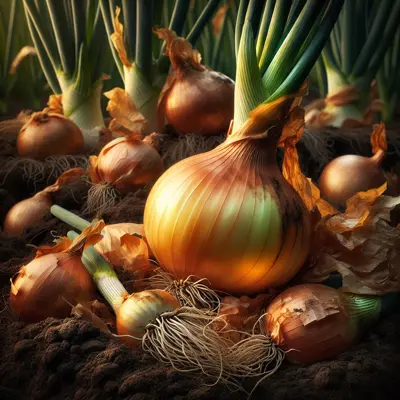
A classic long-day onion variety beloved for producing enormous, mild-flavored bulbs that can reach softball size or larger. These golden-skinned beauties are incredibly versatile in the kitchen, sweet enough to eat raw yet substantial enough for cooking. Perfect for northern gardeners who want to grow impressive onions that store well through winter.
Harvest
110-120d
Days to harvest
Sun
Full sun
Zones
5–10
USDA hardiness
Height
12-18 inches
Planting Timeline
Showing dates for Yellow Sweet Spanish Onion in USDA Zone 7
All Zone 7 allium →Zone Map
Click a state to update dates
Yellow Sweet Spanish Onion · Zones 5–10
Growing Details
Succession Planting
Yellow Sweet Spanish is a 110–120 day onion, and bulb size is tied to day length — plants need to hit a certain leaf count before the lengthening days of early summer trigger bulbing. That biology puts a hard ceiling on how late you can start them. In zone 7, direct sow the first round in early March and a second round in early April, 3–4 weeks apart. Don't push past early May — plants started too late simply won't have enough leaf mass built up when the daylength trigger hits, and you'll pull a lot of golf balls instead of the big sweet onions this variety is capable of.
Complete Growing Guide
Yellow Sweet Spanish onions demand full sun and consistent moisture throughout their 110-120 day growing season, requiring earlier spring planting than short-day varieties to develop their signature massive bulbs before day length triggers maturity. These long-day cultivars need 14+ hours of daylight to bulb properly, making them ideal for northern regions above 35°N latitude. While generally disease-resistant, they're prone to bolting in response to temperature stress or inconsistent watering, so maintain steady soil moisture and avoid transplant shock. Their large size makes them susceptible to neck rot during storage if left in wet conditions, so cure bulbs thoroughly in warm, airy spaces before storing. A practical tip: thin seedlings to 4-6 inches apart early—crowding prevents the enormous bulb development these varieties are bred for, drastically reducing your potential harvest size.
Light: Full sun (6 or more hours of direct sunlight a day). Soil: High Organic Matter, Loam (Silt), Sand. Soil pH: Alkaline (>8.0), Neutral (6.0-8.0). Drainage: Good Drainage, Moist. Height: 1 ft. 0 in. - 1 ft. 6 in.. Spread: 0 ft. 6 in. - 1 ft. 0 in.. Spacing: Less than 12 inches, 12 inches-3 feet. Maintenance: Medium. Regions: Coastal, Mountains, Piedmont.
Harvesting
Harvest Yellow Sweet Spanish onions when their golden skins feel papery and dry to the touch, the foliage yellows and begins to fall over naturally, and bulbs have reached at least 3-4 inches in diameter. Unlike continuously harvested green onions, this variety demands a single-harvest approach at maturity to maximize storage potential and allow proper curing. The critical timing tip: wait until at least 50-75 percent of the tops have collapsed and dried, typically around late August or September in northern climates, rather than harvesting at first signs of readiness—premature harvest compromises the protective skin layer essential for winter storage. Gently loosen soil with a fork before pulling, then cure the bulbs in a warm, well-ventilated location for 2-3 weeks before final storage.
Flowers wither and convert to bulblets
Type: Capsule.
Harvest time: Summer
Edibility: The bulb and tops are edible raw or cooked. However, the plant also has poisonous characteristics as noted in the "Poisonous to Humans" section of this record. Toxicity can depend on the age of the person or animal, the age of the plant, the part of the plant ingested, how much is ingested, whether the person or animal has sensitivities or allergies, whether it's eaten raw or cooked, and so forth. Consult with a medical professional for further details.
Storage & Preservation
Cure harvested onions in a warm (80-85°F), well-ventilated area for 2-3 weeks until outer skins rustle and necks are completely dry and tight. Properly cured Yellow Sweet Spanish onions store 6-8 months in cool (32-40°F), dry conditions with good air circulation.
Store only perfect bulbs with tight necks in mesh bags, braided strings, or shallow boxes—never in plastic bags which trap moisture. Check monthly and remove any showing soft spots immediately to prevent spread.
For preservation, these mild onions excel when sliced and frozen in freezer bags (no blanching required), maintaining flavor for 8-10 months. They're also excellent for dehydrating into onion powder or flakes using a food dehydrator at 115°F for 12-18 hours. Their sweet nature makes them perfect for making pickled onions or onion jam for long-term storage.
History & Origin
The Yellow Sweet Spanish Onion emerged from Spanish onion breeding traditions that emphasized mild flavor and large bulb size, traits highly valued in Mediterranean cuisine and markets. While specific breeder attribution and introduction dates remain poorly documented in readily accessible sources, this variety represents the long-day onion lineage developed primarily for northern climates where extended summer daylight supports robust bulb development. The "Spanish" designation reflects the variety's heritage connection to Spanish onion-breeding practices rather than necessarily pinpointing exact geographic origin. Documentation suggests this cultivar was commercially established and refined throughout the twentieth century by seed companies serving North American gardeners, though comprehensive breeding records are sparse. Its reputation as a reliable, cold-hardy storage onion has ensured its continued cultivation and availability.
Origin: Central Asia and central Persia
Advantages
- +Produces enormous, softball-sized bulbs that impress home gardeners
- +Sweet, mild flavor perfect for eating raw or cooking
- +Excellent long-term storage capability through winter months
- +Easy to grow variety suitable for beginning gardeners
- +Golden skin and impressive size make beautiful harvest displays
Considerations
- -Requires 110-120 days, limiting growing seasons in short-summer regions
- -Vulnerable to multiple diseases including downy mildew and white rot
- -Susceptible to onion thrips and maggots requiring pest management
- -Needs long-day photoperiod, won't bulb properly in southern locations
Companion Plants
Carrots pair well because they occupy a shallower root zone than bulbing onions, so there's no real competition underground — and their volatile compounds are thought to confuse Delia antiqua (onion maggot fly) the same way onion scent disrupts carrot fly. Tomatoes, peppers, and brassicas like cabbage and broccoli coexist without friction; the onion's sulfur compounds may reduce aphid pressure on those neighbors. Beans and peas are the ones to keep at least 3 feet away — allium root exudates suppress the Rhizobium bacteria legumes depend on for nitrogen fixation, and you'll get noticeably stunted pods for the trouble. Asparagus has the same sensitivity and is a perennial, so a bad planting decision there costs you more than one season.
Plant Together
Carrots
Onions repel carrot fly while carrots help break up soil for onion bulb development
Tomatoes
Onions deter aphids, whiteflies, and hornworms that commonly attack tomatoes
Cabbage
Onions repel cabbage worms, cabbage loopers, and flea beetles
Lettuce
Onions provide pest protection while lettuce doesn't compete for space with shallow roots
Peppers
Onions deter aphids and spider mites that target pepper plants
Broccoli
Onions repel cabbage family pests including cabbage maggots and aphids
Spinach
Onions protect spinach from leaf miners and aphids while maximizing garden space
Strawberries
Onions deter slugs, aphids, and nematodes that damage strawberry plants
Keep Apart
Beans
Onions inhibit nitrogen fixation in bean roots and can stunt bean growth
Peas
Onions interfere with nitrogen fixation and root nodule development in pea plants
Asparagus
Both compete for similar soil nutrients and onions can inhibit asparagus spear development
Nutrition Facts
Per 100g serving. % Daily Value based on 2,000 calorie diet. Source: USDA FoodData Central (FDC #170000)
Pests & Disease Resistance
Resistance
Good resistance to pink root and fusarium basal rot
Common Pests
Onion thrips, onion maggot, cutworms
Diseases
Downy mildew, purple blotch, white rot
Troubleshooting Yellow Sweet Spanish Onion
What you'll see, why it happens, and what to do about it.
Leaf tips turning silver or papery, with tiny black specks on the surface — noticed around mid-season
Likely Causes
- Onion thrips (Thrips tabaci) — they rasp the leaf surface and suck the cell contents out
- Hot, dry spells that favor thrips population explosions
What to Do
- 1.Spray with spinosad or insecticidal soap, hitting the base of the leaves where thrips congregate
- 2.Keep irrigation consistent at 1 inch per week — water-stressed plants draw heavier thrips pressure than well-watered ones
- 3.Remove and bag heavily infested outer leaves; don't compost them
Seedlings or young transplants wilting and collapsing at soil level, no obvious above-ground pest visible
Likely Causes
- Cutworms (Agrotis spp.) — they chew through the stem at or just below the soil surface overnight
- Onion maggot (Delia antiqua) — larvae tunnel into the base of the stem and roots, causing the same collapse
What to Do
- 1.Dig around the base of collapsed plants and look for the culprit — cutworms are fat and C-shaped, maggots are small and white
- 2.For cutworms, press cardboard collars 2 inches into the soil around each transplant
- 3.For onion maggot, avoid planting in the same bed two years running and cover young plants with floating row cover until they're 6 inches tall
Gray-purple fuzzy growth on leaf surfaces, leaves yellowing and dying back from the tips, during cool wet weather
Likely Causes
- Downy mildew (Peronospora destructor) — a water mold that spreads in humid conditions below 65°F
- Overhead irrigation or heavy dew that keeps foliage wet overnight
What to Do
- 1.Switch to drip irrigation or water at the base of plants early in the morning
- 2.Apply a copper-based fungicide at first sign of symptoms — it won't cure infected tissue but slows spread to neighboring plants
- 3.Pull and trash affected plants at season's end; Peronospora destructor overwinters in plant debris
Dark purple to brown lesions with a yellow halo on the leaves, often starting on older growth
Likely Causes
- Purple blotch (Alternaria porri) — a fungal pathogen that moves in on plants already stressed by thrips damage or nitrogen deficiency
- Wet foliage from rain or overhead watering
What to Do
- 1.Strip off and bag affected leaves immediately — don't let them sit on the soil surface
- 2.Side-dress with a balanced fertilizer (10-10-10 at about 1 cup per 10 row feet) if plants look pale; Alternaria porri hits hard on underfed plants
- 3.Rotate alliums out of that bed for at least 3 years — the pathogen persists in soil
Frequently Asked Questions
How long does Yellow Sweet Spanish onion take to grow?▼
Can you grow Yellow Sweet Spanish onions in containers?▼
What zone do Yellow Sweet Spanish onions grow best in?▼
When should I plant Yellow Sweet Spanish onion seeds?▼
Are Yellow Sweet Spanish onions good for beginners?▼
How big do Yellow Sweet Spanish onions get?▼
Zone-by-Zone Planting Calendar
| Zone | Indoor Start | Transplant | Direct Sow | Harvest |
|---|---|---|---|---|
| Zone 3 | — | — | May – June | August – October |
| Zone 4 | — | — | April – June | August – October |
| Zone 5 | — | — | April – May | August – November |
| Zone 6 | — | — | April – May | July – November |
| Zone 7 | — | — | March – May | July – November |
| Zone 8 | — | — | March – April | June – December |
| Zone 9 | — | — | February – March | May – December |
| Zone 10 | — | — | January – March | May – December |
| Zone 1 | — | — | June – July | September – September |
| Zone 2 | — | — | May – July | September – September |
| Zone 11 | — | — | January – February | April – December |
| Zone 12 | — | — | January – February | April – December |
| Zone 13 | — | — | January – February | April – December |
Growing Guides from Wind River Greens
Sources & References
External authority sources used in compiling this guide.
See the Methodology page for how this data is sourced, what's AI-assisted, and known limitations.