Yellow Granex Onion
Allium cepa 'Yellow Granex'
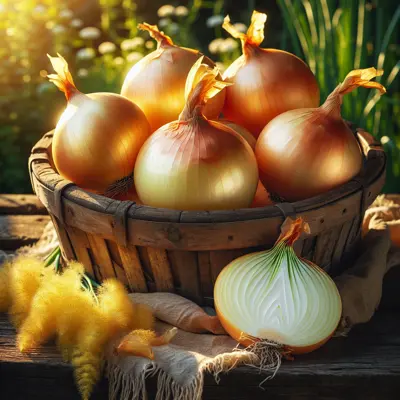
The authentic sweet onion that made Georgia's Vidalia region famous, Yellow Granex produces large, globe-shaped bulbs with exceptionally mild, sweet flavor. These golden beauties are so gentle they can be eaten like apples when grown in the right conditions. Perfect for gardeners wanting to grow their own version of premium sweet onions.
Harvest
110-120d
Days to harvest
Sun
Full sun
Zones
5–10
USDA hardiness
Height
12-18 inches
Planting Timeline
Showing dates for Yellow Granex Onion in USDA Zone 7
All Zone 7 allium →Zone Map
Click a state to update dates
Yellow Granex Onion · Zones 5–10
Growing Details
Succession Planting
Yellow Granex is a short-day onion — it bulbs up as day length hits around 12 hours, which locks you into a single main planting window rather than a rolling one. Direct sow or set out transplants from March through early May in zone 7; anything planted past May 1 won't log enough cool-season days before the heat arrives, and you'll pull small, poorly formed bulbs. One planting per season is the practical reality. If you want a longer harvest window, pair Granex with a mid-day type variety rather than staggering your sow dates — the onions will tell you when they're done, not the calendar.
Complete Growing Guide
Yellow Granex onions are photoperiodic long-day varieties that require precise timing to develop their signature sweetness; plant them in fall in warm climates (September–October) or early spring in cooler regions to ensure they mature during lengthening days without bolting prematurely. These bulbs thrive in loose, well-draining soil rich in organic matter and require consistent moisture—inconsistent watering triggers the sulfur compounds that diminish their mild flavor. Unlike storage onions, Yellow Granex has thin skin and high water content, making them susceptible to pink root and fusarium rot in overly wet conditions, so ensure excellent drainage and avoid overhead watering. Watch for premature bolting if temperatures fluctuate wildly in spring; consistent warmth prevents flowering before bulb expansion. A practical tip: thin seedlings aggressively to 4–6 inches apart early on, as crowding reduces bulb size and increases disease pressure—this cultivar rewards proper spacing with the large, sweet onions gardeners expect.
Light: Full sun (6 or more hours of direct sunlight a day). Soil: High Organic Matter, Loam (Silt), Sand. Soil pH: Alkaline (>8.0), Neutral (6.0-8.0). Drainage: Good Drainage, Moist. Height: 1 ft. 0 in. - 1 ft. 6 in.. Spread: 0 ft. 6 in. - 1 ft. 0 in.. Spacing: Less than 12 inches, 12 inches-3 feet. Maintenance: Medium. Regions: Coastal, Mountains, Piedmont.
Harvesting
Harvest Yellow Granex onions when their papery golden skins fully develop and the bulbs reach 3-4 inches in diameter, signaling peak sweetness and storage readiness. The tops will naturally yellow and begin falling over, indicating the bulbs have finished their growth cycle and are concentrating sugars. For best results, pull onions as they mature rather than waiting for all plants to finish simultaneously, allowing smaller bulbs additional time to develop. Unlike storage onions that require complete drying in the field, these sweet cultivars benefit from prompt harvesting once mature to preserve their delicate, mild flavor and tender texture.
Flowers wither and convert to bulblets
Type: Capsule.
Harvest time: Summer
Edibility: The bulb and tops are edible raw or cooked. However, the plant also has poisonous characteristics as noted in the "Poisonous to Humans" section of this record. Toxicity can depend on the age of the person or animal, the age of the plant, the part of the plant ingested, how much is ingested, whether the person or animal has sensitivities or allergies, whether it's eaten raw or cooked, and so forth. Consult with a medical professional for further details.
Storage & Preservation
Yellow Granex onions are designed for fresh consumption rather than long-term storage, typically keeping 2-4 weeks when properly cured. After harvest, cure bulbs in a warm (80-85°F), well-ventilated area for 2-3 weeks until outer skins become papery and necks feel completely dry. Store cured onions in a cool (45-55°F), dry location with good air circulation, checking regularly and using any that show signs of sprouting or soft spots first.
For longer preservation, Yellow Granex onions excel when caramelized and frozen in portion-sized containers, maintaining their sweet flavor for up to 8 months. They can also be sliced and dehydrated at 135°F for 6-12 hours until crisp, creating sweet onion flakes perfect for seasoning. Pickling is another excellent option—their mild flavor makes exceptional refrigerator pickles that keep for 2-3 months. Avoid traditional root cellar storage methods, as these sweet onions lack the sulfur compounds needed for extended fresh storage.
History & Origin
Yellow Granex emerged as a commercial sweet onion variety in the mid-twentieth century, though its exact breeding origins remain somewhat obscured by incomplete historical documentation. The variety gained prominence in Georgia's Vidalia region during the 1930s-1950s, where specific soil and climate conditions enhanced its naturally mild characteristics. Yellow Granex belongs to the broader Granex onion lineage, which itself derived from Spanish onion breeding stock. While the precise breeder cannot be definitively attributed, seed companies including Estes Seeds played significant roles in commercializing and promoting this variety throughout the American South. Its success in Vidalia ultimately led to protected designation status for the region's sweet onion production.
Origin: Central Asia and central Persia
Advantages
- +Exceptionally sweet and mild flavor makes Yellow Granex perfect for fresh eating.
- +Large globe-shaped bulbs produce premium-quality onions rivaling commercial Vidalia varieties.
- +Easy to grow variety suitable for beginning and experienced gardeners alike.
- +Can be eaten raw like apples when grown in optimal conditions.
Considerations
- -Susceptible to multiple diseases including downy mildew, purple blotch, and neck rot.
- -Requires 110-120 days to mature, limiting growing season in short-season regions.
- -Vulnerable to onion thrips and onion maggots requiring pest management strategies.
- -Needs specific soil and climate conditions to achieve maximum sweetness and flavor.
Companion Plants
Carrots and onions make a sensible pair — their root depths don't compete much, and the scent of each is thought to confuse the other's primary pests (carrot fly and onion thrips). Marigolds nearby don't hurt either, and in our zone 7 Georgia garden they bloom right through onion season with minimal fuss. Keep beans and peas well away: onion root exudates genuinely suppress legume germination and early growth, and your bean yield will show it. Asparagus belongs in a permanent bed you don't want disrupted by allium chemistry season after season — those two just don't share space well long-term.
Plant Together
Carrots
Onions repel carrot flies while carrots help break up soil for onion bulb development
Tomatoes
Onions deter aphids, hornworms, and other tomato pests while improving tomato flavor
Cabbage
Onions repel cabbage worms, flea beetles, and other brassica pests
Lettuce
Onions provide natural pest protection while lettuce acts as living mulch
Broccoli
Onions deter cabbage loopers and aphids that commonly attack brassicas
Peppers
Onions repel aphids and spider mites while peppers don't compete for nutrients
Strawberries
Onions deter slugs, aphids, and other soft-bodied pests that damage strawberry plants
Marigolds
Both repel nematodes and various garden pests through natural compounds
Keep Apart
Beans
Beans and other legumes can inhibit onion growth and bulb development
Peas
Legumes can stunt onion growth through root competition and nitrogen interference
Asparagus
Onions can inhibit asparagus growth and both compete for similar soil nutrients
Nutrition Facts
Per 100g serving. % Daily Value based on 2,000 calorie diet. Source: USDA FoodData Central (FDC #170000)
Pests & Disease Resistance
Resistance
Good resistance to pink root and fusarium basal rot
Common Pests
Onion thrips, onion maggots, cutworms
Diseases
Downy mildew, purple blotch, neck rot
Troubleshooting Yellow Granex Onion
What you'll see, why it happens, and what to do about it.
Leaf tips silvering or streaking, with tiny black specks on the foliage around weeks 4-8
Likely Causes
- Onion thrips (Thrips tabaci) — they rasp the leaf surface and leave frass behind
- Hot, dry spells that stress the plant and favor thrips population explosions
What to Do
- 1.Spray leaves with insecticidal soap every 5-7 days, hitting both sides — thrips hide in the tight leaf folds
- 2.Keep soil consistently moist at 1 inch per week; stressed plants attract heavier pressure
- 3.If population is severe, spinosad (Entrust SC for organic use) works faster than soap alone
Seedlings wilting and toppling at soil level in early spring, no visible insects above ground
Likely Causes
- Onion maggots (Delia antiqua) — larvae chew through the stem base just below the soil line
- Cutworms (Agrotis spp.) — similar damage, active at night, especially in beds with heavy organic matter
What to Do
- 1.Dig around the base of a collapsed seedling; maggots are white and legless, cutworms are fat gray-brown caterpillars — ID before treating
- 2.Place collars (cut toilet paper tubes work fine) around transplants at planting to deter cutworms
- 3.For maggots, use floating row cover from day one and pull it only when you need to weed — Delia flies lay eggs at the soil surface right next to the plant
Gray-purple fuzzy coating on leaves, spreading from older outer leaves inward, usually after a stretch of cool, wet nights
Likely Causes
- Downy mildew (Peronospora destructor) — thrives when nighttime temps sit between 50-60°F with high humidity
- Overcrowded planting that traps moisture between plants
What to Do
- 1.Strip and bag the worst-affected leaves; don't compost them
- 2.Apply copper-based fungicide every 7-10 days during wet stretches — start at first sign, not after it's taken hold
- 3.Space plants at least 4-6 inches apart; that's an easy fix to make before the season starts, and it pays off every time it rains two days in a row
Small, oval, water-soaked lesions on leaves that turn white-purple with a dark border, appearing mid to late season
Likely Causes
- Purple blotch (Alternaria porri) — a fungal disease that moves in on plants already weakened by thrips feeding or physical damage
- Wet foliage from overhead irrigation or heavy dew that doesn't dry before midday
What to Do
- 1.Switch to drip irrigation if you're overhead watering — keeping foliage dry cuts purple blotch pressure significantly
- 2.Apply mancozeb or copper fungicide on a 7-10 day schedule once symptoms appear
- 3.Get ahead of thrips earlier in the season; purple blotch almost always follows their damage, so cutting thrips numbers down in weeks 4-6 reduces your odds of seeing this later
Frequently Asked Questions
How long does Yellow Granex onion take to grow from seed?▼
Can you grow Yellow Granex onions in containers?▼
What makes Yellow Granex onions so sweet compared to regular onions?▼
When should I plant Yellow Granex onion seeds?▼
Is Yellow Granex onion good for beginners?▼
Yellow Granex vs Vidalia onions - what's the difference?▼
Zone-by-Zone Planting Calendar
| Zone | Indoor Start | Transplant | Direct Sow | Harvest |
|---|---|---|---|---|
| Zone 1 | — | — | June – July | September – September |
| Zone 2 | — | — | May – July | September – September |
| Zone 11 | — | — | January – February | April – December |
| Zone 12 | — | — | January – February | April – December |
| Zone 13 | — | — | January – February | April – December |
| Zone 3 | — | — | May – June | August – October |
| Zone 4 | — | — | April – June | August – October |
| Zone 5 | — | — | April – May | August – November |
| Zone 6 | — | — | April – May | July – November |
| Zone 7 | — | — | March – May | July – November |
| Zone 8 | — | — | March – April | June – December |
| Zone 9 | — | — | February – March | May – December |
| Zone 10 | — | — | January – March | May – December |
Growing Guides from Wind River Greens
Sources & References
External authority sources used in compiling this guide.
See the Methodology page for how this data is sourced, what's AI-assisted, and known limitations.