Ailsa Craig Sweet Onion
Allium cepa 'Ailsa Craig'
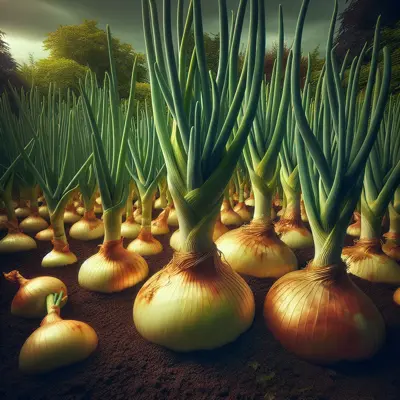
A legendary exhibition onion variety from Scotland that can grow to enormous sizes while maintaining sweet, mild flavor. This pale yellow globe onion is famous for winning competitions and producing bulbs that can weigh 2-3 pounds when grown with proper care. Despite its impressive size, Ailsa Craig maintains excellent eating quality and stores reasonably well.
Harvest
110-120d
Days to harvest
Sun
Full sun
Zones
5–10
USDA hardiness
Height
12-18 inches
Planting Timeline
Showing dates for Ailsa Craig Sweet Onion in USDA Zone 7
All Zone 7 allium →Zone Map
Click a state to update dates
Ailsa Craig Sweet Onion · Zones 5–10
Growing Details
Succession Planting
Ailsa Craig runs 110-120 days and gives you one bulb per plant — it's not a cut-and-come-again situation. You can still spread out the harvest by staggering sow dates. Put in a first round in early March, then a second round 3-4 weeks later in late March or early April. Don't push past early May in zone 7; bulb sizing is triggered by day length, and seed that goes in too late won't have enough time to size up before the long days peak in June.
A third sowing isn't worth it. Onions don't compress their timeline the way salad greens do — two rounds, 3-4 weeks apart, is the practical ceiling for staggering here.
Complete Growing Guide
Ailsa Craig demands an early start—begin seeds indoors 10-12 weeks before your last spring frost to maximize the extended 110-120 day maturity window and achieve those prized 2-3 pound bulbs. This Scottish cultivar thrives in rich, well-draining soil with consistent moisture and full sun, requiring more fertility than standard onion varieties to support vigorous growth. Watch for susceptibility to fusarium basal rot in poorly drained conditions and bolting during temperature fluctuations, which ruins bulb development. The variety's tendency toward "thick-neck" (incomplete drying) means prioritizing excellent soil drainage and ceasing fertilization by mid-summer. One crucial practical tip: thin seedlings aggressively to 4-6 inches apart in the garden, as overcrowding prevents the large bulb expansion Ailsa Craig is bred for, undermining both size potential and exhibition quality.
Light: Full sun (6 or more hours of direct sunlight a day). Soil: High Organic Matter, Loam (Silt), Sand. Soil pH: Alkaline (>8.0), Neutral (6.0-8.0). Drainage: Good Drainage, Moist. Height: 1 ft. 0 in. - 1 ft. 6 in.. Spread: 0 ft. 6 in. - 1 ft. 0 in.. Spacing: Less than 12 inches, 12 inches-3 feet. Maintenance: Medium. Regions: Coastal, Mountains, Piedmont.
Harvesting
Ailsa Craig onions reach peak harvest readiness when their characteristic pale yellow skin develops a papery texture and the tops naturally fall over and dry completely, typically occurring 110-120 days after planting. These exhibition bulbs are ready for pulling when they feel firm and substantial in hand—often reaching 2-3 pounds—and the neck tissue becomes thin and dry rather than soft. Unlike smaller onion varieties that tolerate continuous harvesting, Ailsa Craig performs best with a single, complete harvest once the entire bed shows uniform top-down and skin maturation, as this allows the bulbs maximum time to develop their impressive size and allows for proper curing. Time your harvest for a dry, sunny spell in late summer to cure the bulbs properly in the field for several days before storage, which significantly improves their already reasonable storage capability and intensifies their sweet flavor.
Flowers wither and convert to bulblets
Type: Capsule.
Harvest time: Summer
Edibility: The bulb and tops are edible raw or cooked. However, the plant also has poisonous characteristics as noted in the "Poisonous to Humans" section of this record. Toxicity can depend on the age of the person or animal, the age of the plant, the part of the plant ingested, how much is ingested, whether the person or animal has sensitivities or allergies, whether it's eaten raw or cooked, and so forth. Consult with a medical professional for further details.
Storage & Preservation
Cure freshly harvested Ailsa Craig bulbs in a warm (75-85°F), well-ventilated area for 2-3 weeks until the necks are completely dry and papery. Once cured, trim tops to 1 inch and store in mesh bags or shallow boxes in a cool (35-40°F), dry location with good air circulation.
Properly cured bulbs typically store 3-4 months—shorter than storage onions but respectable for a sweet variety. Check stored bulbs monthly and use any showing soft spots immediately.
For preservation, slice and freeze in portions for up to 8 months, though texture becomes soft when thawed. Dehydrate thin slices at 135°F for crispy onion chips, or pickle rings in mild vinegar brine to showcase their sweet flavor. Their mild nature makes them less suitable for strong pickled preparations.
History & Origin
This legendary Scottish exhibition onion emerged from Scotland's horticultural tradition, though precise breeding documentation remains limited. The variety is believed to have been developed or selected in Scotland during the 19th or early 20th century, gaining prominence through agricultural shows and competitions where its exceptional size and quality earned widespread recognition. The "Ailsa Craig" name references the distinctive granite island off the coast of Ayrshire, Scotland, though whether this directly indicates the breeding origin or simply reflects regional pride is unclear. The variety likely represents careful selection within traditional onion-growing lines rather than formal scientific breeding, developing through the hands of Scottish gardeners and seed savers who valued exhibition-quality bulbs. Its exact parentage and original breeder remain undocumented in accessible sources.
Origin: Central Asia and central Persia
Advantages
- +Can grow to impressive 2-3 pound sizes for exhibition purposes
- +Maintains excellent sweet, mild flavor despite enormous potential bulb size
- +Low sulfur content makes it superior for fresh eating and salads
- +Reasonably good storage capability for such a large, tender onion variety
- +Scottish heritage variety with proven track record in competitions
Considerations
- -Requires 110-120 days and moderate-to-challenging growing skills to succeed
- -Vulnerable to multiple diseases including downy mildew, purple blotch, and neck rot
- -Susceptible to several major pests like onion maggots, thrips, and cutworms
- -Needs consistent, careful management to achieve maximum size without compromising quality
Companion Plants
Carrots and onions make practical sense together: carrot fly (Psila rosae) and onion fly are both confused by the other crop's scent, so interplanting at 4-6 inch spacing gives you cross-protection on both sides. Marigolds (Tagetes spp.) add another layer — their root secretions suppress soil nematodes, and their scent disrupts aphid navigation. Brassicas and lettuce slot in well because they don't share root depth or heavy nitrogen demand with onions, so you're not setting up a resource competition. Ailsa Craig's mild pest-deterrent effect on cabbage loopers is a small bonus there.
Beans and peas need at least 18-24 inches of separation. Onion root exudates genuinely stunt legume growth — this isn't folklore; it's been documented in intercropping trials — and the effect runs both directions, slowing bulb development on the onion side too. Asparagus is a different problem: it's a perennial that needs its own permanent bed, and repeated Allium planting nearby has been shown to inhibit asparagus crown development over multiple seasons.
Plant Together
Carrots
Onions repel carrot flies while carrots help break up soil for onion bulb development
Tomatoes
Onions deter aphids, whiteflies, and hornworms from tomato plants
Brassicas (Cabbage, Broccoli)
Onions repel cabbage worms, flea beetles, and other crucifer pests
Lettuce
Onions provide pest protection while lettuce acts as living mulch for shallow onion roots
Peppers
Onions deter aphids and other soft-bodied insects that attack pepper plants
Strawberries
Onions repel slugs, aphids, and other pests that commonly damage strawberry plants
Marigolds
Both plants repel nematodes and work synergistically to deter various garden pests
Parsley
Attracts beneficial insects while onions provide pest protection, compatible root systems
Keep Apart
Beans
Onions can inhibit nitrogen fixation in bean roots and stunt legume growth
Peas
Allelopathic compounds from onions interfere with pea germination and root development
Asparagus
Onions can slow asparagus growth and interfere with spear production
Nutrition Facts
Per 100g serving. % Daily Value based on 2,000 calorie diet. Source: USDA FoodData Central (FDC #170000)
Pests & Disease Resistance
Resistance
Moderate resistance to pink root and fusarium basal rot
Common Pests
Onion maggot, thrips, aphids, cutworms
Diseases
Downy mildew, purple blotch, neck rot, pink root
Troubleshooting Ailsa Craig Sweet Onion
What you'll see, why it happens, and what to do about it.
Tops falling over and neck feeling soft before bulbs are fully sized, around day 90-100
Likely Causes
- Neck rot (Botrytis allii) — fungal infection that moves in through damaged or wet tissue
- Overwatering or rain during the final 3-4 weeks before harvest when the neck should be drying down
What to Do
- 1.Stop watering entirely once about half the tops have naturally fallen — let the soil dry out
- 2.Harvest promptly and cure in a single layer in a dry, shaded spot with good airflow for 2-3 weeks
- 3.Don't harvest after rain; wait at least 2-3 dry days so the outer skins can tighten up
Leaves showing silver streaking or tiny black specks, plants looking dull and papery
Likely Causes
- Thrips (Thrips tabaci) — they rasp the leaf surface and feed on the juice; the silver streaking is the damage, the black dots are their frass
- Hot, dry spells above 85°F tend to spike thrips populations fast
What to Do
- 1.Spray with spinosad or insecticidal soap, getting coverage down into the leaf bases where thrips hide — repeat every 5-7 days for 2-3 cycles
- 2.Keep soil consistently moist (1 inch per week); drought-stressed plants take thrips damage much harder
- 3.Row cover at planting helps exclude them early; remove it once bulbs start swelling
Stunted seedlings with yellowing lower leaves and roots that look pink or red instead of white
Likely Causes
- Pink root (Phoma terrestris) — a soil-borne fungal disease that persists in the same bed for years
- Planting Alliums in the same ground two seasons in a row
What to Do
- 1.Pull and discard affected plants — there's no treatment once roots are colonized
- 2.Rotate onions out of that bed for at least 3-4 years; Phoma terrestris survives in soil without a host
- 3.Amend with compost to improve drainage, since waterlogged soil accelerates the infection's spread
Frequently Asked Questions
How big do Ailsa Craig onions get?▼
Can you grow Ailsa Craig onions in containers?▼
When should I plant Ailsa Craig onion seeds?▼
What does Ailsa Craig onion taste like?▼
Is Ailsa Craig good for beginner gardeners?▼
How long do Ailsa Craig onions store after harvest?▼
Zone-by-Zone Planting Calendar
| Zone | Indoor Start | Transplant | Direct Sow | Harvest |
|---|---|---|---|---|
| Zone 1 | — | — | June – July | September – September |
| Zone 2 | — | — | May – July | September – September |
| Zone 11 | — | — | January – February | April – December |
| Zone 12 | — | — | January – February | April – December |
| Zone 13 | — | — | January – February | April – December |
| Zone 3 | — | — | May – June | August – October |
| Zone 4 | — | — | April – June | August – October |
| Zone 5 | — | — | April – May | August – November |
| Zone 6 | — | — | April – May | July – November |
| Zone 7 | — | — | March – May | July – November |
| Zone 8 | — | — | March – April | June – December |
| Zone 9 | — | — | February – March | May – December |
| Zone 10 | — | — | January – March | May – December |
Growing Guides from Wind River Greens
Sources & References
External authority sources used in compiling this guide.
See the Methodology page for how this data is sourced, what's AI-assisted, and known limitations.