Vidalia Onion
Allium cepa 'Vidalia'
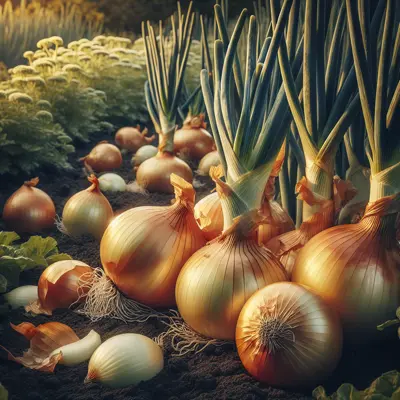
The famous sweet onion from Georgia, prized for its mild flavor and exceptional sweetness that allows it to be eaten raw like an apple. These large, golden onions have become synonymous with Southern cooking and are perfect for caramelizing, grilling, or enjoying fresh in salads. Their low sulfur content and high sugar content make them a favorite among gardeners who want to grow restaurant-quality sweet onions at home.
Harvest
110-120d
Days to harvest
Sun
Full sun
Zones
5–10
USDA hardiness
Height
12-18 inches
Planting Timeline
Showing dates for Vidalia Onion in USDA Zone 7
All Zone 7 allium →Zone Map
Click a state to update dates
Vidalia Onion · Zones 5–10
Growing Details
Succession Planting
Vidalias aren't really a succession crop. They're a short-day onion bred for southern winters, and they need a specific daylength trigger (around 11-12 hours) to start bulbing. Direct sow or set transplants once in late winter to early spring — March through early April in zone 7 — and pull the whole bed in July. A second planting in May will sense the lengthening days and either bolt or make scallions instead of bulbs.
For a continuous onion supply, run scallions or bunching onions (Allium fistulosum) every 3 weeks from March through August in the next bed over. Keep the Vidalia slot for one good crop a year.
Complete Growing Guide
Growing Vidalia onions successfully requires attention to their unique day-length sensitivity and precise timing. These cultivars demand a specific window for planting—typically late summer or early fall in most regions—since they're triggered to bulb by shorter day lengths rather than temperature alone, making spring planting ineffective in many climates. Plant in well-draining, fertile soil with consistent moisture and full sun exposure to maximize their natural sweetness. Vadalias are particularly prone to bolting when exposed to cold temperatures early in growth, so avoid planting too early or exposing seedlings to prolonged cold snaps that may trigger premature flowering. They're generally disease-resistant but watch for onion maggots in spring; use row covers as a preventative barrier. For best results, thin seedlings aggressively to 4-6 inches apart—crowding compromises bulb size and that signature mild flavor. Harvest when tops fall over and cure properly in a warm, dry location to develop their characteristic sweetness and extend storage life.
Light: Full sun (6 or more hours of direct sunlight a day). Soil: High Organic Matter, Loam (Silt), Sand. Soil pH: Alkaline (>8.0), Neutral (6.0-8.0). Drainage: Good Drainage, Moist. Height: 1 ft. 0 in. - 1 ft. 6 in.. Spread: 0 ft. 6 in. - 1 ft. 0 in.. Spacing: Less than 12 inches, 12 inches-3 feet. Maintenance: Medium. Regions: Coastal, Mountains, Piedmont.
Harvesting
Vidalia onions reach peak harvest readiness when their papery golden skin develops a rich, deep tan color and the bulbs feel firm and heavy for their size, typically reaching three to four inches in diameter. Watch for the characteristic signal of mature Vidalias: the tops will begin to yellow and naturally fall over, indicating the plant is redirecting energy into bulb development rather than foliage. Harvest by pulling the entire plant from the soil once approximately seventy to eighty percent of the tops have fallen, then cure them in a warm, dry location for two to three weeks before storage. A crucial timing tip specific to Vidalias is to harvest slightly earlier than standard onion varieties—picking when the necks just begin to soften rather than waiting for complete drying—to preserve their signature exceptional sweetness and tender texture.
Flowers wither and convert to bulblets
Type: Capsule.
Harvest time: Summer
Edibility: The bulb and tops are edible raw or cooked. However, the plant also has poisonous characteristics as noted in the "Poisonous to Humans" section of this record. Toxicity can depend on the age of the person or animal, the age of the plant, the part of the plant ingested, how much is ingested, whether the person or animal has sensitivities or allergies, whether it's eaten raw or cooked, and so forth. Consult with a medical professional for further details.
Storage & Preservation
Vidalia onions have a notably shorter storage life than storage onions due to their high sugar and water content. After harvest, cure in a single layer in a warm, dry, well-ventilated area for 2-3 weeks until necks are completely dry and papery. Store properly cured bulbs in a cool, dry place with good air circulation - they'll keep 2-4 months maximum.
Refrigerate individual onions wrapped in paper towels for up to 6 weeks, or store whole bulbs in mesh bags in the refrigerator crisper. Their high sugar content makes them excellent for caramelizing and freezing - slice and sauté until golden, then freeze in portions for up to 8 months. They also excel in pickled preparations, maintaining their signature sweetness while developing complex flavors. Avoid long-term room temperature storage, as their high moisture content leads to sprouting and rot faster than conventional storage onions.
History & Origin
The Vidalia onion's origins trace to the Vidalia region of Georgia, where the combination of soil composition and climate creates naturally sweet onions with low sulfur content. While the variety's exact breeding lineage remains somewhat obscure in formal documentation, Vidalias emerged from traditional sweet onion cultivation practices rather than deliberate modern breeding programs. The onion gained commercial prominence in the mid-20th century when Georgia farmers recognized the distinctive sweetness of locally grown bulbs, leading to establishment of the Vidalia trademark in 1986. The variety likely descended from Spanish or Italian sweet onion types, though specific parentage records are not well documented in horticultural literature.
Origin: Central Asia and central Persia
Advantages
- +Exceptionally sweet and mild flavor perfect for eating raw fresh
- +Large golden bulbs yield impressive harvests ideal for home gardeners
- +Low sulfur content means minimal tear-inducing fumes when cutting
- +Versatile for caramelizing, grilling, salads, and sophisticated culinary applications
- +Restaurant-quality sweet onions achievable through home garden cultivation
Considerations
- -Moderate growing difficulty requires careful attention to soil conditions
- -Susceptible to multiple diseases including downy mildew and neck rot
- -Long 110-120 day maturation period demands extended growing season commitment
- -Multiple pest vulnerabilities including thrips and onion maggots require management
Companion Plants
Onions take up almost no horizontal space and their sulfur compounds confuse a lot of insect pests, which is why they slot into mixed beds well. Carrots are the standard pair — onion smell throws off carrot rust fly (Psila rosae), and carrot foliage seems to mask onions from onion fly in return. Lettuce works for a different reason: it's shallow-rooted and quick, so it fills the gaps between 4-inch onion spacings and finishes before the bulbs swell. Cabbage and broccoli benefit from onions deterring cabbage loopers and aphids, and brassica taproots don't compete with the shallow onion root mass.
Beans and peas are the ones to keep apart from your Vidalia bed. Alliums release sulfur compounds that suppress the Rhizobium bacteria legumes depend on for nitrogen fixation — you'll see pale, stunted beans and smaller onions because both crops are fighting instead of feeding. Asparagus is a separate issue: it's a long-lived perennial with deep crowns, and you don't want to be digging onions out of an asparagus row every July.
Plant Together
Tomatoes
Onions repel aphids, spider mites, and tomato hornworms while improving tomato flavor
Carrots
Onions deter carrot rust flies, while carrots help break up soil for onion bulb development
Cabbage
Onions repel cabbage worms, cabbage loopers, and flea beetles from brassicas
Lettuce
Onions provide natural pest protection without competing for nutrients or space
Peppers
Onions deter aphids and other soft-bodied insects that commonly attack pepper plants
Strawberries
Onions repel slugs, aphids, and other pests while not interfering with berry production
Broccoli
Onions help protect against cabbage moths and root maggots that target brassicas
Marigolds
Both plants repel nematodes and work synergistically for comprehensive pest control
Keep Apart
Beans
Onions can inhibit bean growth and nitrogen fixation by releasing allelopathic compounds
Peas
Onions stunt pea growth and interfere with their ability to fix nitrogen in soil
Asparagus
Onions can slow asparagus establishment and may reduce spear production
Nutrition Facts
Per 100g serving. % Daily Value based on 2,000 calorie diet. Source: USDA FoodData Central (FDC #170000)
Pests & Disease Resistance
Resistance
Moderate resistance to pink root and fusarium basal rot
Common Pests
Onion thrips, onion maggots, wireworms
Diseases
Downy mildew, purple blotch, neck rot, pink root
Troubleshooting Vidalia Onion
What you'll see, why it happens, and what to do about it.
Silvery streaks and stippling on the leaves, with tiny pale insects tucked into the leaf crotches around day 60-90
Likely Causes
- Onion thrips (Thrips tabaci) — they rasp the leaf surface and suck the sap, and they multiply fast in hot dry weather
- Plants stressed from inconsistent watering, which makes them more attractive to thrips
What to Do
- 1.Spray the leaf bases directly with insecticidal soap or spinosad in the evening — thrips hide deep in the crotch where contact sprays struggle to reach, so aim there
- 2.Keep up the 1 inch of water per week; thrips populations explode on drought-stressed onions
- 3.Hang blue sticky cards at canopy height to monitor — if you're catching dozens a week, treat again on a 7-day interval
Bulbs rotting at the neck after harvest, with grayish mold and a soft sunken area where the leaves meet the bulb
Likely Causes
- Neck rot (Botrytis allii) — a storage disease that infects through green neck tissue before curing finishes
- Onions pulled before the tops fell over naturally, or cured in humid conditions
What to Do
- 1.Wait until at least 50-75% of the tops have flopped before pulling — that's when the neck starts to dry and seal
- 2.Cure in a single layer somewhere warm, dry, and well-ventilated (a covered porch with a box fan works) for 2-3 weeks until the necks are papery
- 3.Cull any bulbs with thick green necks at curing time and eat those first — they won't store regardless
Frequently Asked Questions
How long do Vidalia onions take to grow from transplant?▼
Can you grow Vidalia onions in containers?▼
What zone do Vidalia onions grow best in?▼
Why are my Vidalia onions not sweet?▼
Is Vidalia onion good for beginners?▼
When should I plant Vidalia onions?▼
Zone-by-Zone Planting Calendar
| Zone | Indoor Start | Transplant | Direct Sow | Harvest |
|---|---|---|---|---|
| Zone 1 | — | — | June – July | September – September |
| Zone 2 | — | — | May – July | September – September |
| Zone 11 | — | — | January – February | April – December |
| Zone 12 | — | — | January – February | April – December |
| Zone 13 | — | — | January – February | April – December |
| Zone 3 | — | — | May – June | August – October |
| Zone 4 | — | — | April – June | August – October |
| Zone 5 | — | — | April – May | August – November |
| Zone 6 | — | — | April – May | July – November |
| Zone 7 | — | — | March – May | July – November |
| Zone 8 | — | — | March – April | June – December |
| Zone 9 | — | — | February – March | May – December |
| Zone 10 | — | — | January – March | May – December |
Growing Guides from Wind River Greens
Sources & References
External authority sources used in compiling this guide.
See the Methodology page for how this data is sourced, what's AI-assisted, and known limitations.