Spanish Roja Garlic
Allium sativum var. ophioscorodon 'Spanish Roja'
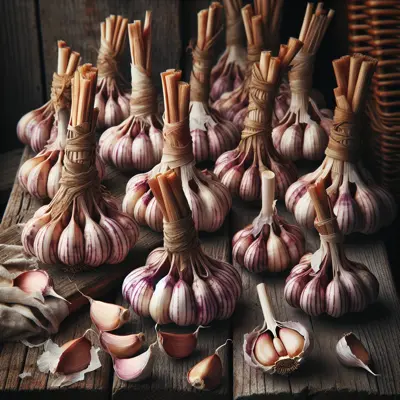
A legendary hardneck garlic variety brought to the Pacific Northwest by Spanish immigrants, Spanish Roja offers full-bodied flavor with a satisfying heat that doesn't overpower. Known for its beautiful purple-striped bulb wrappers and reliable performance in cold climates. This is the garlic that made Spokane famous among garlic enthusiasts.
Harvest
240-270d
Days to harvest
Sun
Full sun
Zones
4–9
USDA hardiness
Height
12-18 inches
Planting Timeline
Showing dates for Spanish Roja Garlic in USDA Zone 7
All Zone 7 allium →Zone Map
Click a state to update dates
Spanish Roja Garlic · Zones 4–9
Growing Details
Succession Planting
Spanish Roja is planted once in fall — typically October through early November in zone 7 — and harvested the following June or July when roughly half the leaves have browned down. There's no succession planting in the traditional sense; each clove produces one bulb, and the whole crop comes out at once. Plant what you need in one go.
That said, if you want to stagger your fresh garlic use, you can pull a few bulbs early as "green garlic" starting around late April when stalks are still upright and the bulb hasn't fully differentiated — those are mild, good fresh, and free up a little bed space. The main harvest window is fixed regardless: stop watering 2 weeks before you pull, wait for the foliage signal, and cure the bulbs in a shaded spot with good airflow for 3-4 weeks before storage.
Complete Growing Guide
Spanish Roja demands fall planting between September and November to satisfy its 240-270 day vernalization requirement, making it non-negotiable for spring harvests in cold climates. This hardneck variety thrives in well-draining soil with consistent moisture through winter and spring, though it tolerates the Pacific Northwest's wet conditions better than softneck types. Plant cloves 2 inches deep in full sun and space them 6 inches apart to prevent cramping as bulbs develop. Watch for white rot in persistently wet springs—ensure excellent drainage to minimize fungal pressure. Spanish Roja tends to bolt reliably when day length triggers flowering, which is normal; simply snap off scapes at the curl stage to redirect energy into bulb expansion. A practical advantage: its robust purple wrapper leaves indicate maturity clearly, making harvest timing easier than varieties with subtle color cues.
Light: Full sun (6 or more hours of direct sunlight a day). Soil: Clay, High Organic Matter, Loam (Silt), Sand. Soil pH: Neutral (6.0-8.0). Drainage: Good Drainage, Moist. Height: 1 ft. 0 in. - 1 ft. 6 in.. Spread: 0 ft. 8 in. - 1 ft. 0 in.. Spacing: Less than 12 inches, 12 inches-3 feet. Growth rate: Medium. Maintenance: Medium. Regions: Coastal, Mountains, Piedmont.
Harvesting
Spanish Roja reaches peak harvest readiness when the distinctive purple-striped bulb wrappers begin to fade and papery brown tones emerge, typically around late June to early July in the Pacific Northwest. The tops will naturally yellow and flop over as the plant senesces, signaling that the bulbs have finished sizing. Unlike continuous-harvest varieties, Spanish Roja performs best with a single harvest window—pull the entire plant once the lower leaves brown but before the tops completely desiccate, as premature harvesting yields smaller cloves while delayed harvesting risks bulb splitting in soil. A helpful timing tip specific to this hardneck cultivar: monitor when the scape has fully emerged and begun to curl; this marks approximately two to three weeks before optimal bulb maturity, giving you a reliable countdown to harvest readiness.
Capsule on top of the flowering stalk. Splits open when ripe.
Color: Cream/Tan. Type: Capsule.
Storage & Preservation
Cure Spanish Roja in a warm, dry, well-ventilated area (75-85°F, 60-70% humidity) for 2-3 weeks until outer skins are papery and necks are completely dry. Properly cured Spanish Roja stores 4-6 months at room temperature in mesh bags or braided by their sturdy stems.
For longer storage, keep in a cool, dry location (32-40°F) with good air circulation — never in plastic bags or sealed containers. Check monthly and remove any bulbs showing soft spots.
Preserve excess harvest by making garlic powder from dehydrated cloves, freezing whole peeled cloves in olive oil (use within 3 months), or fermenting in salt brine for complex umami flavors. Spanish Roja's robust flavor holds up exceptionally well to roasting and can be preserved in roasted garlic oil.
History & Origin
Spanish Roja garlic arrived in the Pacific Northwest through Spanish immigrant communities, though detailed documentation of its exact origin remains limited. The variety belongs to the hardneck ophioscorodon group, suggesting Eastern European or Mediterranean ancestry typical of garlic varieties adapted to cold climates. Its establishment in the Spokane region became well-documented through regional cultivation, where it thrived and gained prominence among American garlic growers. The variety represents a heritage tradition of immigrant-preserved seeds rather than formal breeding programs, maintaining characteristics valued by Spanish agriculturalists for centuries before its introduction to North America.
Origin: Asia and Iran
Advantages
- +Beautiful purple-striped bulbs add ornamental value to gardens and markets
- +Legendary flavor profile with satisfying heat makes it superior for cooking
- +Reliable cold-climate performer thrives in Pacific Northwest and northern regions
- +Full-bodied complexity develops rich taste that surpasses milder garlic varieties
- +Easy cultivation requires minimal expertise even for beginning gardeners
Considerations
- -White rot fungus can devastate entire crops in poorly drained soil
- -Long 240-270 day season demands patience and significant garden space commitment
- -Susceptible to multiple pests including onion thrips and destructive bulb mites
- -Vulnerable to rust and basal rot in humid or overly wet conditions
Companion Plants
Garlic pulls weight next to tomatoes and peppers because the sulfur compounds it off-gasses genuinely disorient aphids and spider mites — it's not folklore, there's a real chemical mechanism. Cabbage benefits for a similar reason: those same compounds muddle the scent trails that cabbage loopers use to find their host plants. Carrots and lettuce slot in easily because neither competes with garlic's 6-8 inch bulb zone underground, and they fill the bed canopy without shading out the full sun Spanish Roja needs through its long June harvest.
In our zone 7 Georgia garden, the ones to keep clear are beans, peas, and asparagus. Garlic's sulfur exudates inhibit the Rhizobium bacteria that fix nitrogen in legume root nodules — plant them within a foot of each other and your bean yield takes a real hit. Asparagus is the other hard no: it's a 15-20 year perennial investment, and allium root competition sets it back in ways that won't be obvious until the following season, when your fern growth comes in thin.
Plant Together
Tomatoes
Garlic repels aphids, spider mites, and hornworms that attack tomatoes
Roses
Garlic deters aphids, Japanese beetles, and may reduce black spot disease
Cabbage
Garlic repels cabbage worms, aphids, and cabbage root maggots
Carrots
Garlic repels carrot rust flies and nematodes while improving carrot flavor
Lettuce
Garlic deters aphids and slugs that commonly damage lettuce leaves
Spinach
Garlic repels aphids and leaf miners while not competing for nutrients
Peppers
Garlic deters aphids, spider mites, and may reduce fungal diseases
Strawberries
Garlic repels slugs, aphids, and may deter rodents from berry patches
Keep Apart
Beans
Garlic inhibits nitrogen fixation by rhizobia bacteria in bean root nodules
Peas
Garlic compounds interfere with pea growth and nitrogen fixation process
Asparagus
Garlic's allelopathic compounds can stunt asparagus growth and development
Nutrition Facts
Per 100g serving. % Daily Value based on 2,000 calorie diet. Source: USDA FoodData Central (FDC #1104647)
Pests & Disease Resistance
Resistance
Good resistance to white rot and fusarium
Common Pests
Onion thrips, bulb mites, nematodes
Diseases
White rot, rust, basal rot
Troubleshooting Spanish Roja Garlic
What you'll see, why it happens, and what to do about it.
Leaf tips turning silver or streaked, with tiny black specks on the foliage in late spring
Likely Causes
- Onion thrips (Thrips tabaci) — rasping the leaf surface and leaving frass behind
- Dry, hot conditions that favor thrips population explosions
What to Do
- 1.Spray with insecticidal soap or spinosad every 5-7 days until pressure drops — get it into the leaf folds where thrips hide
- 2.Keep soil consistently moist; stressed plants attract heavier thrips feeding
- 3.At season's end, pull all debris out of the bed — thrips overwinter in plant material
Bright orange or yellow pustules on the outer leaves, usually showing up in early to mid spring
Likely Causes
- Allium rust (Puccinia allii) — a fungal disease that spreads fast in cool, wet weather
- Overcrowded planting that traps humidity between plants
What to Do
- 1.Strip and bag the worst-affected leaves — don't compost them
- 2.Confirm 6-inch spacing; thin any cloves that came up doubled to restore airflow
- 3.Apply a sulfur-based fungicide at the first sign of pustules; don't wait until the whole row is orange
Bulbs rotting at the base with white, fluffy mold and hard black dots (sclerotia) visible on the roots
Likely Causes
- White rot (Sclerotium cepivorum) — a soil-borne fungus that can persist in the bed for 20+ years
- Planting infected seed stock
What to Do
- 1.Pull and destroy affected plants immediately — don't compost, don't leave them in the bed
- 2.Do not plant alliums in that bed again for at least 8 years; the sclerotia don't break down
- 3.Source certified disease-free seed garlic next season, not cloves saved from a bed that had problems
Foliage yellowing unevenly, bulbs undersized at harvest despite adequate fertilizing, roots appearing stunted or brownish
Likely Causes
- Root knot nematodes (Meloidogyne spp.) — microscopic roundworms that damage root tissue and block nutrient uptake
- Bulb mites (Aceria tulipae) — often move in on already-stressed roots and compound the damage
What to Do
- 1.After harvest, dig a few bulbs and check roots for galls (nematodes) or a powdery, off-smell (bulb mites) to confirm the culprit before treating
- 2.Plant a cover crop of French marigolds (Tagetes patula) in that bed the following summer — NC State Extension notes they suppress root knot nematode populations measurably
- 3.Solarize the bed in July-August (6 weeks under clear plastic) before replanting alliums to reduce both nematode and mite pressure
Frequently Asked Questions
How long does Spanish Roja garlic take to grow?▼
Can you grow Spanish Roja garlic in containers?▼
What does Spanish Roja garlic taste like compared to store-bought?▼
Is Spanish Roja garlic good for beginners?▼
When should I plant Spanish Roja garlic cloves?▼
How do you know when Spanish Roja garlic is ready to harvest?▼
Zone-by-Zone Planting Calendar
| Zone | Indoor Start | Transplant | Direct Sow | Harvest |
|---|---|---|---|---|
| Zone 3 | — | — | May – June | December – October |
| Zone 4 | — | — | April – June | December – October |
| Zone 5 | — | — | April – May | December – November |
| Zone 6 | — | — | April – May | December – November |
| Zone 7 | — | — | March – May | December – November |
| Zone 8 | — | — | March – April | November – December |
| Zone 9 | — | — | February – March | October – December |
| Zone 10 | — | — | January – March | October – December |
| Zone 1 | — | — | June – July | December – September |
| Zone 2 | — | — | May – July | December – September |
| Zone 11 | — | — | January – February | September – December |
| Zone 12 | — | — | January – February | September – December |
| Zone 13 | — | — | January – February | September – December |
Growing Guides from Wind River Greens
Sources & References
External authority sources used in compiling this guide.
See the Methodology page for how this data is sourced, what's AI-assisted, and known limitations.