Copra Onion
Allium cepa 'Copra'
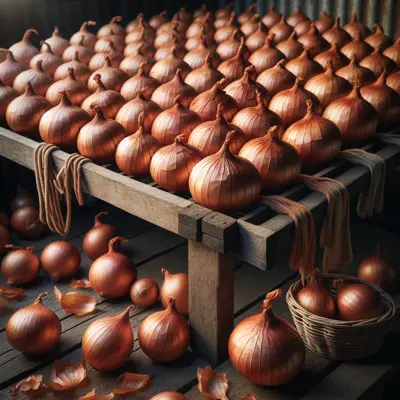
The gold standard for long-storage onions, Copra delivers outstanding keeping quality with bulbs storing 8-12 months when properly cured. This reliable variety produces uniform, dense bulbs with excellent flavor that intensifies during storage. A must-have for gardeners seeking year-round onion self-sufficiency.
Harvest
104-110d
Days to harvest
Sun
Full sun
Zones
5–10
USDA hardiness
Height
12-18 inches
Planting Timeline
Showing dates for Copra Onion in USDA Zone 7
All Zone 7 allium →Zone Map
Click a state to update dates
Copra Onion · Zones 5–10
Growing Details
Succession Planting
Copra is a storage onion, not a cut-and-come-again crop, so succession planting makes sense if you want a staggered harvest rather than a single giant pull. Direct sow or set transplants every 3-4 weeks from late February through mid-April in zone 7. Starting seeds in May rarely pays off — Copra needs 14+ hours of daylight to trigger bulb formation, and late-started plants tend to produce small, underdeveloped bulbs before summer heat shuts things down.
Stop successive plantings once daytime highs are consistently above 80°F — germination rates drop sharply and seedlings struggle to establish before the heat arrives. Fall onion production with Copra isn't really an option; that's a job for short-day varieties, not this one.
Complete Growing Guide
Copra onions require careful timing to reach full maturity within their 104-110 day window, so start seeds indoors 6-8 weeks before your last spring frost and transplant once soil reaches 50°F. This long-day variety performs best in regions with 14+ hours of summer daylight and prefers full sun with well-draining, nutrient-rich soil; avoid excessive nitrogen, which encourages leafy growth at the expense of bulb development. Copra's dense bulbs make it less susceptible to pink root and fusarium than many varieties, but ensure excellent air circulation to prevent fungal issues during humid summers. The key to maximizing storage potential is proper curing: harvest when 50-75% of tops have fallen over, then cure in a warm (80-85°F), dry location with good airflow for 2-3 weeks before trimming necks and storing at 32-50°F.
Light: Full sun (6 or more hours of direct sunlight a day). Soil: High Organic Matter, Loam (Silt), Sand. Soil pH: Alkaline (>8.0), Neutral (6.0-8.0). Drainage: Good Drainage, Moist. Height: 1 ft. 0 in. - 1 ft. 6 in.. Spread: 0 ft. 6 in. - 1 ft. 0 in.. Spacing: Less than 12 inches, 12 inches-3 feet. Maintenance: Medium. Regions: Coastal, Mountains, Piedmont.
Harvesting
Harvest Copra onions when the papery, copper-gold outer skin develops a deep bronze hue and the bulbs feel firm and dense to gentle pressure, typically around 104-110 days after planting. Watch for the telltale sign of neck softening and foliage yellowing and falling over naturally rather than cutting them down artificially, as this signals peak maturity. Unlike varieties requiring staggered harvesting, Copra's uniform maturation allows a single, complete harvest when conditions align, maximizing storage potential. Time your harvest for a dry spell or morning when soil moisture is moderate, as this promotes faster curing and helps the protective outer layers dry quickly, essential for achieving that legendary 8-12 month storage capability this cultivar is renowned for.
Flowers wither and convert to bulblets
Type: Capsule.
Harvest time: Summer
Edibility: The bulb and tops are edible raw or cooked. However, the plant also has poisonous characteristics as noted in the "Poisonous to Humans" section of this record. Toxicity can depend on the age of the person or animal, the age of the plant, the part of the plant ingested, how much is ingested, whether the person or animal has sensitivities or allergies, whether it's eaten raw or cooked, and so forth. Consult with a medical professional for further details.
Storage & Preservation
Proper curing is essential for Copra's legendary storage potential. Spread harvested onions in a single layer in a well-ventilated, dry location (garage, shed, or covered porch) for 2-4 weeks until necks are completely dry and papery. Once cured, trim roots and tops to 1 inch, then store in mesh bags or crates in a cool (32-40°F), dry location with good air circulation.
Properly cured Copra onions store 8-12 months at 32-40°F with 60-70% humidity. For shorter storage, keep at room temperature for 2-3 months. Freeze diced onions in portions for cooking, or dehydrate sliced onions for seasoning. Their intense flavor makes them excellent for pickling or fermenting into onion relish.
History & Origin
Copra onion emerged from Cornell University's agricultural breeding program in the 1970s, developed specifically to meet commercial and home gardener demands for superior storage longevity. The variety was bred by selecting for the dense bulb structure and papery outer scales that contribute to its exceptional 8-12 month storage capability. While detailed documentation of the exact cross parentage remains limited in publicly available sources, Copra became the benchmark for long-storage onions and was widely adopted by seed companies throughout North America. Its introduction represented a significant advancement in onion breeding for storage durability, establishing the variety as the horticultural standard against which other storage onions are measured.
Origin: Central Asia and central Persia
Advantages
- +Stores 8-12 months when properly cured, enabling year-round self-sufficiency.
- +Produces uniform, dense bulbs with excellent sharp flavor profile.
- +Flavor intensifies during storage, improving taste over time.
- +Easy to grow with reliable performance across most conditions.
- +Gold standard long-storage variety trusted by serious gardeners.
Considerations
- -Susceptible to onion thrips, onion maggots, and wireworm infestations.
- -Vulnerable to downy mildew, purple blotch, and bacterial soft rot.
- -Requires proper curing and storage conditions to achieve longevity.
- -Matures in 104-110 days, limiting planting flexibility in short seasons.
Companion Plants
Carrots and onions have a long-standing reputation as mutual pest confusers — each crop's volatile sulfur and terpene compounds are thought to mask the scent of the other from root flies and aphids. The practical case for the pairing is structural: carrot taproots push down past 12 inches while Copra's bulbs develop in the top 6-8 inches of soil, so neither crop is fighting the other for the same real estate. You can interplant them at close spacing without shortchanging either harvest. Marigolds (Tagetes patula specifically) are worth tucking at the row ends — there's documented evidence they reduce Thrips tabaci pressure, and thrips are the pest you'll deal with most consistently on Copra in a dry summer.
Brassicas like cabbage and broccoli share a cool-season window with Copra and aren't competing for the same nutrients. Lettuce fills gaps between onion rows without pulling much water — its roots stay in the top 6 inches and it's done and gone before Copra hits its peak demand of 1 inch per week in summer heat. It's a genuinely low-friction combination.
Beans and peas are the ones to physically separate from your allium beds. Onions produce compounds that suppress the Rhizobium bacteria living in legume root nodules — those bacteria are what fix atmospheric nitrogen for the plant, so proximity to alliums cuts into bean and pea yields in a measurable way. Asparagus is a different concern: alliums are allelopathic to asparagus crowns, and since an asparagus planting is a 15-20 year commitment, there's no good reason to put those two anywhere near each other.
Plant Together
Carrots
Onions repel carrot flies while carrots help break up soil for onion bulb development
Tomatoes
Onions deter aphids and hornworms from tomatoes while improving their flavor
Brassicas (Cabbage, Broccoli)
Onions repel cabbage worms, flea beetles, and other brassica pests
Lettuce
Onions provide pest protection and don't compete for nutrients due to different root depths
Peppers
Onions deter aphids and other soft-bodied insects that damage pepper plants
Strawberries
Onions repel slugs and other pests while not competing for growing space
Marigolds
Both plants repel nematodes and various garden pests when grown together
Parsley
Attracts beneficial insects and doesn't compete with onions for nutrients
Keep Apart
Beans
Onions can inhibit bean growth and nitrogen fixation
Peas
Onions stunt pea growth and interfere with their nitrogen-fixing ability
Asparagus
Onions can inhibit asparagus growth and reduce spear production
Nutrition Facts
Per 100g serving. % Daily Value based on 2,000 calorie diet. Source: USDA FoodData Central (FDC #170000)
Pests & Disease Resistance
Resistance
Good resistance to pink root and fusarium basal rot
Common Pests
Onion thrips, onion maggots, wireworms
Diseases
Downy mildew, purple blotch, bacterial soft rot
Troubleshooting Copra Onion
What you'll see, why it happens, and what to do about it.
Silvery streaking or stippling on leaves, with tiny dark specks (frass) visible on close inspection
Likely Causes
- Onion thrips (Thrips tabaci) — rasping insects that feed between leaf layers, worst in hot, dry stretches
- Overcrowded planting that limits airflow and makes it hard to spot early
What to Do
- 1.Spray with insecticidal soap or spinosad every 5-7 days, hitting the base of leaves where thrips shelter
- 2.Keep plants to 4-6 inch spacing so you can actually see what's happening in there
- 3.Remove and bag heavily infested foliage — don't compost it
Seedlings or young transplants wilting and collapsing at the soil line, with the base of the stem soft or hollowed
Likely Causes
- Onion maggots (Delia antiqua) — larvae of a small fly that lays eggs at the soil surface near stems in spring
- Wet, heavy soils that slow drainage and make larval damage worse
What to Do
- 1.Cover beds with floating row cover immediately after planting and keep it sealed until bulb initiation
- 2.Apply beneficial nematodes (Steinernema feltiae) to the soil before planting in historically infested beds
- 3.Rotate alliums out of the same bed for at least 3 years — maggot flies return to where they laid eggs before
Grayish-purple fuzzy growth on outer leaves, with leaves yellowing and dying back from the tips
Likely Causes
- Downy mildew (Peronospora destructor) — airborne spores that germinate in cool, wet conditions, typically below 60°F at night
- Dense planting or low-lying beds where cold air pools and foliage stays wet for hours
What to Do
- 1.Pull and destroy affected plants — Peronospora destructor spreads fast and there's no effective organic rescue spray once it's established
- 2.Apply a copper-based fungicide preventively if you've had it before and weather is persistently wet and cool
- 3.Next season, plant Copra on raised beds or a slope where drainage keeps the surface drier overnight
Stored bulbs developing a slimy, foul-smelling rot that moves inward from the outer scales
Likely Causes
- Bacterial soft rot (Pectobacterium carotovorum) — enters through wounds, sunscald, or insect feeding damage
- Curing cut short — bulbs put into storage before necks are fully dry, which typically takes a minimum of 2 weeks
What to Do
- 1.Cure Copra bulbs in a warm (80-85°F), well-ventilated spot for a full 2-3 weeks before storage — necks should be papery and tight
- 2.Sort through stored onions every 2 weeks and pull any that feel soft; one rotting bulb will take out its neighbors
- 3.Don't store bulbs with any cuts, bruises, or insect entry wounds — use those first
Frequently Asked Questions
How long does Copra onion take to grow from seed?▼
Can you grow Copra onions in containers?▼
What does Copra onion taste like?▼
When should I plant Copra onion seeds?▼
Is Copra onion good for beginners?▼
How do you cure Copra onions for long storage?▼
Zone-by-Zone Planting Calendar
| Zone | Indoor Start | Transplant | Direct Sow | Harvest |
|---|---|---|---|---|
| Zone 1 | — | — | June – July | September – September |
| Zone 2 | — | — | May – July | September – September |
| Zone 11 | — | — | January – February | April – December |
| Zone 12 | — | — | January – February | April – December |
| Zone 13 | — | — | January – February | April – December |
| Zone 3 | — | — | May – June | August – October |
| Zone 4 | — | — | April – June | August – October |
| Zone 5 | — | — | April – May | July – November |
| Zone 6 | — | — | April – May | July – November |
| Zone 7 | — | — | March – May | July – November |
| Zone 8 | — | — | March – April | June – December |
| Zone 9 | — | — | February – March | May – December |
| Zone 10 | — | — | January – March | May – December |
Growing Guides from Wind River Greens
Sources & References
External authority sources used in compiling this guide.
See the Methodology page for how this data is sourced, what's AI-assisted, and known limitations.