Red Cabbage Microgreens
Brassica oleracea var. capitata
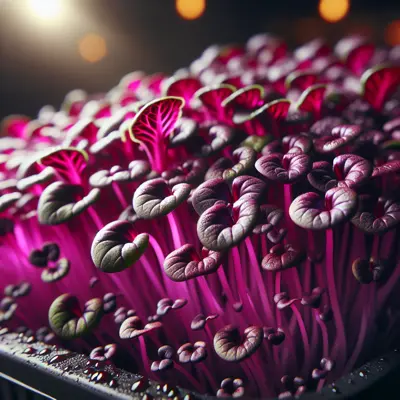
Red Cabbage Microgreens are vibrant purple-red seedlings harvested at 10-14 days for optimal flavor and texture. These tender microgreens feature a mild cabbage taste with subtle peppery undertones and deliver a delicate crunch. They mature quickly, making them ideal for home growers of all skill levels. With their striking deep color and nutrient density, red cabbage microgreens serve as an excellent raw garnish for salads, grain bowls, and sandwiches, adding visual appeal and fresh, crisp flavor to dishes.
Harvest
68d
Days to harvest
Sun
Full sun to partial shade
Zones
6–9
USDA hardiness
Height
10-24 inches
Planting Timeline
Showing dates for Red Cabbage Microgreens in USDA Zone 7
All Zone 7 microgreen →Zone Map
Click a state to update dates
Red Cabbage Microgreens · Zones 6–9
Growing Details
Succession Planting
Red cabbage microgreens cut in roughly 8–12 days from sowing — the 68-day figure is for a full-head cabbage grown to maturity, not for tray production. That short window makes staggered sowing simple: start a fresh 10x20 tray every 5–7 days to keep cuts coming without a gap. There's no heat cutoff or frost date to plan around since these grow indoors year-round. One tray per week is enough for most households; bump to two if you're putting microgreens on every plate.
Complete Growing Guide
Red Cabbage Microgreens require patience, as their 68-day maturation period is significantly longer than typical microgreen crops, demanding consistent cool temperatures between 50–65°F to prevent premature bolting and maintain their prized sweet flavor. These seedlings develop slower than faster-maturing brassicas, so avoid overwatering during germination, which invites damping-off disease in the humid microgreen environment. The cultivar's tendency toward uniform, compact growth means adequate air circulation is essential—position fans to reduce fungal issues while the dense canopy develops. Watch carefully around day 50–60 for signs of early heading, as some plants may bolt if temperatures spike or day length extends significantly. A practical strategy is to sow in succession every two weeks rather than expecting a single large harvest, allowing you to stagger production and capture plants at their optimal tender stage before inner leaves toughen. Their moderate vigor means slightly lower seeding density prevents unnecessary competition and stretch.
Light: Full sun (6 or more hours of direct sunlight a day), Partial Shade (Direct sunlight only part of the day, 2-6 hours). Soil: Clay, Loam (Silt), Sand. Soil pH: Acid (<6.0), Neutral (6.0-8.0). Drainage: Good Drainage, Moist. Height: 0 ft. 10 in. - 2 ft. 0 in.. Spread: 1 ft. 0 in. - 2 ft. 0 in.. Spacing: 12 inches-3 feet. Growth rate: Medium. Maintenance: Medium. Propagation: Seed, Stem Cutting. Regions: Coastal, Mountains, Piedmont.
Harvesting
Red Cabbage Microgreens reach peak harvest readiness when the small heads display deep purple-red coloration throughout the wrapper leaves and feel firm yet slightly yielding when gently squeezed. Visual uniformity across your crop signals optimal timing, as all heads should reach similar size simultaneously around 68 days from planting. For best results, harvest in the early morning when inner leaves contain maximum moisture and crunch, cutting heads just below the base with a sharp knife. While a single full harvest is most practical given the compact 10–24 inch height, you may selectively pick outer wrapper leaves earlier if needed, allowing central heads additional days to reach full size. Avoid waiting beyond peak firmness, as heads quickly become woody and lose their prized tender texture.
The fruits dry and split when ripe.
Color: Brown/Copper, Green. Type: Siliqua. Length: > 3 inches.
Garden value: Edible
Harvest time: Fall, Summer
Edibility: The foliage is edible raw or cooked but when cooked can emit an unpleasant odor.
Storage & Preservation
Fresh red cabbage microgreens stay crisp for 5-7 days when stored properly in the refrigerator. Immediately after harvesting, gently rinse if needed and spin dry in a salad spinner. Store in airtight containers lined with paper towels to absorb excess moisture, which prevents wilting and bacterial growth. Keep refrigerated at 35-40°F.
For longer preservation, red cabbage microgreens freeze exceptionally well while retaining their color and nutritional value. Spread clean, dry microgreens on parchment-lined trays, freeze until solid, then transfer to freezer bags. They'll maintain quality for up to 6 months and work perfectly in smoothies or cooked dishes.
Dehydrating is another excellent option that concentrates the peppery flavor. Use a food dehydrator at 95°F for 4-6 hours until crisp. Store dried microgreens in airtight containers for up to one year. They make an excellent seasoning salt when ground with sea salt, preserving both the color and nutritional benefits.
History & Origin
Red cabbage microgreens are derived from Brassica oleracea var. capitata, the species that encompasses all common cabbages and has been cultivated for over two thousand years, with evidence of selective breeding dating to ancient Greece and Rome. The specific breeding lineage and introduction date for this microgreen variety are not well documented in publicly available sources. However, the commercial development of red cabbage microgreens as a distinct product reflects the broader expansion of the microgreens industry beginning in the 1980s and 1990s, when seed companies began offering specialized cultivars optimized for early-stage harvesting. The mild flavor and tender texture characteristic of this variety align with intentional breeding selections favoring rapid growth and palatability rather than mature head formation.
Origin: W. Europe
Advantages
- +Mild, sweet cabbage flavor with peppery notes appeals to diverse palates
- +Uniform small heads with excellent wrapper leaves provide consistent quality
- +Easy cultivation difficulty makes red cabbage microgreens suitable for beginners
- +Tender, crunchy inner leaves work well in salads, slaws, cooked dishes
Considerations
- -Susceptible to flea beetles and aphids requiring pest management strategies
- -Damping off and clubroot diseases can significantly reduce crop viability
- -68-day growth cycle is longer than many competing microgreen varieties
- -Fungus gnats attracted to red cabbage microgreens necessitate careful humidity control
Companion Plants
Red cabbage microgreens are almost always grown on a tray indoors or on a greenhouse bench, so traditional in-ground companion logic doesn't transfer cleanly — but if you're running an outdoor cold-frame setup in our zone 7 Georgia garden, proximity still matters. Chives and onions can deter aphids through volatile sulfur compounds without competing for bench space. Marigolds (Tagetes spp.) placed nearby suppress fungus gnat adults at the soil surface. Keep strawberries and tomatoes off the same bench entirely — they attract different pest loads and require different moisture levels, and cross-contamination between trays is genuinely annoying to sort out mid-cycle.
Plant Together
Dill
Attracts beneficial insects and may enhance cabbage flavor while repelling cabbage worms
Onions
Repel cabbage moths, aphids, and other brassica pests with their strong sulfur compounds
Marigolds
Deter aphids, whiteflies, and nematodes while attracting beneficial predatory insects
Nasturtiums
Act as trap crops for aphids and flea beetles, drawing pests away from cabbage
Chamomile
Improves soil health and may enhance growth and flavor of brassicas
Lettuce
Compatible growing conditions and helps maximize space utilization without competition
Chives
Repel aphids and other soft-bodied insects while improving soil with their root system
Carrots
Compatible root zones and carrots help break up soil for better cabbage root development
Keep Apart
Strawberries
Compete for nutrients and may stunt brassica growth through root competition
Tomatoes
May inhibit cabbage growth and both plants compete for similar nutrients
Pole Beans
Can overshadow microgreens and compete for nitrogen despite being nitrogen-fixers
Nutrition Facts
Per 100g serving. % Daily Value based on 2,000 calorie diet. Source: USDA FoodData Central (FDC #169975)
Pests & Disease Resistance
Resistance
Good disease resistance typical of brassicas when grown in clean conditions
Common Pests
Flea beetles, aphids, fungus gnats
Diseases
Damping off, clubroot, black leg (rare in microgreen production)
Troubleshooting Red Cabbage Microgreens
What you'll see, why it happens, and what to do about it.
Seedlings collapse at the soil line within the first 3–5 days after germination, often in patches
Likely Causes
- Damping off (Pythium or Rhizoctonia spp.) — triggered by overwatering and poor airflow
- Seeding too thick, which traps moisture and heat between stems
What to Do
- 1.Back off misting immediately — let the surface dry slightly between waterings
- 2.Run a small fan on low nearby to keep air moving across the tray
- 3.If it spreads, toss the whole tray, sterilize it with a 10% bleach solution, and start fresh with a clean growing medium
Stems are tall and spindly, leaning hard toward the light source by day 4–6
Likely Causes
- Insufficient light — less than 4 hours of direct sun or a grow light positioned too far above the tray
- Blackout dome left on too long past germination
What to Do
- 1.Move the tray to a south-facing window or drop your grow light to 2–3 inches above the canopy
- 2.Remove the blackout dome as soon as you see the first sprouts arching up — usually day 3–4
- 3.Rotate the tray 180° every day if using a window, so stems don't all lean one direction
Tiny dark insects jumping off the tray when disturbed, with small pinholes chewed through the cotyledons
Likely Causes
- Flea beetles (Phyllotreta spp.) — common in any space with nearby outdoor soil or open windows
What to Do
- 1.Cover trays with a fine row cover or a humidity dome with vents — flea beetles need to land to feed
- 2.Check that any nearby potting mix or compost isn't harboring adults; they overwinter in soil
- 3.Cut the tray at 8–10 days if you're seeing active feeding — the greens are still good at that size, and you'll lose less than if you wait
Slow, uneven germination with some seeds rotting in place after 5–7 days — fewer than 70% of seeds sprouting
Likely Causes
- Old or low-viability seed stock — microgreen production needs germination rates above 85% to fill a tray evenly
- Tray medium too wet at sowing, causing seeds to suffocate before radicle emergence
- Soil temperature below 60°F slowing germination in an unheated space
What to Do
- 1.Run a paper-towel germination test before committing a full tray — fold 10 seeds in a moist towel and check at 72 hours
- 2.At sowing, press seeds firmly onto pre-moistened medium and mist once lightly — don't flood the tray
- 3.Set trays on a heat mat to hold 65–72°F until sprouts emerge, then move to ambient temperature
Frequently Asked Questions
How long do red cabbage microgreens take to grow?▼
Do red cabbage microgreens need special lighting?▼
Can you regrow red cabbage microgreens after harvesting?▼
What do red cabbage microgreens taste like?▼
Are red cabbage microgreens good for beginners?▼
How do you prevent red cabbage microgreens from getting moldy?▼
Zone-by-Zone Planting Calendar
| Zone | Indoor Start | Transplant | Direct Sow | Harvest |
|---|---|---|---|---|
| Zone 1 | January – December | — | — | January – December |
| Zone 2 | January – December | — | — | January – December |
| Zone 11 | January – December | — | — | January – December |
| Zone 12 | January – December | — | — | January – December |
| Zone 13 | January – December | — | — | January – December |
| Zone 3 | January – December | — | — | January – December |
| Zone 4 | January – December | — | — | January – December |
| Zone 5 | January – December | — | — | January – December |
| Zone 6 | January – December | — | — | January – December |
| Zone 7 | January – December | — | — | January – December |
| Zone 8 | January – December | — | — | January – December |
| Zone 9 | January – December | — | — | January – December |
| Zone 10 | January – December | — | — | January – December |
Growing Guides from Wind River Greens
Sources & References
External authority sources used in compiling this guide.
See the Methodology page for how this data is sourced, what's AI-assisted, and known limitations.