Purple Kohlrabi Microgreens
Brassica oleracea var. gongylodes
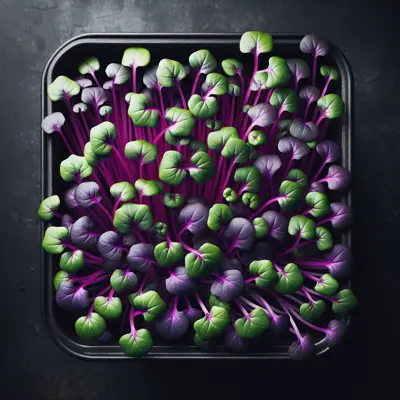
Purple Kohlrabi Microgreens are vibrant, delicate shoots with deep purple cotyledons and green stems, typically ready to harvest at the 2-3 leaf stage within 10-14 days of germination. These microgreens deliver a mild, cabbage-like flavor with a subtle peppery bite and satisfying crunch. The striking purple coloration makes them an excellent garnish for salads, grain bowls, and plated dishes, while their tender texture works well in smoothies and fresh preparations. Easy to grow in standard seed starting mixes with consistent moisture and indirect light, they're ideal for beginners exploring microgreen cultivation.
Harvest
80d
Days to harvest
Sun
Full sun to partial shade
Zones
6–9
USDA hardiness
Height
10-24 inches
Planting Timeline
Showing dates for Purple Kohlrabi Microgreens in USDA Zone 7
All Zone 7 microgreen →Zone Map
Click a state to update dates
Purple Kohlrabi Microgreens · Zones 6–9
Growing Details
Succession Planting
Kohlrabi microgreens don't regrow after cutting — one tray, one harvest. So succession just means staggering your sow dates. With a 3–5 day germination window and a harvest target of day 10–14, starting a fresh tray every 7 days gives you a near-continuous supply without much overlap or gap. These grow year-round indoors, so there's no hard seasonal cutoff.
Natural light is the one variable that throws off the schedule. Below 10 hours of daylight — December and January in most of the country — growth slows and stems get leggy reaching for the window. A T5 or LED panel set to a 16-hour photoperiod keeps the 10–14 day timeline consistent regardless of the month.
Complete Growing Guide
Purple Kohlrabi Microgreens require patience compared to faster-growing microgreens, needing a full 80 days to reach peak harvest size around 8 inches in diameter. Unlike tender leafy microgreens, these brassicas develop sturdy roots that make them excellent for cold storage up to four months, but this extended timeline means maintaining consistent soil moisture and cool growing conditions throughout development. Watch for typical brassica pests like flea beetles and cabbage moths, particularly in warm weather, and ensure adequate air circulation to prevent fungal diseases common in dense brassica crops. These plants have minimal bolting tendency when kept cool, though they may stretch if light becomes insufficient—position them in bright, indirect light rather than full sun during peak heat. A practical tip: harvest when the round bulbs are still tender at 8 inches; waiting longer causes elongation and toughening of the flesh, diminishing the sweet, delicate quality that makes this variety worthwhile.
Light: Full sun (6 or more hours of direct sunlight a day), Partial Shade (Direct sunlight only part of the day, 2-6 hours). Soil: Clay, Loam (Silt), Sand. Soil pH: Acid (<6.0), Neutral (6.0-8.0). Drainage: Good Drainage, Moist. Height: 0 ft. 10 in. - 2 ft. 0 in.. Spread: 1 ft. 0 in. - 2 ft. 0 in.. Spacing: 12 inches-3 feet. Growth rate: Medium. Maintenance: Medium. Propagation: Seed, Stem Cutting. Regions: Coastal, Mountains, Piedmont.
Harvesting
Harvest Purple Kohlrabi Microgreens when the round bulbs reach approximately 8 inches in diameter and display their characteristic deep purple coloring, signaling peak tenderness and sweetness. Gently press the bulb—it should feel firm yet yield slightly to indicate optimal maturity before the plant begins its elongation phase. This variety is best harvested as a single crop rather than through continuous cutting, as the goal is developing the full bulbous root system underground. Time your harvest in the early morning when stems are most turgid and crisp, ensuring the crunchiest texture and mild cabbage-like flavor with its signature peppery bite. Avoid waiting until bulbs exceed 8 inches, as delayed harvest compromises both texture and storage potential.
The fruits dry and split when ripe.
Color: Brown/Copper, Green. Type: Siliqua. Length: > 3 inches.
Garden value: Edible
Harvest time: Fall, Summer
Edibility: The foliage is edible raw or cooked but when cooked can emit an unpleasant odor.
Storage & Preservation
Fresh purple kohlrabi microgreens store best when harvested dry and immediately placed in breathable containers. Use plastic clamshell containers lined with paper towels or perforated bags to maintain proper humidity while allowing air circulation. Store in the refrigerator at 32-35°F with 90-95% humidity for optimal shelf life of 7-10 days.
For longer preservation, purple kohlrabi microgreens can be flash-frozen on parchment-lined trays before transferring to freezer bags, though this changes their texture and makes them suitable only for smoothies or cooked applications. Dehydrating at low temperatures (95-105°F) creates a concentrated garnish that retains the peppery flavor while losing the fresh crunch. Unlike mature kohlrabi, microgreens aren't suitable for traditional preservation methods like fermentation or canning due to their delicate structure.
History & Origin
Purple Kohlrabi belongs to the Brassica oleracea species, which encompasses cabbage, broccoli, and kale—vegetables domesticated from wild mustard plants in the Mediterranean region thousands of years ago. Kohlrabi itself likely originated in northern Europe during the Middle Ages, developing from cabbage through selective breeding for stem enlargement. The purple varieties emerged later as breeders selected for anthocyanin pigmentation, a trait common across brassicas. While specific documentation of the "Purple Kohlrabi Microgreens" cultivar's origin is limited, its development reflects the broader twentieth-century expansion of kohlrabi breeding programs in European seed companies. The variety represents modern microgreen-focused cultivation rather than a distinct historical lineage, combining kohlrabi genetics with contemporary harvesting methods.
Origin: W. Europe
Advantages
- +Purple kohlrabi microgreens offer mild, slightly peppery flavor with satisfying crunch
- +Relatively easy to moderate difficulty makes growing accessible to most gardeners
- +Extended cold storage up to 4 months provides excellent post-harvest shelf life
- +Organic seed availability allows chemical-free cultivation for health-conscious growers
Considerations
- -Susceptible to flea beetles and aphids requiring consistent pest management
- -Long 80-day growing season demands significant time investment before harvest
- -Clubroot and damping off diseases require careful soil management and sanitation
Companion Plants
For tray-grown microgreens, "companion planting" means what you put on adjacent trays, not what you tuck in the ground nearby. Radish microgreens and arugula microgreens are natural shelf-mates for purple kohlrabi because all three want the same misting frequency and airflow — you can run one schedule across the whole rack without shortchanging any of them. Pea shoots work well alongside too: they grow taller without shading the kohlrabi cotyledons at 4–6 hours of light, and their 10–14 day harvest window lines up closely enough that you're not juggling separate cut days.
Fennel is the one to pull off your rack entirely. It releases allelopathic compounds — sesquiterpene lactones, primarily — that suppress germination and early root development in brassicas, and at tray density you'd see the effect within the first few days as uneven, stunted germination. The tomato warning in our database is really a field note; if you're starting tomato seedlings on the same bench as brassica microgreens, though, keep a few feet between them — shared airborne fungal pressure in a humid grow space is real, even if it's not the classic allelopathy story. Strawberries aren't a concern in this context at all.
Plant Together
Lettuce
Similar growing conditions and harvest timing, efficient space utilization
Radish Microgreens
Compatible brassica family member with similar care requirements
Arugula Microgreens
Fellow brassica with complementary spicy flavor profile
Pea Shoots
Nitrogen-fixing properties benefit soil health for successive plantings
Chives
Natural pest deterrent against aphids and flea beetles
Cilantro
Attracts beneficial insects and provides flavor contrast
Spinach Microgreens
Similar light and moisture requirements, good companion crop
Nasturtium
Acts as trap crop for flea beetles and aphids that target brassicas
Keep Apart
Fennel
Allelopathic compounds inhibit growth of brassica family plants
Strawberries
May stunt growth of brassicas through root competition
Tomatoes
Different pH and nutrient requirements can negatively impact kohlrabi growth
Nutrition Facts
Per 100g serving. % Daily Value based on 2,000 calorie diet. Source: USDA FoodData Central (FDC #168424)
Pests & Disease Resistance
Resistance
Good resistance typical of brassicas
Common Pests
Flea beetles, aphids
Diseases
Clubroot, black rot, damping off
Troubleshooting Purple Kohlrabi Microgreens
What you'll see, why it happens, and what to do about it.
Seedlings collapse at the soil line, often in patches, within the first 5 days after germination
Likely Causes
- Damping off (Pythium or Rhizoctonia spp.) — fungal pathogens that thrive in overwatered, poorly ventilated trays
- Seeding too thick, which traps humidity at the medium surface
What to Do
- 1.Cut misting back to twice daily and run a small fan across the trays for 30–60 minutes after each misting session
- 2.If you're reusing trays, sanitize them with a 10% bleach solution between grows — damping off spores persist on plastic
- 3.Discard the affected tray; damping off spreads fast and there's no saving a collapsed patch
Cotyledons developing small, ragged holes or a shotgun-blast pattern of tiny pits, usually appearing 4–7 days after uncovering the tray
Likely Causes
- Flea beetles (Phyllotreta spp.) — they're attracted to brassicas and can find even indoor trays near open windows or greenhouse vents
- Growing near outdoor brassica crops that already have flea beetle pressure
What to Do
- 1.Cover trays with row cover or fine insect mesh immediately after germination if you're growing in a greenhouse or near open vents
- 2.Move trays deeper into an indoor space — flea beetles rarely penetrate well-sealed indoor grow rooms
- 3.Harvest at day 8–9 instead of day 10–12 to outrun feeding damage on the cotyledon stage
Stems developing a slimy, dark rot at their base, with a faint sulfur smell, after day 6
Likely Causes
- Black rot (Xanthomonas campestris pv. campestris) — a bacterial disease that enters through water-saturated tissue
- Bottom-watering that stays pooled in the tray longer than 20–30 minutes, keeping roots in standing water
What to Do
- 1.Switch to top-misting only and confirm your trays drain completely within 20 minutes — add drainage holes if yours don't have them
- 2.Source seed from a supplier that lists hot-water-treated brassica seed, which reduces bacterial contamination on the seed coat
- 3.Trash the affected tray and wipe down your grow shelf with isopropyl alcohol before starting the next batch
Frequently Asked Questions
How long do purple kohlrabi microgreens take to grow?▼
Do purple kohlrabi microgreens need special lighting?▼
What do purple kohlrabi microgreens taste like?▼
Can you regrow purple kohlrabi microgreens after cutting?▼
Are purple kohlrabi microgreens good for beginners?▼
Why are my purple kohlrabi microgreens not turning purple?▼
Zone-by-Zone Planting Calendar
| Zone | Indoor Start | Transplant | Direct Sow | Harvest |
|---|---|---|---|---|
| Zone 1 | January – December | — | — | January – December |
| Zone 2 | January – December | — | — | January – December |
| Zone 11 | January – December | — | — | January – December |
| Zone 12 | January – December | — | — | January – December |
| Zone 13 | January – December | — | — | January – December |
| Zone 3 | January – December | — | — | January – December |
| Zone 4 | January – December | — | — | January – December |
| Zone 5 | January – December | — | — | January – December |
| Zone 6 | January – December | — | — | January – December |
| Zone 7 | January – December | — | — | January – December |
| Zone 8 | January – December | — | — | January – December |
| Zone 9 | January – December | — | — | January – December |
| Zone 10 | January – December | — | — | January – December |
Growing Guides from Wind River Greens
Sources & References
External authority sources used in compiling this guide.
See the Methodology page for how this data is sourced, what's AI-assisted, and known limitations.