Fennel Microgreens
Foeniculum vulgare
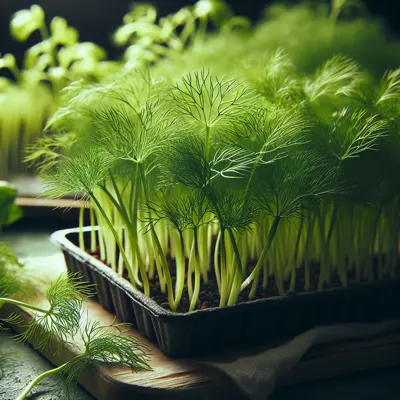
Fennel microgreens are delicate, feathery greens with fine, thread-like leaves that develop a soft yellow-green hue as they mature. Ready to harvest in 50-60 days, these heirloom microgreens deliver an intense anise-licorice flavor that is remarkably aromatic and concentrated. The strong, distinctive taste makes them a specialty garnish for gourmet cuisines, particularly suited for seafood dishes, Mediterranean preparations, and culinary applications where bold licorice notes are desired. Grown indoors under full sun conditions with well-draining seed-starting mix, fennel microgreens require moderate cultivation skill and careful monitoring for aphids and fungus gnats.
Harvest
50-60d
Days to harvest
Sun
Full sun
Zones
4–9
USDA hardiness
Height
4-6 feet
Planting Timeline
Showing dates for Fennel Microgreens in USDA Zone 7
All Zone 7 microgreen →Zone Map
Click a state to update dates
Fennel Microgreens · Zones 4–9
Growing Details
Succession Planting
Fennel microgreens are a fast-turnaround crop — 7–12 days to germination, with harvest typically coming around day 14–18 once shoots reach 2–3 inches (not the 50–60 days listed for full-grown fennel). You cut the whole tray once and that's it, so succession is entirely on you. Sow a fresh 10x20 tray every 7–10 days if you want a continuous supply; that's usually 2–3 trays staggered at any given time. Since these grow indoors year-round, there's no real seasonal cutoff — just keep your germination space between 65°F and 75°F and you'll get consistent results in any month.
The one thing that will interrupt your cadence is summer humidity in an unconditioned space. Damping-off pressure climbs noticeably above 80°F with poor airflow, so either move trays into air conditioning or tighten your misting schedule in July and August.
Complete Growing Guide
Fennel microgreens develop their signature anise-licorice intensity gradually, so resist harvesting at the baby-leaf stage if you want bold flavor—wait until plants reach 8-12 inches tall for the fullest profile. This vigorous, slow-bolting strain is less prone to premature flowering than other fennel types, but maintain consistent moisture and avoid temperature spikes above 70°F to prevent early bolt. Ensure excellent air circulation to mitigate the fungal issues fennel can encounter in humid conditions, particularly damping-off in seedling trays. One practical advantage: this cultivar's uniform growth means synchronized harvesting across your entire crop. Sow densely for traditional microgreen production or thin seedlings if you're growing toward mature plants for edible flowers, which deliver the same sweet anise notes and pair excellently with fish and potato dishes.
Light: Full sun (6 or more hours of direct sunlight a day). Soil: Clay, High Organic Matter, Loam (Silt), Sand. Soil pH: Acid (<6.0), Alkaline (>8.0), Neutral (6.0-8.0). Drainage: Good Drainage, Moist, Occasionally Dry. Height: 4 ft. 0 in. - 6 ft. 0 in.. Spread: 1 ft. 6 in. - 3 ft. 3 in.. Spacing: Less than 12 inches. Maintenance: Low. Propagation: Seed. Regions: Coastal, Mountains, Piedmont.
Harvesting
Fennel microgreens reach peak harvest readiness when their cotyledons have fully expanded and turned a vibrant yellow-green, typically around 10-14 days after sprouting, with a tender yet sturdy texture that resists wilting when gently pinched. The stems should measure approximately 1-2 inches tall with fully unfurled leaves that display the characteristic feathery fennel foliage. A continuous harvest approach works well for this vigorous cultivar, allowing you to cut outer leaves at soil level while leaving the growing center intact for successive flushes, though a single complete harvest is also effective for microgreen applications. Time your final harvest in the morning after moisture has dried from the leaves, as this ensures maximum crispness and flavor intensity while minimizing potential mold issues during storage.
Aromatic seeds follow the flowers in late summer, early fall.
Color: Green, White.
Garden value: Edible, Fragrant
Harvest time: Fall
Storage & Preservation
Fresh fennel microgreens are highly perishable and best used within 3-5 days of harvest. After cutting, gently rinse in cool water and spin dry in a salad spinner or pat dry with paper towels, being careful not to crush the delicate stems.
Store in the refrigerator at 35-40°F in a sealed container lined with paper towels to absorb excess moisture. Change the paper towels if they become damp. Never store wet microgreens, as they'll quickly develop bacterial soft rot.
For longer storage, fennel microgreens can be gently dehydrated at low temperatures (95-105°F) to preserve their anise flavor for use as a seasoning herb. They lose their fresh texture but retain much of their aromatic intensity.
Freezing isn't recommended for fennel microgreens as their high water content and delicate structure make them mushy when thawed. Instead, consider making fennel-infused oils or vinegars with fresh microgreens—chop and steep in olive oil for 2-3 days, then strain for a flavorful finishing oil that captures their essence.
History & Origin
Fennel microgreens derive from the species Foeniculum vulgare, a Mediterranean herb with ancient culinary and medicinal roots spanning thousands of years across European and Middle Eastern traditions. While the specific breeder and introduction date for this particular microgreen strain remain undocumented, the variety represents the modern microgreens movement's adaptation of fennel's established bulbing and leafy cultivars into compact, fast-growing baby-leaf formats. The nonbulbing characteristic and vigor noted in this strain reflect selective breeding priorities common to contemporary microgreen producers seeking uniform, market-ready harvests. This fennel microgreen strain continues the Mediterranean herb's lineage while serving contemporary culinary applications in salads and garnishes.
Origin: Southern Europe and the Mediterranean
Advantages
- +Strong anise-licorice flavor intensifies as fennel microgreens mature fully
- +Vigorous and uniform growth strain resists bolting better than typical fennel
- +Edible flowers add ornamental appeal and pair excellently with fish dishes
- +Versatile culinary applications work in salads, slaws, dressings, and garnishes
Considerations
- -Moderate difficulty level requires careful attention to watering and drainage
- -Susceptible to damping-off and root rot from overwatering during germination
- -Extended 50-60 day growing cycle takes longer than many microgreen varieties
- -Indoor cultivation attracts fungus gnats and aphids requiring pest management
Companion Plants
Fennel microgreens in a tray context are really about what you're growing nearby in the same physical space — a grow rack, a windowsill, a germination chamber. Dill, cilantro, arugula, and radish microgreens all make sensible neighbors because they share similar moisture requirements and germination windows, so you're not juggling wildly different misting schedules on the same shelf. In our zone 7 Georgia garden, where indoor growing spaces can turn warm and stuffy by late spring, grouping these similarly-paced crops together also means one fan setting handles the whole rack without over-drying anything slower.
The problem companions are worth understanding. Tomato seedlings started on the same rack will compete for light and airflow, and fennel produces anethole and other volatile compounds that have documented allelopathic effects on tomato germination — even at the microgreen stage, proximity matters. Bean sprouts need a completely different environment: dark, humid, rinsed twice daily, no growing medium at all. Carrots and kohlrabi are slow enough that they'll still be on their cotyledons when your fennel tray is already cut and in a bowl.
Plant Together
Dill
Both are umbellifer family plants that grow well together and attract beneficial insects
Cilantro
Compatible growth rates and both benefit from similar growing conditions
Chives
Natural pest deterrent that protects fennel microgreens from aphids and fungus gnats
Lettuce
Shallow roots don't compete and fennel's aromatic oils may deter lettuce pests
Spinach
Similar water and light requirements, spinach benefits from fennel's pest-repelling properties
Arugula
Fast-growing brassica that pairs well with fennel's growth cycle and pest protection
Parsley
Fellow umbellifer that thrives in similar conditions and attracts beneficial predatory insects
Radish Microgreens
Quick germination companion that helps break soil crust and deters root maggots
Keep Apart
Tomato
Fennel's allelopathic compounds inhibit tomato growth and development
Bean Sprouts
Fennel compounds can stunt legume growth and interfere with nitrogen fixation
Carrot
Despite being related, fennel can inhibit carrot seed germination and root development
Kohlrabi
Fennel's allelopathic effects particularly suppress brassica root vegetables
Nutrition Facts
Per 100g serving. % Daily Value based on 2,000 calorie diet. Source: USDA FoodData Central (FDC #167782)
Pests & Disease Resistance
Resistance
Good disease resistance when properly ventilated
Common Pests
Aphids, fungus gnats (indoor growing)
Diseases
Damping-off, root rot from overwatering
Troubleshooting Fennel Microgreens
What you'll see, why it happens, and what to do about it.
Seedlings collapse at the base and fall over, usually within the first 5–8 days after germination
Likely Causes
- Damping-off (Pythium or Rhizoctonia spp.) — fungal pathogens that thrive in wet, poorly ventilated conditions
- Overwatering combined with low airflow, which keeps the medium saturated long enough for fungal colonization to take hold
What to Do
- 1.Back off misting immediately — the medium should feel like a wrung-out sponge, not wet
- 2.Point a small fan at the tray on low for a few hours a day to improve surface airflow
- 3.Toss the affected tray; damping-off doesn't reverse. Sanitize with a 10% bleach rinse before reusing
Tiny flies hovering around trays, and seedlings stalling out or looking stunted after day 10
Likely Causes
- Fungus gnats (Bradysia spp.) — their larvae chew fine root hairs in the growing medium, cutting off uptake
- Consistently moist top layer of medium, which is exactly where fungus gnats lay eggs
What to Do
- 1.Let the top 1/4 inch of medium dry slightly between mistings — larvae can't survive without sustained surface moisture
- 2.Place a yellow sticky trap flat near tray level to catch adults and get a read on population size
- 3.For a persistent infestation, drench the medium once with a diluted hydrogen peroxide solution (1 part 3% H2O2 to 4 parts water) to knock out larvae without harming seeds
Frequently Asked Questions
How long do fennel microgreens take to grow?▼
Do fennel microgreens taste like licorice?▼
Why won't my fennel microgreen seeds germinate?▼
Can you regrow fennel microgreens after cutting?▼
Are fennel microgreens good for beginners?▼
What's the best way to prevent damping-off in fennel microgreens?▼
Zone-by-Zone Planting Calendar
| Zone | Indoor Start | Transplant | Direct Sow | Harvest |
|---|---|---|---|---|
| Zone 1 | January – December | — | — | January – December |
| Zone 2 | January – December | — | — | January – December |
| Zone 11 | January – December | — | — | January – December |
| Zone 12 | January – December | — | — | January – December |
| Zone 13 | January – December | — | — | January – December |
| Zone 3 | January – December | — | — | January – December |
| Zone 4 | January – December | — | — | January – December |
| Zone 5 | January – December | — | — | January – December |
| Zone 6 | January – December | — | — | January – December |
| Zone 7 | January – December | — | — | January – December |
| Zone 8 | January – December | — | — | January – December |
| Zone 9 | January – December | — | — | January – December |
| Zone 10 | January – December | — | — | January – December |
Growing Guides from Wind River Greens
Sources & References
External authority sources used in compiling this guide.
- ExtensionNC State Extension
- USDAUSDA FoodData Central
See the Methodology page for how this data is sourced, what's AI-assisted, and known limitations.