Cilantro Microgreens
Coriandrum sativum
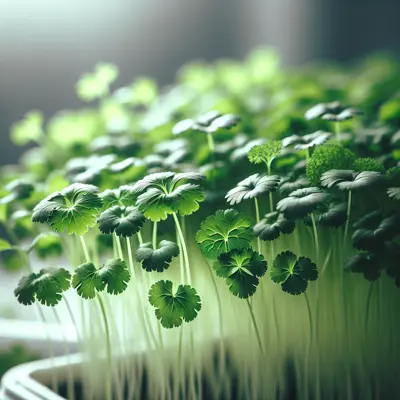
Cilantro Microgreens are delicate, tender seedlings harvested at 16-25 days, featuring thin stems topped with vibrant green, feathery leaves that resemble mature cilantro foliage. These heirloom microgreens deliver an intensely concentrated cilantro flavor—bright, citrusy, and distinctly herbaceous—making them a potent garnish and flavoring agent. Ideal for fresh applications like salsas, Asian cuisines, and contemporary plating, they add sophisticated herb character to dishes without bulk. Their moderate difficulty and preference for well-draining medium make them suitable for home cultivation under full sun to partial shade conditions.
Harvest
16-25d
Days to harvest
Sun
Full sun to partial shade
Zones
1–12
USDA hardiness
Height
12-24 inches
Planting Timeline
Showing dates for Cilantro Microgreens in USDA Zone 7
All Zone 7 microgreen →Zone Map
Click a state to update dates
Cilantro Microgreens · Zones 1–12
Growing Details
Succession Planting
A single tray of cilantro microgreens turns around in 16 to 25 days, so stagger new trays every 7 days to keep a continuous harvest. Start the next tray when the previous one hits day 7 or 8 — right as germination wraps up — and you'll pull cuttings on a weekly rotation without gaps. Because cilantro microgreens grow indoors under controlled light and temperature, there's no summer heat cutoff; this cadence runs all 12 months.
Complete Growing Guide
Cilantro microgreens require patience, as they typically need 16–25 days to reach maturity—longer than many common microgreens—so plan accordingly for succession plantings. These seeds benefit from consistent moisture and moderate light; avoid overwatering, which can trigger damping-off disease in the dense growing environment. Cilantro is notably prone to bolting when exposed to excessive heat or light stress, so maintain temperatures around 65–70°F and provide bright but indirect light. At 26 grams per tray, this cultivar produces vigorous growth that can become leggy if light is insufficient, causing the characteristic stretch that weakens flavor intensity. Harvest at the first true leaf stage rather than waiting for full cotyledon development to capture the most vibrant, citrusy flavor. A practical tip: soak seeds for 2–4 hours before planting to improve germination rates and reduce the overall maturity window by a day or two.
Light: Full sun (6 or more hours of direct sunlight a day), Partial Shade (Direct sunlight only part of the day, 2-6 hours). Soil: Loam (Silt). Drainage: Good Drainage, Moist. Height: 1 ft. 0 in. - 2 ft. 0 in.. Spread: 1 ft. 0 in. - 2 ft. 0 in.. Spacing: 12 inches-3 feet. Growth rate: Rapid. Maintenance: Low. Propagation: Seed. Regions: Coastal, Mountains, Piedmont.
Harvesting
Cilantro microgreens reach peak harvest readiness when the first true leaves emerge with their characteristic medium-green color and achieve a height of 12-24 inches, displaying a tender yet sturdy texture when gently squeezed. Visual cues include the unfurling of the distinctive cilantro leaf shape beyond the initial cotyledons and a vibrant, uniform green coloration throughout the tray. Most growers employ a single-harvest method, cutting just above the soil line when microgreens reach approximately 20 days from seeding, as this timing maximizes the bright, citrusy flavor intensity before leaves become woody. For optimal results, harvest in the morning after any surface moisture has dried, as this extends shelf life and preserves the delicate herb's aromatic qualities essential for Mexican and Asian cuisines.
Coriander seeds ripen in round, yellow-brown pod
Color: Brown/Copper, Gold/Yellow. Length: < 1 inch.
Garden value: Edible
Edibility: Leaves, stems, flowers and seeds are edible. Leaves/flowers as an herb and seeds (Coriander) as a spice.
Storage & Preservation
Store freshly harvested cilantro microgreens immediately in the refrigerator between 35-40°F in a breathable container—plastic clamshells with ventilation holes work perfectly. Line containers with a slightly damp paper towel to maintain humidity without creating soggy conditions. Properly stored microgreens maintain peak quality for 7-10 days.
For preservation, cilantro microgreens freeze exceptionally well. Spread clean, dry microgreens on parchment-lined trays, freeze until solid, then transfer to freezer bags. They'll maintain flavor for up to 6 months and can be added directly to hot dishes without thawing.
Dehydrating is another excellent option—use a dehydrator at 95°F for 4-6 hours until crisp. Dried cilantro microgreens concentrate the flavor beautifully and store in airtight containers for up to one year.
History & Origin
Cilantro microgreens derive from *Coriandrum sativum*, a herb with ancient origins in the Mediterranean and South Asia, cultivated for thousands of years. The microgreen format itself represents a modern horticultural innovation developed over the past few decades as demand for fresh, nutrient-dense greens increased. While specific breeding records for cilantro microgreen varieties are not extensively documented in academic literature, commercial seed companies began producing and promoting cilantro microgreen seed stocks in the early 2000s as part of the broader microgreens movement. The variety described here reflects standard commercial cilantro germplasm optimized for rapid growth and visual appeal in controlled indoor growing systems, rather than a distinctly named or formally released cultivar.
Origin: Western Mediterranean, Southern Europe, Western Asia
Advantages
- +Intense, bright citrusy flavor is superior to standard chopped cilantro leaves
- +Versatile ingredient for Mexican, Asian, and fusion cuisine applications
- +Elegant presentation and visual appeal with medium-green leaves and stems
- +Relatively quick 16-25 day maturity makes production cycles efficient
- +First true leaf harvest stage offers optimal flavor concentration
Considerations
- -Moderate difficulty level requires careful attention to growing conditions
- -Susceptible to aphids and fungus gnats requiring pest management strategies
- -Prone to root rot and damping off from overwatering or poor drainage
- -Higher seeding density of 26 gm per tray increases seed costs per crop
Companion Plants
Basil and lettuce are the practical neighbors for cilantro microgreens in a tray setup — basil's volatile oils have documented pest-repellent effect, and lettuce shares the same shallow moisture needs without competing for root depth. Radish microgreens germinate fast enough to fill gaps without crowding. Keep fennel and dill off the bench entirely; all three are Apiaceae, cross-pollination is a real concern if any plants are allowed to bolt, and dill carries mild allelopathic compounds that can suppress neighboring seedlings. In our zone 7 Georgia garden, where summer humidity already stacks the deck toward damping off, pairing cilantro with lower-moisture companions like arugula helps you keep the whole tray a tick drier.
Plant Together
Basil
Repels aphids and whiteflies that can damage cilantro microgreens
Chives
Natural pest deterrent that repels aphids without competing for space
Lettuce
Similar growing conditions and harvest timing, efficient space utilization
Spinach
Compatible moisture and temperature requirements, quick harvest cycle
Radish Microgreens
Fast-growing companion with similar care needs and harvest window
Arugula
Thrives in same cool, moist conditions preferred by cilantro microgreens
Peas
Nitrogen fixation benefits cilantro growth, similar moisture preferences
Mint
Repels ants and rodents, though should be contained to prevent spreading
Keep Apart
Fennel
Produces allelopathic compounds that inhibit germination and growth of cilantro
Dill
Can cross-pollinate and compete for similar nutrients, may affect flavor
Sunflowers
Release allelopathic chemicals that suppress growth of smaller plants
Nutrition Facts
Per 100g serving. % Daily Value based on 2,000 calorie diet. Source: USDA FoodData Central (FDC #169997)
Pests & Disease Resistance
Resistance
Generally hardy but sensitive to overwatering
Common Pests
Aphids, fungus gnats
Diseases
Root rot from overwatering, damping off in poor drainage conditions
Troubleshooting Cilantro Microgreens
What you'll see, why it happens, and what to do about it.
Seedlings collapsing at the soil line, stems pinching and turning brown at the base, usually between days 5 and 10
Likely Causes
- Damping off (Pythium or Rhizoctonia spp.) — fungal pathogens that thrive in waterlogged growing medium
- Overwatering or misting too frequently, especially in a low-airflow tray setup
What to Do
- 1.Cut misting to once daily and make sure your tray has drainage — standing water at the bottom is the main culprit
- 2.Run a small fan on low for 30 minutes or more per day to move air across the tray surface
- 3.Dump the tray and start fresh — damping off spreads fast and there's no saving an affected flat
Tiny slow-moving insects on the growing medium surface or around tray edges, seedlings growing sluggishly or not at all
Likely Causes
- Fungus gnats (Bradysia spp.) — adults lay eggs in moist medium, larvae chew roots and stall germination
- Consistently wet top layer of growing medium, which is exactly what fungus gnat larvae need to establish
What to Do
- 1.Let the top 1/4 inch of the growing medium dry out between mistings — cilantro microgreens want less water than most microgreens, so pulling back is correct practice anyway
- 2.Place yellow sticky traps flat near the tray surface to catch adults and gauge how bad the pressure is
- 3.For persistent infestations, drench the medium once with a diluted hydrogen peroxide solution (1 part 3% H2O2 to 4 parts water) to knock back larvae without harming seedlings
Frequently Asked Questions
How long do cilantro microgreens take to grow?▼
Do I need to crush cilantro seeds before planting microgreens?▼
Can you grow cilantro microgreens without soil?▼
What do cilantro microgreens taste like compared to mature cilantro?▼
Why are my cilantro microgreens dying after sprouting?▼
Are cilantro microgreens good for beginners?▼
Zone-by-Zone Planting Calendar
| Zone | Indoor Start | Transplant | Direct Sow | Harvest |
|---|---|---|---|---|
| Zone 3 | January – December | — | — | January – December |
| Zone 4 | January – December | — | — | January – December |
| Zone 5 | January – December | — | — | January – December |
| Zone 6 | January – December | — | — | January – December |
| Zone 7 | January – December | — | — | January – December |
| Zone 8 | January – December | — | — | January – December |
| Zone 9 | January – December | — | — | January – December |
| Zone 10 | January – December | — | — | January – December |
| Zone 1 | January – December | — | — | January – December |
| Zone 2 | January – December | — | — | January – December |
| Zone 11 | January – December | — | — | January – December |
| Zone 12 | January – December | — | — | January – December |
| Zone 13 | January – December | — | — | January – December |
Growing Guides from Wind River Greens
Sources & References
External authority sources used in compiling this guide.
- ExtensionNC State Extension
- USDAUSDA FoodData Central
See the Methodology page for how this data is sourced, what's AI-assisted, and known limitations.