Celery Microgreens
Apium graveolens
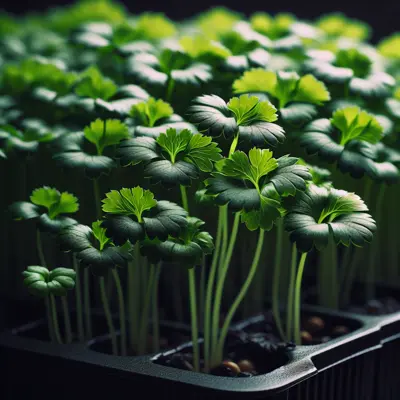
Medium-large, relatively smooth round roots with buff-colored skin. Interiors are white and flavorful and resist pithiness and hollow heart. Also available with NOP-compliant pelleting.
Harvest
100d
Days to harvest
Sun
Full sun
Zones
3–6
USDA hardiness
Height
1-3 feet
Planting Timeline
Showing dates for Celery Microgreens in USDA Zone 7
All Zone 7 microgreen →Zone Map
Click a state to update dates
Celery Microgreens · Zones 3–6
Growing Details
Complete Growing Guide
Light: Full sun (6 or more hours of direct sunlight a day). Soil: High Organic Matter. Soil pH: Neutral (6.0-8.0). Drainage: Good Drainage, Moist. Height: 1 ft. 6 in. - 3 ft. 0 in.. Spread: 1 ft. 0 in. - 1 ft. 6 in.. Spacing: Less than 12 inches. Maintenance: Medium. Propagation: Seed.
Harvesting
The fruits are black when ripened. The tiny seeds are ovoid-shaped.
Color: Black. Type: Schizocarp. Length: < 1 inch. Width: < 1 inch.
Harvest time: Fall
Edibility: Celery Seed comes from Wild Celery. The bitter-tasting leaves are inedible.
Storage & Preservation
Fresh celery microgreens are highly perishable and best used within 3-5 days of harvest. Store them unwashed in a breathable container lined with paper towels in the refrigerator at 35-38°F. Avoid plastic bags, which trap moisture and accelerate decay.
For preservation, dehydration works exceptionally well with celery microgreens due to their intense flavor concentration. Use a dehydrator at 95°F for 8-12 hours until crispy, then store in airtight containers for up to 6 months. The dried microgreens make excellent seasoning blends and soup garnishes.
Freezing is less ideal due to their delicate structure, but you can freeze them in ice cubes with water or olive oil for later use in cooked dishes. They'll lose their crisp texture but retain most of their flavor compounds for up to 3 months.
History & Origin
Origin: Macaronesia to North Africa, Europe to West Himalaya
Advantages
- +Attracts: Bees, Butterflies
- +Edible: Celery Seed comes from Wild Celery. The bitter-tasting leaves are inedible.
Companion Plants
In our zone 7 Georgia indoor and greenhouse setups, celery microgreens grow in trays rather than beds, so in-ground companion logic doesn't map directly — but spacing and airflow still matter when trays share a rack. Chives and parsley work well on adjacent shelves because they tolerate the same light misting cadence without creating a humidity spike that invites damping off. Fennel is the one to keep off your rack entirely: its volatile allelopathic compounds suppress germination in Apiaceae relatives, and celery is squarely in that family. Carrots present the same problem — they're close enough genetically that crowding the two in shared airspace tends to produce uneven, patchy germination in both trays.
Plant Together
Chives
Repels aphids and other soft-bodied insects that commonly attack celery
Tomatoes
Celery improves tomato flavor and growth while tomatoes provide natural pest protection
Lettuce
Similar growing conditions and spacing requirements, good companion for microgreen trays
Spinach
Compatible moisture and temperature needs, can be grown in adjacent trays
Parsley
Both are umbellifers with similar growing requirements and pest resistance
Cabbage
Celery repels cabbage worms and flea beetles that attack brassicas
Marigolds
Natural pest deterrent that protects against aphids and whiteflies
Dill
Attracts beneficial insects and has similar growing conditions
Keep Apart
Carrots
Both are susceptible to carrot fly and sharing space increases pest pressure
Corn
Creates too much shade and competes heavily for nutrients
Fennel
Inhibits growth of most plants including celery through allelopathic compounds
Nutrition Facts
Per 100g serving. % Daily Value based on 2,000 calorie diet. Source: USDA FoodData Central (FDC #167782)
Pests & Disease Resistance
Resistance
Moderate resistance, can be sensitive to fungal issues in high humidity
Common Pests
Aphids, spider mites in dry conditions
Diseases
Damping off, leaf blight, septoria leaf spot in humid conditions
Troubleshooting Celery Microgreens
What you'll see, why it happens, and what to do about it.
Seedlings collapse at soil level, falling over within the first 5–10 days after germination
Likely Causes
- Damping off (Pythium or Rhizoctonia spp.) — fungal pathogens that thrive in waterlogged growing medium
- Overwatering or poor drainage in the tray, especially with a lid left on too long
What to Do
- 1.Remove any humidity dome as soon as the first shoots emerge — celery microgreens don't need it past day 3 or 4
- 2.Switch from misting to a very light, targeted spray and let the surface dry slightly between waterings
- 3.If most of the tray is affected, pull the whole flat and start fresh — damping off spreads fast and there's no recovering a tray that's half gone
Thin, pale, leggy seedlings stretching toward the light by day 7–10, stems too weak to stand upright
Likely Causes
- Insufficient light — celery microgreens need 6+ hours of direct light or a grow light kept 2–3 inches above the canopy
- Grow light mounted too high, prompting seedlings to reach instead of thickening up
What to Do
- 1.Move the tray to your brightest south-facing windowsill, or drop the grow light to within 2–3 inches of the canopy
- 2.Harvest earlier — leggy celery microgreens at 10–12 days are still usable; waiting longer just compounds the problem
Webbing visible between stems with tiny moving specks, seedlings look dry and stippled despite regular misting
Likely Causes
- Spider mites (Tetranychus urticae) — common in dry indoor conditions, especially in heated rooms in winter
- Low ambient humidity around the tray, which spider mites prefer over anything above 50% relative humidity
What to Do
- 1.Harvest immediately if the tray is close to ready — mites move fast and the greens are still edible at that stage
- 2.Raise ambient humidity with a small humidifier near your growing area, aiming for 50–60% RH
- 3.Between cycles, wipe down trays with a diluted neem solution and let them dry completely before reseeding
Frequently Asked Questions
How long do celery microgreens take to grow?▼
Are celery microgreens good for beginners?▼
Can you grow celery microgreens without soil?▼
What do celery microgreens taste like?▼
Why are my celery microgreens falling over and dying?▼
Can celery microgreens be regrown after cutting?▼
Zone-by-Zone Planting Calendar
| Zone | Indoor Start | Transplant | Direct Sow | Harvest |
|---|---|---|---|---|
| Zone 1 | January – December | — | — | January – December |
| Zone 2 | January – December | — | — | January – December |
| Zone 11 | January – December | — | — | January – December |
| Zone 12 | January – December | — | — | January – December |
| Zone 13 | January – December | — | — | January – December |
| Zone 3 | January – December | — | — | January – December |
| Zone 4 | January – December | — | — | January – December |
| Zone 5 | January – December | — | — | January – December |
| Zone 6 | January – December | — | — | January – December |
| Zone 7 | January – December | — | — | January – December |
| Zone 8 | January – December | — | — | January – December |
| Zone 9 | January – December | — | — | January – December |
| Zone 10 | January – December | — | — | January – December |
Growing Guides from Wind River Greens
Sources & References
External authority sources used in compiling this guide.
See the Methodology page for how this data is sourced, what's AI-assisted, and known limitations.