Red Kingdom
Brassica rapa
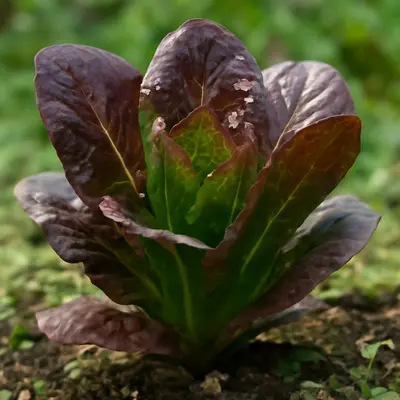
Gently scalloped margin on a broad, deeply colored leaf. Mild flavor. Underside of leaf is light green with striking dark purple veining. AAS Winner.
Harvest
21d
Days to harvest
Sun
Full sun to part shade
Zones
5–9
USDA hardiness
Height
3 feet
Planting Timeline
Showing dates for Red Kingdom in USDA Zone 7
All Zone 7 lettuce →Zone Map
Click a state to update dates
Red Kingdom · Zones 5–9
Growing Details
Succession Planting
Direct sow every 14 days starting around March 1. Red Kingdom matures in 21 days, so a two-week cadence keeps you from having more heads ready than you can use at once. Keep sowing through early May, then stop — once daytime highs are consistently above 80°F, quality drops fast and bolting follows within days, not weeks.
Start again around August 15, sowing every 14 days through mid-September. That puts your last harvest in late October or early November, which lines up with the zone 7 planting calendar. In zones 8–9, push the fall start to early September and you'll still get 2–3 rounds before the season ends.
Complete Growing Guide
Gently scalloped margin on a broad, deeply colored leaf. Mild flavor. Underside of leaf is light green with striking dark purple veining. AAS Winner. According to Johnny's Selected Seeds, Red Kingdom is 21 baby; 40 full size to maturity, annual, hybrid (f1). Notable features: Cold Tolerant, Hydroponic Performer, Heat Tolerant, AAS (All-America Selections) Winners.
Light: Full sun (6 or more hours of direct sunlight a day), Partial Shade (Direct sunlight only part of the day, 2-6 hours). Soil: Clay, Loam (Silt), Sand. Soil pH: Acid (<6.0), Neutral (6.0-8.0). Drainage: Good Drainage, Moist. Height: 0 ft. 10 in. - 2 ft. 0 in.. Spread: 1 ft. 0 in. - 2 ft. 0 in.. Spacing: 12 inches-3 feet. Growth rate: Medium. Maintenance: Medium. Propagation: Seed, Stem Cutting. Regions: Coastal, Mountains, Piedmont.
Harvesting
Red Kingdom reaches harvest at 21 baby; 40 full size from sowing per Johnny's Selected Seeds. As an annual, harvest continues until frost ends the season.
The fruits dry and split when ripe.
Color: Brown/Copper, Green. Type: Siliqua. Length: > 3 inches.
Garden value: Edible
Harvest time: Fall, Summer
Bloom time: Spring, Summer
Edibility: The foliage is edible raw or cooked but when cooked can emit an unpleasant odor.
Storage & Preservation
Red Kingdom lettuce stores best at 32–36°F with 95% humidity in a perforated plastic bag within the crisper drawer. Keep it away from ethylene-producing fruits like apples. Fresh heads remain crisp for 7–10 days when properly chilled immediately after harvest.
For preservation, freezing is the most practical method: blanch leaves briefly in boiling water for 2–3 minutes, cool in ice water, pat dry, and freeze in airtight containers for up to 8 months. The texture won't suit fresh salads post-thaw, but frozen leaves work well in soups and cooked dishes. Fermenting is another option—layer shredded Red Kingdom with salt (2% by weight) in a jar and let it culture at room temperature for 3–7 days before refrigerating.
Red Kingdom's deep burgundy leaves retain their color better during freezing than lighter varieties, making them visually appealing in winter cooking.
History & Origin
Red Kingdom is an F1 hybrid developed through controlled cross-pollination. Listed in the Johnny's Selected Seeds catalog.
Brassica rapa is an annual to biennial plant species native to Eurasia that is from the Brassicaceae family. The B. rapa subspecies oleifera is an oilseed commonly known as turnip rape, field mustard, bird's rape, and keblock.
Advantages
- +Striking dark purple veining and coloring makes Red Kingdom visually distinctive in salads.
- +Mild flavor appeals to broad palates without the bitterness of some varieties.
- +Fast 21-day maturity allows multiple succession plantings throughout the growing season.
- +AAS award recognition indicates superior performance in taste, appearance, and reliability.
- +Gently scalloped leaf margins add textural interest and visual appeal to plates.
Considerations
- -Deep purple coloration may fade or become less vibrant in extreme heat.
- -Light green underside suggests potential vulnerability to tipburn in calcium-deficient soils.
- -Broad, delicate leaves are more prone to bruising during harvest and handling.
- -Red varieties typically have shorter shelf life than green lettuce types.
Companion Plants
Radishes and chives are the two companions most worth planting close to Red Kingdom. Radishes mature in 25–30 days and pull flea beetles (Phyllotreta spp.) toward themselves and away from your lettuce — they're expendable in a way a 21-day head crop isn't. Chives and garlic both contain sulfur compounds thought to deter aphids, which matters specifically here because Myzus persicae doesn't need to linger long to transmit lettuce mosaic virus. Marigolds (Tagetes patula) have some evidence for reducing thrips pressure at close range and slot neatly into an edge row without competing for the consistent moisture Red Kingdom needs.
Broccoli is the companion to drop from the list. It's a heavy feeder with a wide root zone, and it'll muscle Red Kingdom out of both water and nutrients. Sunflowers release allelopathic compounds from their roots that can stunt shallow-rooted crops nearby — keep them at least 3 feet away from any lettuce bed.
Plant Together
Chives
Repels aphids and improves lettuce flavor while providing natural pest deterrent
Carrots
Compatible root depths, carrots help break up soil for lettuce shallow roots
Radishes
Fast-growing radishes break up soil and can be harvested before lettuce needs full space
Marigolds
Repel nematodes, aphids, and other pests while attracting beneficial insects
Spinach
Similar growing requirements and can be intercropped for efficient space use
Garlic
Natural fungicide properties help prevent lettuce diseases and repel pests
Nasturtiums
Act as trap crop for aphids and cucumber beetles, protecting lettuce
Cilantro
Attracts beneficial insects and provides natural pest control for lettuce
Keep Apart
Broccoli
Competes heavily for nutrients and can shade out lettuce with large leaves
Sunflowers
Allelopathic effects inhibit lettuce growth and massive size creates too much shade
Parsley
Can attract carrot fly which may damage lettuce roots and competes for similar nutrients
Nutrition Facts
Per 100g serving. % Daily Value based on 2,000 calorie diet. Source: USDA FoodData Central (FDC #2346388)
Pests & Disease Resistance
Common Pests
Aphids, slugs, snails, flea beetles
Diseases
Lettuce mosaic virus, downy mildew, powdery mildew
Troubleshooting Red Kingdom
What you'll see, why it happens, and what to do about it.
Seedlings collapse at soil level within the first 7–10 days after transplanting, sometimes with fuzzy white mold on the soil surface
Likely Causes
- Damping off — a complex of soil-borne fungi (Pythium spp., Rhizoctonia solani) that attack stems at the soil line
- Replanting in the same bed where lettuce has grown for 2–3 consecutive years, allowing pathogen buildup
What to Do
- 1.Pull and discard the dead seedlings — don't compost them
- 2.Rotate out of that bed for at least one season; the NC State IPM framework specifically flags repeated use of the same raised bed as a contributing factor
- 3.Improve drainage and back off irrigation in the first week — damp, warm soil is where damping off thrives
Leaves show pale yellow-green mosaic patterning or mottling, with distorted or crinkled new growth
Likely Causes
- Lettuce mosaic virus (LMV), transmitted by aphids (especially Myzus persicae) in a non-persistent manner — even a brief aphid visit can transfer it
- Starting from infected seed lots
What to Do
- 1.Source certified virus-free seed — LMV can be seed-borne, so this is the most effective prevention step
- 2.Use row cover (Agribon AG-15 or similar) from transplant to reduce aphid pressure during the first few weeks
- 3.Remove and bag any symptomatic plants immediately; there's no cure once a plant is infected
Grayish-purple fuzzy growth on the undersides of leaves, with corresponding yellow patches on the upper surface
Likely Causes
- Downy mildew (Bremia lactucae) — favored by cool nights around 50–60°F combined with high humidity or overhead watering
- Dense planting that restricts airflow between plants
What to Do
- 1.Water at the base of the plant, not overhead, especially in the evening
- 2.Give each plant its full 12–18 inches of spacing — crowding is the most common reason Bremia lactucae spreads quickly through a bed
- 3.Strip affected outer leaves and put them in the trash; apply a copper-based fungicide if the infection is still advancing
Ragged holes chewed into leaves overnight, with no insects visible during the day — seedlings can be nearly stripped within 48 hours
Likely Causes
- Slugs or snails feeding after dark — they retreat to moist, shaded spots (under mulch, pot edges, boards) by morning
- Flea beetles (Phyllotreta spp.) — these leave smaller, cleaner holes and are active during the day; brush the foliage and watch for tiny jumping insects
What to Do
- 1.For slugs: go out with a flashlight 1–2 hours after dark and hand-pick, or set beer traps at soil level; iron phosphate bait (Sluggo) is effective and safe around other crops
- 2.For flea beetles: cover transplants with row cover immediately after planting — plants under 21 days old take the worst damage
- 3.Pull mulch 2–3 inches back from the base of plants to cut down on slug hiding spots
Frequently Asked Questions
How long does Red Kingdom lettuce take to mature?▼
Is Red Kingdom lettuce good for beginners?▼
Can you grow Red Kingdom lettuce in containers?▼
What does Red Kingdom lettuce taste like?▼
When should I plant Red Kingdom lettuce?▼
Why is Red Kingdom lettuce an AAS Winner?▼
Zone-by-Zone Planting Calendar
| Zone | Indoor Start | Transplant | Direct Sow | Harvest |
|---|---|---|---|---|
| Zone 3 | — | — | May – June | May – October |
| Zone 4 | — | — | April – June | May – October |
| Zone 5 | — | — | April – May | May – November |
| Zone 6 | — | — | April – May | April – November |
| Zone 7 | — | — | March – May | April – November |
| Zone 8 | — | — | March – April | March – December |
| Zone 9 | — | — | February – March | February – December |
| Zone 10 | — | — | January – March | February – December |
| Zone 1 | — | — | June – July | June – September |
| Zone 2 | — | — | May – July | June – September |
| Zone 11 | — | — | January – February | January – December |
| Zone 12 | — | — | January – February | January – December |
| Zone 13 | — | — | January – February | January – December |
Growing Guides from Wind River Greens
Sources & References
External authority sources used in compiling this guide.
- BreederJohnny's Selected Seeds
- USDAUSDA FoodData Central
See the Methodology page for how this data is sourced, what's AI-assisted, and known limitations.