Rosie
Brassica rapa var. chinensis
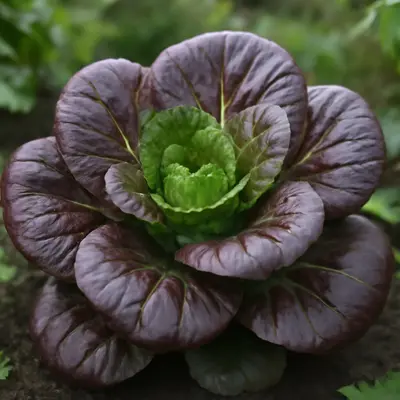
12" tall plants are vase-shaped with bright red leaves and greenish-red stems. Good for mixed packs with green- or white-stemmed pac chois. Also excellent as a baby leaf.
Harvest
21d
Days to harvest
Sun
Full sun to part shade
Zones
5–9
USDA hardiness
Height
3 feet
Planting Timeline
Showing dates for Rosie in USDA Zone 7
All Zone 7 lettuce →Zone Map
Click a state to update dates
Rosie · Zones 5–9
Growing Details
Succession Planting
Direct sow Rosie every 14 days starting March 1 in zone 7, running through early May. At 21 days to harvest, three or four staggered sowings are enough to keep a near-continuous supply without overplanting. Stop once daytime highs are consistently hitting 85°F — heat triggers rapid bolting and leaf bitterness on bok choy-type greens, and Rosie moves fast in that direction.
Pick back up with sowings in late August through early October. Fall plantings often outperform spring in flavor; cooler nights slow cell elongation and the leaves come in denser and less bitter. In zone 7, an October 1 sowing can push harvest into November with a light row cover on frost nights.
Complete Growing Guide
12" tall plants are vase-shaped with bright red leaves and greenish-red stems. Good for mixed packs with green- or white-stemmed pac chois. Also excellent as a baby leaf. According to Johnny's Selected Seeds, Rosie is 21 baby; 45 full size to maturity, annual, hybrid (f1). Notable features: Cold Tolerant, Hydroponic Performer.
Light: Full sun (6 or more hours of direct sunlight a day), Partial Shade (Direct sunlight only part of the day, 2-6 hours). Soil: Clay, Loam (Silt), Sand. Soil pH: Acid (<6.0), Neutral (6.0-8.0). Drainage: Good Drainage, Moist. Height: 0 ft. 10 in. - 2 ft. 0 in.. Spread: 1 ft. 0 in. - 2 ft. 0 in.. Spacing: 12 inches-3 feet. Growth rate: Medium. Maintenance: Medium. Propagation: Seed, Stem Cutting. Regions: Coastal, Mountains, Piedmont.
Harvesting
Rosie reaches harvest at 21 baby; 45 full size from sowing per Johnny's Selected Seeds. Expect 12" at peak. As an annual, harvest continues until frost ends the season.
The fruits dry and split when ripe.
Color: Brown/Copper, Green. Type: Siliqua. Length: > 3 inches.
Garden value: Edible
Harvest time: Fall, Summer
Bloom time: Spring, Summer
Edibility: The foliage is edible raw or cooked but when cooked can emit an unpleasant odor.
Storage & Preservation
Harvest Rosie at peak tenderness (around 21 days) and store unwashed heads in a perforated plastic bag in the refrigerator's crisper drawer at 32–35°F with 95% humidity. Properly stored, Rosie will keep fresh for 7–10 days, though quality declines after day five. For longer preservation, blanch leaves briefly in boiling water, shock in ice water, then freeze in airtight containers or vacuum-seal bags for up to three months. Fermentation works well too: shred leaves, salt at 2–3% by weight, and pack tightly in jars under brine for a crisp, probiotic condiment lasting several weeks. Drying is less rewarding for this tender variety. Rosie's thin, delicate leaves are prone to bruising during storage, so handle gently and avoid stacking heavy items on top—pack them loosely with paper towels to absorb excess moisture and maintain texture.
History & Origin
Rosie is an F1 hybrid developed through controlled cross-pollination. Listed in the Johnny's Selected Seeds catalog.
Brassica is a genus of plants in the cabbage and mustard family (Brassicaceae). The members of the genus are informally known as cruciferous vegetables, cabbages, mustard plants, or simply brassicas. Crops from this genus are sometimes called cole crops—derived from the Latin caulis, denoting the stem or stalk of a plant.
Advantages
- +Vibrant red leaves create striking visual appeal in salads and dishes
- +Compact 12-inch vase shape maximizes space efficiency in garden beds
- +Fast 21-day maturity enables quick successive plantings throughout growing season
- +Excellent dual-purpose variety works as baby leaf or full-size harvest
- +Pairs beautifully with green or white-stemmed pac chois in mixed plantings
Considerations
- -Red pigmentation may fade or brown under excessive heat stress
- -Requires consistent moisture to prevent bolting and maintain leaf tenderness
- -Limited seed availability compared to standard green lettuce varieties
Companion Plants
Radishes and carrots are the most practical companions here. Radishes germinate in 5–7 days and can be interplanted at 4-inch spacing to break up the soil surface and draw flea beetles away from Rosie's leaves — flea beetles will go for radish foliage first, giving you a sacrificial crop that's easier to monitor. Carrots share a similar root depth and don't compete hard for water or nitrogen at the densities most gardeners use. Marigolds (Tagetes patula specifically) planted at the bed edges put off compounds that irritate aphids at close range — not a miracle, but a documented effect within about 12 inches. Chives and garlic work on a similar principle; their sulfur compounds are a genuine deterrent to soft-bodied insects.
Fennel is the one to pull far from this bed. It releases anethole from its roots, which suppresses germination and early growth in brassica-family plants — tested, not folklore. Broccoli is a problem for a different reason: it's a heavy nitrogen feeder that competes directly with Rosie, and it hosts the same aphid species that will move onto your bok choy once populations build up.
Plant Together
Chives
Repels aphids and improves lettuce flavor while providing natural pest deterrent
Carrots
Loosens soil for lettuce roots and doesn't compete for nutrients due to different root depths
Radishes
Quick-growing root vegetables that break up soil and can be intercropped with lettuce
Marigolds
Repels nematodes, aphids, and other pests while attracting beneficial insects
Nasturtiums
Acts as trap crop for aphids and cucumber beetles, protecting lettuce from damage
Garlic
Natural fungicide and pest repellent that deters aphids and slugs
Spinach
Similar growing conditions and harvest times, efficient use of garden space
Parsley
Attracts beneficial insects and provides light shade without competing heavily for nutrients
Keep Apart
Broccoli
Heavy feeder that competes intensely for nitrogen and can overshadow lettuce
Fennel
Produces allelopathic compounds that inhibit germination and growth of lettuce
Sunflowers
Tall growth creates excessive shade and roots compete aggressively for water and nutrients
Nutrition Facts
Per 100g serving. % Daily Value based on 2,000 calorie diet. Source: USDA FoodData Central (FDC #2346388)
Pests & Disease Resistance
Common Pests
Aphids, slugs, flea beetles, cutworms
Diseases
Powdery mildew, downy mildew, root rot (in waterlogged conditions)
Troubleshooting Rosie
What you'll see, why it happens, and what to do about it.
Seedlings collapsing at the soil line within the first 7–10 days after planting — stem looks pinched or water-soaked at the base
Likely Causes
- Damping off — a fungal complex (commonly Pythium spp. or Rhizoctonia solani) that thrives in wet, poorly drained soil
- Overwatering or compacted soil that holds moisture too long after transplant
What to Do
- 1.Pull and discard affected seedlings; don't compost them
- 2.Let the bed surface dry slightly between waterings — Rosie needs consistent moisture, not standing water
- 3.If you've lost seedlings in the same bed multiple years running, NC State's IPM guidance recommends sending a soil sample to a diagnostic lab to confirm the pathogen before replanting
White powdery coating on the upper leaf surfaces, usually showing up once temps stay above 70°F
Likely Causes
- Powdery mildew — most likely Erysiphe cichoracearum on brassica-type greens
- Poor airflow from crowded planting at less than 8 inches apart
What to Do
- 1.Thin plants to at least 8–10 inches apart to open up airflow
- 2.Remove heavily coated leaves and bin them
- 3.Apply a dilute neem oil spray (2 tsp per quart of water) every 7 days until the outbreak slows
Irregular yellow patches on upper leaf surfaces with grayish-purple fuzz on the undersides
Likely Causes
- Downy mildew (Peronospora parasitica) — favored by cool nights below 65°F and high humidity
- Overhead irrigation that keeps foliage wet overnight
What to Do
- 1.Switch to drip or base watering to keep the leaves dry
- 2.Increase spacing and remove the worst-affected outer leaves
- 3.Downy mildew doesn't respond to the same treatments as powdery mildew — copper-based fungicides are a reasonable first chemical step, not neem
Ragged holes chewed in leaves, or seedlings cut off entirely at the soil line overnight
Likely Causes
- Slugs — active at night in moist conditions, leave a visible slime trail on leaves and soil
- Cutworms (larvae of various Noctuidae moths) — work just below the soil surface and sever young stems
What to Do
- 1.For slugs: scatter iron phosphate bait (Sluggo) around the base of plants at dusk; confirm with a flashlight check for slime trails
- 2.For cutworms: dig 1–2 inches into the soil around a severed plant — you'll usually find the pale, curled larva; drop it in soapy water
- 3.Place a 3-inch cardboard or plastic collar pushed 1 inch into the soil around transplants to block cutworm access
Frequently Asked Questions
How long does Rosie lettuce take to grow?▼
Can you grow Rosie lettuce in containers?▼
Is Rosie lettuce good for beginners?▼
What does Rosie lettuce taste like?▼
When should you plant Rosie lettuce?▼
Can Rosie lettuce tolerate cold weather?▼
Zone-by-Zone Planting Calendar
| Zone | Indoor Start | Transplant | Direct Sow | Harvest |
|---|---|---|---|---|
| Zone 1 | — | — | June – July | June – September |
| Zone 2 | — | — | May – July | June – September |
| Zone 11 | — | — | January – February | January – December |
| Zone 12 | — | — | January – February | January – December |
| Zone 13 | — | — | January – February | January – December |
| Zone 3 | — | — | May – June | May – October |
| Zone 4 | — | — | April – June | May – October |
| Zone 5 | — | — | April – May | May – November |
| Zone 6 | — | — | April – May | April – November |
| Zone 7 | — | — | March – May | April – November |
| Zone 8 | — | — | March – April | March – December |
| Zone 9 | — | — | February – March | February – December |
| Zone 10 | — | — | January – March | February – December |
Growing Guides from Wind River Greens
Sources & References
External authority sources used in compiling this guide.
- BreederJohnny's Selected Seeds
- USDAUSDA FoodData Central
See the Methodology page for how this data is sourced, what's AI-assisted, and known limitations.