Koji
Brassica rapa
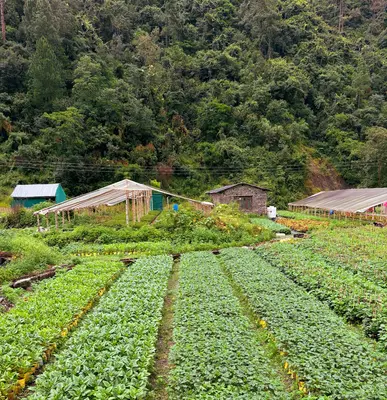
Cupped, heavy leaves are beautifully savoyed and borne on long, elegant stems. Heat and cold tolerant for all-season production. Mild flavor and crunchy texture. Striking paired with Red Cloud at full size. Space 12" apart for full-size heads.
Harvest
25d
Days to harvest
Sun
Full sun to part shade
Zones
5–9
USDA hardiness
Height
3 feet
Planting Timeline
Showing dates for Koji in USDA Zone 7
All Zone 7 lettuce →Zone Map
Click a state to update dates
Koji · Zones 5–9
Growing Details
Succession Planting
Koji hits harvest in just 25 days, which makes succession planting straightforward and worth doing. Direct sow every 10–14 days starting March 1 in zone 7, continuing through early May. Lettuce bolts fast once daytime highs consistently reach 80°F, so stop sowing for summer and pick back up around August 15 — soil temps should be dropping enough by then for reliable germination, and you can carry harvests through October or into November depending on your frost date.
If you're sowing into warm soil in late summer, refrigerate the seeds for 24 hours before planting. Lettuce seed has a well-documented thermoinhibition response above 75°F soil temp, and that one step meaningfully improves germination rates.
Complete Growing Guide
Cupped, heavy leaves are beautifully savoyed and borne on long, elegant stems. Heat and cold tolerant for all-season production. Mild flavor and crunchy texture. Striking paired with Red Cloud at full size. Space 12" apart for full-size heads. According to Johnny's Selected Seeds, Koji is 25 baby; 43 full size to maturity, annual, hybrid (f1). Notable features: Cold Tolerant, Hydroponic Performer.
Light: Full sun (6 or more hours of direct sunlight a day), Partial Shade (Direct sunlight only part of the day, 2-6 hours). Soil: Clay, Loam (Silt), Sand. Soil pH: Acid (<6.0), Neutral (6.0-8.0). Drainage: Good Drainage, Moist. Height: 0 ft. 10 in. - 2 ft. 0 in.. Spread: 1 ft. 0 in. - 2 ft. 0 in.. Spacing: 12 inches-3 feet. Growth rate: Medium. Maintenance: Medium. Propagation: Seed, Stem Cutting. Regions: Coastal, Mountains, Piedmont.
Harvesting
Koji reaches harvest at 25 baby; 43 full size from sowing per Johnny's Selected Seeds. Expect 12" at peak. As an annual, harvest continues until frost ends the season.
The fruits dry and split when ripe.
Color: Brown/Copper, Green. Type: Siliqua. Length: > 3 inches.
Garden value: Edible
Harvest time: Fall, Summer
Bloom time: Spring, Summer
Edibility: The foliage is edible raw or cooked but when cooked can emit an unpleasant odor.
Storage & Preservation
Harvest koji lettuce at peak tenderness around day 25 and store immediately in the refrigerator at 32–40°F with high humidity (95% ideal). Place unwashed heads in a perforated plastic bag or crisper drawer lined with damp paper towels to maintain moisture without promoting rot. Fresh koji keeps 7–10 days under these conditions before quality declines noticeably.
For preservation beyond fresh storage, freezing works best for cooked applications—blanch briefly in boiling water, shock in ice water, and pack into freezer containers for up to three months. Alternatively, ferment fresh leaves with salt to create a traditional preserved condiment that develops complex flavor over weeks. Drying is less practical for this tender variety as it loses its characteristic crisp texture.
Koji's relatively short harvest window makes prompt refrigeration critical; delaying storage by even a few hours measurably reduces shelf life.
History & Origin
Koji is an F1 hybrid developed through controlled cross-pollination. Listed in the Johnny's Selected Seeds catalog.
Brassica rapa is an annual to biennial plant species native to Eurasia that is from the Brassicaceae family. The B. rapa subspecies oleifera is an oilseed commonly known as turnip rape, field mustard, bird's rape, and keblock.
Advantages
- +Beautiful savoyed leaves on elegant stems create striking visual appeal
- +Tolerates both heat and cold enabling reliable year-round garden production
- +Quick 25-day maturity means fast harvests and succession planting opportunities
- +Mild flavor and crisp texture works well in mixed salads
- +Pairs beautifully with Red Cloud lettuce for color contrast displays
Considerations
- -Requires 12-inch spacing reducing plant density compared to compact varieties
- -Long stems may require staking or support in windy locations
- -Cupped leaf structure can trap soil and debris during washing
Companion Plants
Radishes and carrots are the most practical neighbors for Koji. Radishes germinate fast and can be pulled in 25–30 days, loosening the top inch of soil as they go — plus they draw flea beetles away before those beetles reach your Brassica rapa. Carrots root deep enough that there's no real competition at 12-inch lettuce spacing; the two genuinely share space without stepping on each other. Chives and garlic along the bed edge release sulfur compounds that deter aphids, which NC State Extension lists as one of the most consistent lettuce pests. French marigolds are worth tucking in if your soil has any history of nematode pressure — NC State's IPM notes recommend a solid marigold planting to knock back nematode populations before returning susceptible crops to a bed.
Broccoli is the companion to avoid. It's in the same family as Koji, which means shared pressure from flea beetles and Bremia lactucae — putting them side by side just gives both problems a bigger target. Sunflowers are allelopathic and will stunt nearby plants; keep them at least 3 feet out from your lettuce bed.
Plant Together
Chives
Repels aphids and improves lettuce flavor when planted nearby
Carrots
Loosens soil for lettuce roots and doesn't compete for nutrients
Radishes
Quick-growing, breaks up soil, and helps deter flea beetles
Marigolds
Natural pest deterrent, repels nematodes and aphids
Spinach
Similar growing requirements and harvest times, efficient space usage
Garlic
Repels slugs, snails, and aphids that commonly attack lettuce
Nasturtiums
Acts as trap crop for aphids and cucumber beetles
Dill
Attracts beneficial insects and may improve lettuce growth
Keep Apart
Broccoli
Heavy feeder that competes for nutrients and can shade lettuce
Sunflowers
Allelopathic compounds inhibit lettuce germination and growth
Parsley
Can stunt lettuce growth when planted too close together
Nutrition Facts
Per 100g serving. % Daily Value based on 2,000 calorie diet. Source: USDA FoodData Central (FDC #2346388)
Pests & Disease Resistance
Common Pests
Aphids, slugs, lettuce root aphids, flea beetles
Diseases
Lettuce mosaic virus, downy mildew, bacterial leaf spot
Troubleshooting Koji
What you'll see, why it happens, and what to do about it.
Seedlings collapsing at the soil line within the first 7–10 days after sowing, sometimes with fuzzy white mold visible on the soil surface
Likely Causes
- Damping off — typically Pythium or Rhizoctonia spp. — a soil-borne fungal complex that thrives in wet, poorly drained conditions
- Replanting the same bed with lettuce year after year, which builds up pathogen load in the soil
What to Do
- 1.Hold off watering until the top half-inch of soil is dry — excess moisture is what tips the scale toward damping off
- 2.Improve drainage by amending with perlite or compost, or switch to a fresh raised-bed mix
- 3.Rotate lettuce out of that bed for at least one season; NC State's IPM guidance specifically flags repeated same-bed planting as a risk factor for seedling disease buildup
Leaves showing irregular yellow patches on top with grayish-purple fuzzy growth on the undersides, usually in cool, wet weather
Likely Causes
- Downy mildew (Bremia lactucae) — spreads fast in temps between 50–65°F with high humidity or overhead moisture
- Crowded spacing that keeps foliage wet and limits airflow between plants
What to Do
- 1.Space plants at least 12 inches apart and thin aggressively — Koji gets up to 3 feet tall and needs the room
- 2.Water at the base, not overhead, and do it in the morning so foliage dries before nightfall
- 3.Pull and bag (don't compost) any heavily infected leaves; Bremia spores overwinter in plant debris
Frequently Asked Questions
How long does it take to grow Koji lettuce from seed to harvest?▼
Is Koji lettuce good for beginners?▼
Can you grow Koji lettuce in containers?▼
What does Koji lettuce taste like?▼
When should I plant Koji lettuce for best results?▼
How does Koji lettuce compare to Red Cloud?▼
Zone-by-Zone Planting Calendar
| Zone | Indoor Start | Transplant | Direct Sow | Harvest |
|---|---|---|---|---|
| Zone 1 | — | — | June – July | June – September |
| Zone 2 | — | — | May – July | June – September |
| Zone 11 | — | — | January – February | January – December |
| Zone 12 | — | — | January – February | January – December |
| Zone 13 | — | — | January – February | January – December |
| Zone 3 | — | — | May – June | May – October |
| Zone 4 | — | — | April – June | May – October |
| Zone 5 | — | — | April – May | May – November |
| Zone 6 | — | — | April – May | April – November |
| Zone 7 | — | — | March – May | April – November |
| Zone 8 | — | — | March – April | March – December |
| Zone 9 | — | — | February – March | February – December |
| Zone 10 | — | — | January – March | February – December |
Growing Guides from Wind River Greens
Sources & References
External authority sources used in compiling this guide.
- BreederJohnny's Selected Seeds
- USDAUSDA FoodData Central
See the Methodology page for how this data is sourced, what's AI-assisted, and known limitations.