Joi Choi
Brassica rapa var. chinensis
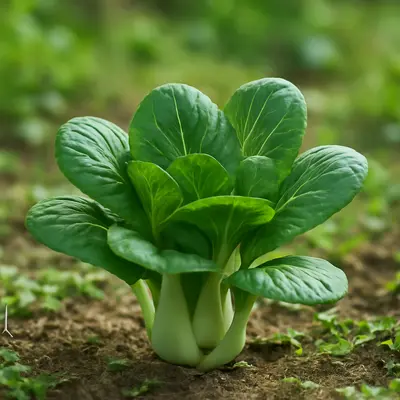
Joi Choi forms a 12-15" tall, broad, heavy plant with dark green leaves and thick, flattened white petioles. Tolerant to heat and cold. Space 10-12" apart.
Harvest
50d
Days to harvest
Sun
Full sun to part shade
Zones
5–9
USDA hardiness
Height
3 feet
Planting Timeline
Showing dates for Joi Choi in USDA Zone 7
All Zone 7 lettuce →Zone Map
Click a state to update dates
Joi Choi · Zones 5–9
Growing Details
Succession Planting
Direct sow Joi Choi every 14–21 days starting March 1 in zone 7, and continue through early May. At 50 days to harvest, staggered sowings give you a steady supply rather than 40 heads ready the same week. Pick back up in late August for a fall run — sow through mid-September and you'll be cutting into November before hard frost ends it.
Stop succession sowings once daytime highs are consistently above 85°F. Joi Choi tolerates heat better than head lettuce, but it will still bolt and turn bitter in midsummer. Let that bed rest or plant a heat crop, then restart your fall succession in late summer when temperatures drop back below 85°F during the day.
Complete Growing Guide
Joi Choi forms a 12-15" tall, broad, heavy plant with dark green leaves and thick, flattened white petioles. Tolerant to heat and cold. Space 10-12" apart. According to Johnny's Selected Seeds, Joi Choi is 50 days to maturity, annual, hybrid (f1). Notable features: Cold Tolerant, Hydroponic Performer.
Light: Full sun (6 or more hours of direct sunlight a day), Partial Shade (Direct sunlight only part of the day, 2-6 hours). Soil: Clay, Loam (Silt), Sand. Soil pH: Acid (<6.0), Neutral (6.0-8.0). Drainage: Good Drainage, Moist. Height: 0 ft. 10 in. - 2 ft. 0 in.. Spread: 1 ft. 0 in. - 2 ft. 0 in.. Spacing: 12 inches-3 feet. Growth rate: Medium. Maintenance: Medium. Propagation: Seed, Stem Cutting. Regions: Coastal, Mountains, Piedmont.
Harvesting
Joi Choi reaches harvest at 50 days from sowing per Johnny's Selected Seeds. Expect 12-15" at peak. As an annual, harvest continues until frost ends the season.
The fruits dry and split when ripe.
Color: Brown/Copper, Green. Type: Siliqua. Length: > 3 inches.
Garden value: Edible
Harvest time: Fall, Summer
Bloom time: Spring, Summer
Edibility: The foliage is edible raw or cooked but when cooked can emit an unpleasant odor.
Storage & Preservation
Harvest Joi Choi at 50 days and refrigerate immediately in a sealed plastic bag or container at 32–40°F with 95% humidity; proper moisture retention is critical since these tender leaves wilt quickly. Expect 7–10 days of acceptable freshness, though peak quality drops after 5–6 days. For preservation, light blanching (2–3 minutes) followed by freezing works well for cooked applications like stir-fries; avoid freezing raw, as the delicate leaves become mushy upon thaw. Fermentation is an excellent option—submerge trimmed leaves in 3–5% saltwater brine for 5–7 days at room temperature for a tangy condiment. Drying is less practical given the high water content. One peculiarity of Joi Choi: the tender petioles remain crisp far longer than the leaf blade if separated and stored independently, making them worth isolating for extended freshness.
History & Origin
Joi Choi is an F1 hybrid developed through controlled cross-pollination. Listed in the Johnny's Selected Seeds catalog.
Brassica is a genus of plants in the cabbage and mustard family (Brassicaceae). The members of the genus are informally known as cruciferous vegetables, cabbages, mustard plants, or simply brassicas. Crops from this genus are sometimes called cole crops—derived from the Latin caulis, denoting the stem or stalk of a plant.
Advantages
- +Joi Choi reaches full size in just 50 days for quick harvests
- +Impressive 12-15 inch height provides substantial yields per plant
- +Tolerates both heat and cold extremes without bolting or splitting
- +Thick white petioles offer satisfying crunch and premium market appearance
- +Easy difficulty rating makes it ideal for beginner and commercial growers
Considerations
- -Requires 10-12 inch spacing, reducing plant density compared to smaller varieties
- -Susceptible to cabbage worms and flea beetles common to Brassicas
- -Heavy plant structure needs consistent moisture or leaves become bitter and tough
Companion Plants
Radishes are worth direct-sowing right alongside Joi Choi — they germinate in 5–7 days, break up the soil surface for slower brassica roots, and their pungency disrupts flea beetles before those beetles locate your bok choy. Marigolds (Tagetes spp.) add something different: root secretions that suppress certain soil nematodes, plus open flowers that draw hoverflies whose larvae consume aphids — the same aphids that carry lettuce mosaic virus into your planting. Chives and garlic work through sulfur compounds released from their roots and foliage, which seem to slow aphid colonization. Neither competes aggressively for water at the 10–12 inch spacing Joi Choi needs.
Broccoli is the pairing to skip. It's close enough in the Brassica family to share clubroot (Plasmodiophora brassicae) in the soil, and it pulls in the same flea beetle pressure — stacking two targets in one spot just amplifies both problems. Sunflowers release allelopathic compounds from their roots and decomposing debris that can inhibit germination and suppress growth in nearby leafy greens. Keep both at least a full bed's distance away.
Plant Together
Chives
Repels aphids and other pests that commonly attack lettuce
Carrots
Deep roots don't compete with shallow lettuce roots, helps break up soil
Radishes
Quick harvest allows space for lettuce expansion, breaks up compacted soil
Marigolds
Deters aphids, whiteflies, and nematodes while attracting beneficial insects
Garlic
Natural pest deterrent against aphids, slugs, and cabbage worms
Spinach
Similar growing requirements and harvest times, efficient space usage
Dill
Attracts beneficial insects like ladybugs and parasitic wasps
Nasturtiums
Acts as trap crop for aphids and cucumber beetles
Parsley
Attracts beneficial insects and doesn't compete for root space
Keep Apart
Sunflowers
Tall growth creates excessive shade and competes for nutrients
Broccoli
Heavy feeder that competes for nitrogen and space
Nutrition Facts
Per 100g serving. % Daily Value based on 2,000 calorie diet. Source: USDA FoodData Central (FDC #2346388)
Pests & Disease Resistance
Common Pests
Aphids, slugs, flea beetles
Diseases
Lettuce mosaic virus, downy mildew, bacterial leaf spot
Troubleshooting Joi Choi
What you'll see, why it happens, and what to do about it.
Seedlings collapse at soil level within the first 7–10 days after transplanting or germination
Likely Causes
- Damping off — a fungal complex (commonly Pythium or Rhizoctonia) that thrives in wet, poorly drained soil
- Planting into a bed that has grown brassicas or lettuce for 3+ consecutive years without rotation
What to Do
- 1.Don't overwater newly seeded flats or beds — let the top 1/4 inch dry slightly between waterings
- 2.If you see whitish fuzzy mold on the soil surface (NC State Extension's IPM case study describes exactly this), pull affected seedlings immediately and improve drainage before resowing
- 3.Rotate the bed out of brassicas and leafy greens for at least one full season
Leaves show irregular yellow mosaic patterning or puckering, plants stunted by day 30
Likely Causes
- Lettuce mosaic virus (LMV), transmitted by aphids — particularly green peach aphid (Myzus persicae)
- Starting from infected seed stock
What to Do
- 1.Pull and trash infected plants — LMV has no cure once established
- 2.Source certified virus-free seed for future plantings
- 3.Knock aphid colonies back early with a hard water spray or insecticidal soap; a small colony can vector the virus across an entire bed in days
White to gray downy coating on the undersides of outer leaves, with yellow patches on the upper surface
Likely Causes
- Downy mildew (Bremia lactucae) — favored by cool nights below 60°F and humidity that stays high overnight
- Overhead irrigation that leaves foliage wet through the evening
What to Do
- 1.Switch to drip irrigation or water in the morning so leaves dry before nightfall
- 2.Strip and trash affected outer leaves at first sign — don't compost them
- 3.Space plants at least 10–12 inches apart; crowded rows trap moisture and give Bremia exactly what it wants
Irregular holes chewed in leaves overnight, with silvery slime trails visible the next morning
Likely Causes
- Slugs — especially active in cool, wet spring conditions and in beds with heavy mulch tight against the stems
- Flea beetles produce similar small holes but leave no slime trail and feed during the day
What to Do
- 1.Scatter iron phosphate bait (Sluggo is the common brand) around plants at dusk — it breaks down into fertilizer and won't harm soil biology or pets
- 2.Pull mulch a few inches back from each stem to cut daytime hiding spots
- 3.For flea beetle pressure, float row cover over transplants for the first 2–3 weeks; that window is when the damage is worst
Frequently Asked Questions
How long does Joi Choi lettuce take to harvest?▼
Is Joi Choi good for beginners?▼
Can you grow Joi Choi in containers?▼
What does Joi Choi lettuce taste like?▼
When should I plant Joi Choi?▼
Does Joi Choi need full sun?▼
Zone-by-Zone Planting Calendar
| Zone | Indoor Start | Transplant | Direct Sow | Harvest |
|---|---|---|---|---|
| Zone 1 | — | — | June – July | July – September |
| Zone 2 | — | — | May – July | July – September |
| Zone 11 | — | — | January – February | February – December |
| Zone 12 | — | — | January – February | February – December |
| Zone 13 | — | — | January – February | February – December |
| Zone 3 | — | — | May – June | June – October |
| Zone 4 | — | — | April – June | June – October |
| Zone 5 | — | — | April – May | June – November |
| Zone 6 | — | — | April – May | May – November |
| Zone 7 | — | — | March – May | May – November |
| Zone 8 | — | — | March – April | April – December |
| Zone 9 | — | — | February – March | March – December |
| Zone 10 | — | — | January – March | March – December |
Growing Guides from Wind River Greens
Sources & References
External authority sources used in compiling this guide.
- BreederJohnny's Selected Seeds
- USDAUSDA FoodData Central
See the Methodology page for how this data is sourced, what's AI-assisted, and known limitations.