Purple Top White Globe Turnip
Brassica rapa 'Purple Top White Globe'
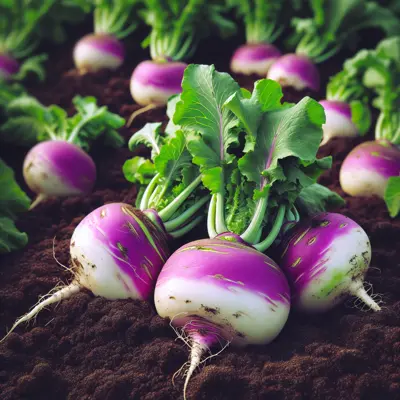
A classic heirloom turnip variety prized for its sweet, mild flavor and distinctive purple and white coloring that makes it as beautiful as it is delicious. Both the tender roots and nutritious greens are edible, giving gardeners two crops from one planting. This fast-growing cool-season crop is perfect for spring and fall gardens and stores well through winter.
Harvest
50-60d
Days to harvest
Sun
Full sun to partial shade
Zones
5–11
USDA hardiness
Height
3 feet
Planting Timeline
Showing dates for Purple Top White Globe Turnip in USDA Zone 7
All Zone 7 herb →Zone Map
Click a state to update dates
Purple Top White Globe Turnip · Zones 5–11
Growing Details
Zone-by-Zone Planting Calendar
| Zone | Indoor Start | Transplant | Direct Sow | Harvest |
|---|---|---|---|---|
| Zone 5 | March – April | May – June | — | June – October |
| Zone 6 | March – April | May – June | — | June – November |
| Zone 7 | February – March | April – June | — | June – November |
| Zone 8 | February – March | April – May | — | May – December |
| Zone 9 | January – February | March – April | — | April – December |
| Zone 10 | January – January | February – April | — | April – December |
Complete Growing Guide
Purple Top White Globe turnips thrive in cool conditions, so timing your planting is crucial for success. For spring crops, direct sow seeds 2-4 weeks before your last expected frost when soil temperatures reach 45-50°F. Fall plantings are often more successful—start 10-12 weeks before your first hard frost for the sweetest roots.
Prepare your planting bed by working compost or aged manure into loose, well-drained soil with a pH between 6.0-7.0. Turnips develop poorly in compacted clay or waterlogged conditions, so raised beds work exceptionally well. Unlike many root crops, Purple Top White Globe tolerates partial shade, making it perfect for those tricky garden spots that get only 4-6 hours of direct sunlight.
Sow seeds directly in the garden rather than starting indoors—turnips hate transplant shock and often bolt prematurely if their taproots are disturbed. Plant seeds ¼ inch deep in rows 12 inches apart, or broadcast them in wide beds. You'll need to thin seedlings to 4-6 inches apart once they're 2 inches tall—don't skip this step or you'll end up with all greens and no roots.
Fertilize lightly with a balanced 10-10-10 fertilizer at planting, then side-dress with nitrogen 3-4 weeks later if plants look pale. Avoid over-fertilizing with nitrogen, which produces lush tops but disappointing roots. Consistent moisture is essential—allow soil to dry slightly between waterings but never let plants wilt, as stress causes woody, bitter roots.
The biggest mistake novice growers make is planting too late in spring. If temperatures consistently hit 75°F or higher, your turnips will bolt to seed without forming good roots. In hot climates (zones 8-10), stick to fall and winter plantings. Northern gardeners can succession plant every 2-3 weeks through late summer for continuous harvests.
Harvesting
Purple Top White Globe turnips are ready when roots reach 2-4 inches in diameter, typically 50-60 days from seeding. The distinctive purple 'shoulders' should be clearly visible above ground—this variety naturally pushes about one-third of its root above the soil line. Harvest when roots feel firm and the white portion has a bright, clean appearance.
For the sweetest flavor, harvest after a few light frosts, which convert starches to sugars. Test readiness by gently brushing soil away from the purple crown—if it's 2 inches across, it's ready. Avoid letting roots exceed 4 inches, as they become woody and develop a strong, unpleasant flavor.
Harvest in the morning when plants are fully hydrated. Grasp the greens close to the root and pull straight up with a gentle twisting motion. In hard soil, loosen around the root with a garden fork first. Cut greens to 1 inch from the root immediately after harvest to prevent moisture loss. Both baby turnips (1-2 inches) and full-size roots are excellent eating—harvest according to your kitchen needs rather than waiting for maximum size.
Storage & Preservation
Fresh Purple Top White Globe turnips store exceptionally well when properly handled. Remove greens immediately, leaving 1 inch of stem to prevent bleeding. Store unwashed roots in perforated plastic bags in the refrigerator crisper drawer at 32-35°F with high humidity—they'll keep 4-6 months this way.
For root cellaring, layer turnips in slightly damp sand or peat moss in a cool (32-40°F), humid location. They'll remain crisp through winter using this traditional method. Avoid storing near apples or pears, which release ethylene gas that causes bitter flavors.
Preservation options include blanching and freezing cubed turnips (though texture softens), fermentation for traditional turnip kraut, or pickling smaller roots whole. The greens freeze beautifully after blanching for 2 minutes—treat them like collards or kale. Dehydrating works well for turnip chips or for grinding into powder for seasoning.
History & Origin
Purple Top White Globe represents one of America's oldest and most enduring turnip varieties, with documented cultivation dating back to the 1850s. This heirloom variety likely originated from Scottish and English turnip varieties brought by early European settlers, then underwent selection by American farmers for improved flavor and storage characteristics.
The variety gained particular prominence in the mid-Atlantic and Northeastern states, where its cold tolerance and storage ability made it a crucial winter food source. Many period seed catalogs from the 1880s-1920s featured Purple Top White Globe as their premier turnip offering, praising its 'perfect globe shape' and 'superior table quality.'
Unlike many modern hybrid turnips bred primarily for commercial uniformity, this heirloom maintains the genetic diversity that allowed early American farmers to save seed and adapt the variety to local growing conditions. Its continued popularity among home gardeners reflects both its reliable performance and the nostalgic appeal of growing the same variety that sustained previous generations through harsh winters.
Advantages
- +Exceptional cold tolerance—actually improves in flavor after light frosts
- +Dual-purpose crop providing both sweet roots and nutritious greens from one planting
- +Outstanding storage life of 4-6 months when properly stored
- +Fast-growing with harvest possible in just 50 days
- +Naturally pushes above ground making harvest timing easy to judge
- +Mild, sweet flavor appeals to turnip skeptics
- +Adapts well to partial shade conditions where other root crops fail
Considerations
- -Becomes woody and bitter if allowed to grow larger than 4 inches
- -Bolts quickly in hot weather—spring planting window is narrow
- -Susceptible to flea beetle damage on young leaves
- -Requires consistent moisture or roots become tough and fibrous
- -Poor performance in heavy clay or waterlogged soils
Companion Plants
Plant Together
Radishes
Break up compacted soil with their roots, helping turnip root development
Lettuce
Shallow roots don't compete with turnips, provides ground cover
Spinach
Cool-season companion with similar growing requirements and non-competing root systems
Carrots
Different root depths allow efficient use of soil space without competition
Onions
Repel root maggots and other pests that commonly attack turnip roots
Garlic
Natural pest deterrent, especially against aphids and root flies
Peas
Fix nitrogen in soil which benefits turnip leaf growth
Marigolds
Repel nematodes and other soil pests that damage turnip roots
Keep Apart
Mustard
Both are brassicas and attract the same pests like flea beetles and clubroot disease
Cabbage
Fellow brassica that competes for nutrients and shares common diseases like black rot
Broccoli
Same plant family leading to increased pest pressure and soil nutrient depletion
Nutrition Facts
Per 100g serving. % Daily Value based on 2,000 calorie diet. Source: USDA FoodData Central (FDC #170465)
Pests & Disease Resistance
Resistance
Moderate resistance to clubroot and black rot
Common Pests
Flea beetles, cabbage root maggot, aphids
Diseases
Clubroot, black rot, downy mildew