Gourmet Gold Dill
Anethum graveolens 'Gourmet Gold'
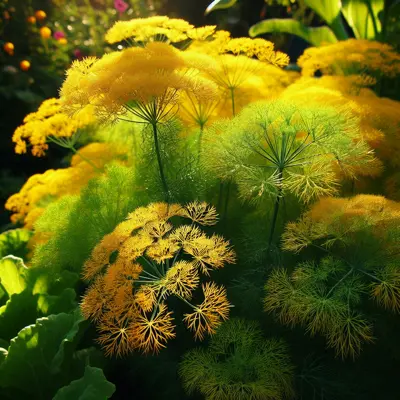
A stunning ornamental dill variety with bright golden-yellow foliage that adds both culinary value and visual drama to herb gardens. The vibrant color intensifies in cool weather while maintaining the classic dill flavor profile. Perfect for gardeners who want their herb garden to double as landscape decoration.
Harvest
40-50d
Days to harvest
Sun
Full sun to partial shade
Zones
2–11
USDA hardiness
Height
2-5 feet
Planting Timeline
Showing dates for Gourmet Gold Dill in USDA Zone 7
All Zone 7 herb →Zone Map
Click a state to update dates
Gourmet Gold Dill · Zones 2–11
Growing Details
Succession Planting
Dill bolts quickly in heat, so a single sowing won't carry you through the season. In zone 7, transplant a first round in April, then direct sow every 14–21 days through mid-May. Stop once daytime highs are consistently hitting 85°F — anything going in after that will sprint to flower within a couple of weeks and give you almost no harvestable leaf. For fall production, resume direct sowing in late August or early September; dill handles light frost down to about 25°F, so you can pull leaves well into November.
Complete Growing Guide
Light: Full sun (6 or more hours of direct sunlight a day), Partial Shade (Direct sunlight only part of the day, 2-6 hours). Soil: High Organic Matter, Loam (Silt), Sand. Soil pH: Acid (<6.0), Neutral (6.0-8.0). Drainage: Good Drainage, Moist. Height: 2 ft. 6 in. - 5 ft. 0 in.. Spread: 2 ft. 0 in. - 3 ft. 0 in.. Spacing: 12 inches-3 feet. Growth rate: Medium. Maintenance: Low. Propagation: Seed. Regions: Coastal, Mountains, Piedmont.
Harvesting
Dill fruits are oval, compressed with ridges and progress from bright green color to dark brown with age. They have a pleasant aromatic odor.
Color: Brown/Copper, Green. Type: Schizocarp. Length: < 1 inch. Width: < 1 inch.
Garden value: Edible, Fragrant
Harvest time: Fall, Spring, Summer
Edibility: Leaves (dill weed), seeds, and flowers are edible (used in teas, pickling, and as culinary seasoning). Dill herb and dill seed oils are steam-distilled and used by the food industry as seasonings. Add to pickles, mince in butter, and cook with salmon, borscht, fish, and soups. Dill can be used in teas and as seasoning for butter, cakes, bread, vinegars, soups, fish, pickles, salads, etc.
Storage & Preservation
Freshly harvested Gourmet Gold dill keeps best in the refrigerator at 35-40°F with moderate humidity, loosely wrapped in damp paper towels and stored in a perforated plastic bag. Use within 7-10 days for optimal flavor and the vibrant golden color that makes this variety prized as a garnish. For longer preservation, freezing works excellently—chop the fronds and freeze in ice cube trays with a little water, or pack directly into freezer bags for up to three months. Drying is equally effective; hang bundles upside down in a warm, airy space for one to two weeks, then strip the dried fronds into airtight containers. The seeds dry naturally on the plant and store well in a cool, dry place for up to two years. The golden foliage can fade during preservation, so freeze early harvests if you want to maintain color for garnishing purposes.
History & Origin
Origin: Mediterranean, southern Russia, northern and western Africa
Advantages
- +Attracts: Bees, Butterflies, Hummingbirds, Pollinators
- +Edible: Leaves (dill weed), seeds, and flowers are edible (used in teas, pickling, and as culinary seasoning). Dill herb and dill seed oils are steam-distilled and used by the food industry as seasonings. Add to pickles, mince in butter, and cook with salmon, borscht, fish, and soups. Dill can be used in teas and as seasoning for butter, cakes, bread, vinegars, soups, fish, pickles, salads, etc.
- +Low maintenance
Companion Plants
Dill does its best companion work through its flowers. Once it bolts — which happens fast in a zone 7 Georgia garden once June heat sets in — those flat umbels draw parasitic wasps and predatory beetles that reduce aphid and caterpillar pressure on nearby tomatoes, cucumbers, and cabbage. Carrots share a similar root depth and growth window, so the two don't compete much for resources. Give dill a wide berth from fennel (Foeniculum vulgare), though — the two cross-pollinate readily and you'll end up with muddled seed from both. Lavender is a poor pairing as well: it wants drier conditions and a lower watering frequency than dill will tolerate through its active growth phase.
Plant Together
Tomatoes
Dill repels tomato hornworms and aphids while improving tomato flavor
Cucumber
Dill attracts beneficial insects that control cucumber beetles and improves growth
Cabbage
Repels cabbage worms, cabbage loopers, and other brassica pests
Lettuce
Provides light shade for lettuce while repelling aphids and attracting beneficial insects
Onions
Both plants repel each other's pests and dill attracts predatory insects
Corn
Dill attracts beneficial wasps that control corn borers and other corn pests
Carrots
Dill attracts beneficial insects that prey on carrot fly and other root pests
Brussels Sprouts
Repels cabbage moths and imported cabbage worms that damage brassicas
Keep Apart
Fennel
Inhibits dill growth through allelopathy and cross-pollinates affecting seed quality
Lavender
Requires different soil pH and moisture levels, can stunt dill growth
Cilantro
Competes for similar nutrients and space, both bolt quickly in heat
Nutrition Facts
Per 100g serving. % Daily Value based on 2,000 calorie diet. Source: USDA FoodData Central (FDC #172233)
Pests & Disease Resistance
Resistance
Generally disease-free, good resistance to common dill problems
Common Pests
Aphids, spider mites, parsley worms
Diseases
Downy mildew, bacterial leaf spot (rare)
Troubleshooting Gourmet Gold Dill
What you'll see, why it happens, and what to do about it.
Gray-purple fuzzy coating on the undersides of leaves, with yellowing on top — usually appearing after a stretch of cool, wet nights
Likely Causes
- Downy mildew (Peronospora sp.) — a fungus-like organism that thrives when temps stay between 50–65°F and humidity is high
- Crowded planting that traps moisture around the foliage
What to Do
- 1.Pull and trash affected stems immediately — don't compost them
- 2.Thin plants to at least 12 inches apart to open up airflow
- 3.Water at the base, not overhead, and do it in the morning so foliage dries before nightfall
Leaves stippled or curling, with fine webbing on stems and undersides, especially during a hot dry spell
Likely Causes
- Spider mites (Tetranychus urticae) — populations spike when temps climb above 85°F and humidity drops
- Aphid colonies on new growth, which also cause curling and a sticky residue on lower leaves
What to Do
- 1.Knock mites and aphids off with a hard spray of water from the hose — hit the undersides, three mornings in a row
- 2.If the infestation is heavy, apply insecticidal soap to leaf undersides and repeat every 5–7 days
- 3.Let a few dill plants flower out — the umbels attract parasitic wasps that work through aphid colonies faster than most sprays will
Frequently Asked Questions
How long does Gourmet Gold Dill take to grow?▼
Can you grow Gourmet Gold Dill in containers?▼
What does Gourmet Gold Dill taste like?▼
When should I plant Gourmet Gold Dill?▼
Is Gourmet Gold Dill good for beginners?▼
Does Gourmet Gold Dill self-seed like regular dill?▼
Zone-by-Zone Planting Calendar
| Zone | Indoor Start | Transplant | Direct Sow | Harvest |
|---|---|---|---|---|
| Zone 2 | April – May | June – August | — | August – September |
| Zone 11 | January – January | January – March | — | March – December |
| Zone 3 | April – May | June – July | — | July – October |
| Zone 4 | March – April | June – July | — | July – October |
| Zone 5 | March – April | May – June | — | June – October |
| Zone 6 | March – April | May – June | — | June – November |
| Zone 7 | February – March | April – June | — | June – November |
| Zone 8 | February – March | April – May | — | May – December |
| Zone 9 | January – February | March – April | — | April – December |
| Zone 10 | January – January | February – April | — | April – December |
Growing Guides from Wind River Greens
Sources & References
External authority sources used in compiling this guide.
See the Methodology page for how this data is sourced, what's AI-assisted, and known limitations.