Greater Quaking Grass
Briza maxima
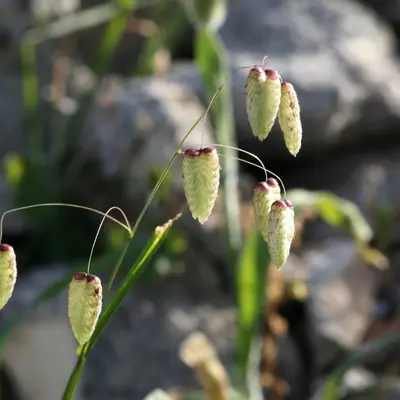
1/2-1" long seedheads turn from light green to a beautiful, golden straw color when dried or left on the plants. Stems of these nodding, dancing beauties are a must-have for adding bits of sparkle and detail to design work. Productive plants produce abundant 12-20" long stems useful for fresh or dried cut flowers. The thin stems of this clump-forming grass are best suited for design work and not recommended for when something sturdy is needed. Beautiful addition to containers or garden beds. Might self-sow if seedheads are left on the plants. Tolerant to dry growing conditions once established. Also commonly known as big quaking grass, rattlesnake grass, and large quaking grass.
Harvest
90-110d
Days to harvest
Sun
Full sun
Zones
2–6
USDA hardiness
Height
2 feet
Planting Timeline
Showing dates for Greater Quaking Grass in USDA Zone 7
All Zone 7 grass →Zone Map
Click a state to update dates
Greater Quaking Grass · Zones 2–6
Growing Details
Succession Planting
Greater Quaking Grass is a warm-season annual grown for its ornamental seed heads, and a single sowing produces one harvest window around day 90–110. If you want a longer cutting season — for a u-pick or cut-flower operation, say — stagger two or three sowings about 3 weeks apart, starting with your first direct sow in March and finishing by early May. Once daytime highs are consistently above 85°F, germination becomes erratic and new seedlings struggle to establish before summer heat bears down.
For most home gardeners, one sowing is plenty. The dried heads hold their shape for months, so a single well-timed cut in early summer stretches the crop's usefulness without any need to succession plant at all.
Complete Growing Guide
Light: Full sun (6 or more hours of direct sunlight a day). Soil: Clay, Loam (Silt), Sand. Soil pH: Neutral (6.0-8.0). Drainage: Good Drainage, Moist. Growth rate: Rapid. Maintenance: Low. Propagation: Seed.
Harvesting
One fruit may be a covered with a thin pericarp or an utricle with the seed being free.
Type: Caryopsis.
Storage & Preservation
For fresh stems, store upright in a vase with water at room temperature (65-75°F) away from direct sunlight for 1-2 weeks. For dried preservation, hang bundles upside down in a warm, dry, well-ventilated space (50-60% humidity) for 2-3 weeks until seedheads are papery and golden. Store dried stems in a cool, dry location in airtight containers or wrapped loosely in tissue paper for up to 6 months. Silica gel drying preserves color and delicate structure, while air drying maintains natural movement and texture ideal for floral design work.
History & Origin
Origin: Native to European and African Mediterranean countries.
Advantages
- +Stunning golden-straw dried seedheads perfect for floral design work
- +Productive plants yield abundant 12-20 inch stems for cutting
- +Tolerant to dry conditions once established, requires minimal watering
- +Self-seeds readily if left unharvested, providing natural garden renewal
- +Attractive nodding seedheads add movement and sparkle to arrangements
Considerations
- -Thin, delicate stems unsuitable for sturdy structural design needs
- -Moderate difficulty level requires some experience for best results
- -Self-seeding tendency may create unwanted volunteer plants in gardens
Companion Plants
The best companions for Greater Quaking Grass are low-to-moderate feeders that share its preference for lean, well-drained soil and won't shade it out. Lavender and catmint fit that profile closely — same sun requirement, same tolerance for dryish conditions, and their fine-textured foliage sits low enough that it doesn't block the light Briza maxima needs to stay upright. Yarrow and black-eyed Susan are deep-rooted perennials that pull moisture from well below the surface, leaving the shallower zone where Briza feeds relatively uncontested. Cosmos fills in fast and tall but its canopy is open enough that it doesn't cast meaningful shade.
Wild bergamot and cornflower are worth including if you're running a pollinator strip alongside a cut-flower planting — both draw beneficial insects that incidentally knock back aphid pressure on neighboring plants, though Briza itself doesn't attract heavy aphid populations.
The harmful companions are mostly a competition and chemistry problem. Tall fescue (Festuca arundinacea) spreads aggressively by tillers and will muscle into a Briza planting within a single season; getting it back out without uprooting everything around it is genuinely annoying. English ivy outcompetes through sheer density at the root level. Tree of Heaven (Ailanthus altissima) is the one to take most seriously — Penn State research documented its allelopathic root exudates suppressing nearby plant growth, and the effect extends well beyond what the canopy covers. Keep Briza at least 8–10 feet from any established Tree of Heaven.
Plant Together
Lavender
Attracts beneficial insects and provides contrasting texture in ornamental displays
Black-eyed Susan
Complementary blooming periods and both thrive in similar well-drained soil conditions
Yarrow
Attracts beneficial predatory insects and improves soil structure with deep roots
Cornflower
Similar drought tolerance and creates attractive naturalized meadow combinations
Catmint
Repels rodents that might damage grass and provides aromatic contrast
Sedum
Excellent drainage requirements match and provides ground-level interest
Cosmos
Attracts beneficial pollinators and creates height variation in wildflower plantings
Wild Bergamot
Attracts butterflies and beneficial insects while tolerating similar growing conditions
Keep Apart
Tall Fescue
Aggressive spreading habit can outcompete and suppress ornamental grasses
English Ivy
Dense mat formation blocks light and nutrients from reaching grass base
Tree of Heaven
Produces allelopathic compounds that inhibit growth of nearby grasses and wildflowers
Troubleshooting Greater Quaking Grass
What you'll see, why it happens, and what to do about it.
Seedlings damping off at soil level within 10–14 days of germination — stems pinch to a thread, then the whole plant topples
Likely Causes
- Pythium or Rhizoctonia fungi thriving in cold, waterlogged soil
- Sowing too early into soil below 55°F
What to Do
- 1.Wait until soil temps are consistently above 55°F before direct sowing
- 2.Improve drainage by working in coarse sand or fine grit before seeding
- 3.Thin seedlings to at least 6 inches early — crowding holds moisture and accelerates spread
Orange or rust-colored pustules on the undersides of leaves, usually appearing mid-season
Likely Causes
- Grass rust (Puccinia spp.) — common on ornamental grasses after prolonged wet spells or in humid, still-air conditions
- Overcrowded planting blocking airflow between stems
What to Do
- 1.Strip and trash (don't compost) affected leaves — rust spores overwinter on plant debris
- 2.Plant at the wider end of the 18–24 inch spacing if your site is humid or low-lying
- 3.Switch to base watering in the morning; evening overhead irrigation keeps foliage wet overnight and feeds the problem
Clumps leaning or flopping badly by midsummer before seed heads have fully matured
Likely Causes
- Excess nitrogen from nearby fertilized beds pushing soft, top-heavy growth
- Fewer than 6 hours of direct sun causing weak, elongated stems
What to Do
- 1.Skip nitrogen fertilizer on this grass entirely — lean soil keeps stems stiff
- 2.Site next year's planting in a spot with 6+ hours of direct sun; south or west exposures usually deliver that reliably
- 3.A single ring of garden twine around the clump at about 12 inches high will hold it upright through harvest
Seed heads already dropping spikelets on the ground before you've cut them — stems nearly bare by the time you get out there
Likely Causes
- Harvesting too late — Briza maxima shatters quickly once heads dry fully on the plant
- A wind or rain event after heads reached full size
What to Do
- 1.Cut for drying when heads are fully formed but still carrying a touch of green — typically day 90–100, not 110
- 2.Harvest in the morning after dew dries; dry stems shatter more readily when handled than slightly damp ones do
- 3.Hang bunches upside down immediately in a ventilated space — don't leave cut stems lying flat or the heads keep dropping
Frequently Asked Questions
How long do Greater Quaking Grass stems last in a vase?▼
Is Greater Quaking Grass good for beginners?▼
Can you grow Greater Quaking Grass in containers?▼
What are Greater Quaking Grass stems used for?▼
When should I plant Greater Quaking Grass seeds?▼
Will Greater Quaking Grass self-sow in my garden?▼
Zone-by-Zone Planting Calendar
| Zone | Indoor Start | Transplant | Direct Sow | Harvest |
|---|---|---|---|---|
| Zone 3 | — | June – August | May – July | — |
| Zone 4 | — | June – July | April – June | — |
| Zone 5 | — | May – July | April – June | — |
| Zone 6 | — | May – July | April – June | — |
| Zone 7 | — | May – June | March – May | — |
| Zone 8 | — | April – June | March – May | — |
| Zone 9 | — | March – May | February – April | — |
| Zone 10 | — | March – April | January – March | — |
| Zone 2 | — | July – August | May – July | — |
Growing Guides from Wind River Greens
Sources & References
External authority sources used in compiling this guide.
- ExtensionNC State Extension
- BreederJohnny's Selected Seeds
See the Methodology page for how this data is sourced, what's AI-assisted, and known limitations.