Italian Prune Plum
Prunus domestica 'Italian Prune'
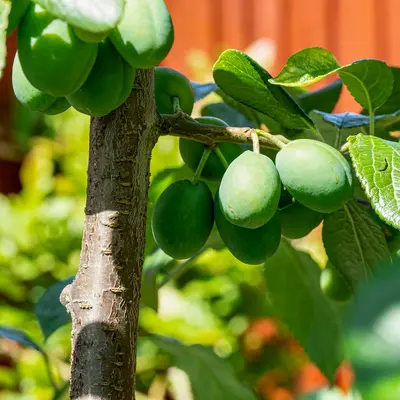
Also known as Fellenberg, this European plum variety is the gold standard for drying into prunes, but fresh fruits are equally delicious with their sweet, rich flavor and firm texture. The oval, purple-blue fruits have golden flesh that's perfect for fresh eating, baking, or preserving. This productive tree is self-fertile and cold-hardy, making it an excellent choice for home orchards seeking a reliable, multipurpose plum variety.
Harvest
100-120d
Days to harvest
Sun
Full sun
Zones
4–9
USDA hardiness
Height
10-20 feet
Planting Timeline
Showing dates for Italian Prune Plum in USDA Zone 7
All Zone 7 fruit-tree →Zone Map
Click a state to update dates
Italian Prune Plum · Zones 4–9
Growing Details
Complete Growing Guide
Light: Full sun (6 or more hours of direct sunlight a day). Soil: High Organic Matter. Drainage: Good Drainage, Moist. Height: 10 ft. 0 in. - 20 ft. 0 in.. Spread: 10 ft. 0 in. - 20 ft. 0 in.. Growth rate: Medium. Maintenance: High. Propagation: Grafting, Root Cutting, Seed. Regions: Mountains, Piedmont.
Harvesting
The fleshy 2-3 inch drupe matures to blue or black and has 1 seed in it. Appears in September
Type: Drupe. Length: 1-3 inches. Width: 1-3 inches.
Garden value: Edible, Showy
Harvest time: Fall
Edibility: Fruits are dried to make plums. They can also be eaten raw or cooked.
Storage & Preservation
Fresh Italian Prune Plums keep at room temperature for 3-5 days to complete ripening, then refrigerate for up to two weeks. Store in the crisper drawer in perforated plastic bags to maintain humidity while preventing moisture buildup.
For drying, this variety excels due to its low moisture content and high sugar levels. Halve and pit the plums, then dehydrate at 135°F for 18-24 hours until leathery but pliable. Properly dried prunes store for months in airtight containers. Freeze whole plums by washing, removing pits, and packing in freezer bags with minimal air – they'll keep for up to a year. The firm flesh also makes excellent jams and preserves, requiring less pectin than softer varieties due to natural pectin content in the skins.
History & Origin
Origin: Turkey
Advantages
- +Attracts: Butterflies, Pollinators
- +Edible: Fruits are dried to make plums. They can also be eaten raw or cooked.
Considerations
- -High maintenance
Companion Plants
Chives and garlic planted in a ring around the drip line are the most practical companions here. Both alliums release volatile sulfur compounds that appear to deter aphids — which do colonize new plum growth in spring — and at 15-20 foot tree spacing, they take up almost no room. Comfrey is worth planting a few feet from the trunk as well. Its taproot pulls calcium and potassium up from subsoil layers that shallow-rooted annuals can't reach, and when you cut it back and leave the leaves to break down in place, that fertility concentrates right at the tree's feeder roots. It'll also crowd out grass around the base, which is useful on its own.
Marigolds and nasturtiums draw in predatory wasps and hoverflies that prey on aphids and soft-bodied pests. They're low-effort and don't compete for resources at this scale, so there's no real argument against scattering them nearby. Lavender and tansy tolerate dry soil well, don't crowd aggressively, and are often planted near stone fruit to deter certain beetles — though the evidence there is thinner than it is for the alliums.
Black walnut (Juglans nigra) is the one to keep well away. It produces juglone from its roots across the entire canopy spread, and Italian Prune Plum is sensitive enough that planting within that zone will stunt or kill it outright. Fennel is allelopathic more broadly and tends to suppress whatever's growing within a few feet — it's simply incompatible with most perennial plantings. Cherry trees planted too close create a shared disease corridor for both brown rot (Monilinia fructicola) and black knot (Apiosporina morbosa), since those pathogens don't distinguish between Prunus species.
Plant Together
Chives
Repels aphids and other pests while attracting beneficial insects
Marigolds
Deters nematodes and aphids, attracts pollinating insects
Comfrey
Deep roots bring nutrients to surface, leaves make excellent mulch
Nasturtiums
Acts as trap crop for aphids and cucumber beetles
Lavender
Repels moths and other pests, attracts pollinators
Tansy
Deters ants, mice, and flying insects that damage fruit
Garlic
Repels aphids, borers, and other insect pests
Dill
Attracts beneficial wasps and predatory insects
Keep Apart
Black Walnut
Produces juglone which is toxic to stone fruit trees
Cherry Trees
Share similar pests and diseases, increasing infestation risk
Fennel
Allelopathic properties inhibit growth of nearby plants
Nutrition Facts
Per 100g serving. % Daily Value based on 2,000 calorie diet. Source: USDA FoodData Central (FDC #169949)
Pests & Disease Resistance
Resistance
Good resistance to most diseases, hardy variety
Common Pests
Plum curculio, aphids, scale insects, Japanese beetles
Diseases
Brown rot, black knot, leaf spot, silver leaf
Troubleshooting Italian Prune Plum
What you'll see, why it happens, and what to do about it.
Small crescent-shaped scars on developing fruit, with sticky ooze or gumminess around the puncture, appearing late spring to early summer
Likely Causes
- Plum curculio (Conotrachelus nenuphar) — a weevil that lays eggs in young fruit right after petal fall
- Cool, slow springs that extend the vulnerable window when fruitlets are small
What to Do
- 1.Kaolin clay (Surround WP) applied at petal fall and reapplied after rain creates a physical barrier the weevil won't land on — start before you think you need to
- 2.Shake branches over a white sheet early in the morning when temps are below 65°F; the beetles drop and play dead, then you collect and destroy them
- 3.Pick up and trash any dropped fruit immediately — larvae in fallen plums complete their cycle in the soil and come back next year
Fruit turning soft and brown, often with a ring of gray-tan spores, starting 2-3 weeks before harvest
Likely Causes
- Brown rot (Monilinia fructicola) — a fungal disease that spreads fast in warm, humid weather above 70°F, especially after rain
- Wounds from curculio damage, cracking, or bird pecks that give the fungus an entry point
What to Do
- 1.Remove mummified fruit from the tree and the ground immediately — those dried-up plums from last season are the primary inoculum source
- 2.Thin fruit clusters to at least 3-4 inches apart in June so air can move through; brown rot travels between touching fruit overnight
- 3.If pressure is high, a copper-based fungicide applied at first pink bud and again at petal fall (per label rates) can reduce early-season spore load
Black, warty, elongated swellings on branches — sometimes a few inches long, sometimes encircling the whole limb — appearing over one or more seasons
Likely Causes
- Black knot (Apiosporina morbosa) — a fungal disease specific to Prunus species; spores spread in rain during spring and infect new wood
- Nearby wild plums or chokecherries (Prunus virginiana) acting as a reservoir, especially in wooded or rural settings
What to Do
- 1.Prune out infected wood in late winter, cutting at least 4 inches below where the gall starts; sterilize your saw between cuts with 70% isopropyl alcohol
- 2.Burn or bag the prunings — do not compost black knot wood
- 3.Scout for new galls every spring before bud break; catching them small (under 1 inch) dramatically reduces how far the disease spreads
Frequently Asked Questions
How long does Italian Prune Plum take to produce fruit?▼
Can you grow Italian Prune Plum in containers?▼
What does Italian Prune Plum taste like?▼
When should I plant Italian Prune Plum trees?▼
Do Italian Prune Plums need a pollinator tree?▼
How do you prevent plum curculio on Italian Prune Plums?▼
Zone-by-Zone Planting Calendar
Growing Guides from Wind River Greens
Sources & References
External authority sources used in compiling this guide.
- ExtensionNC State Extension
- USDAUSDA FoodData Central
See the Methodology page for how this data is sourced, what's AI-assisted, and known limitations.