Cherry Belle Radish
Brassica rapa var. radish 'Cherry Belle'
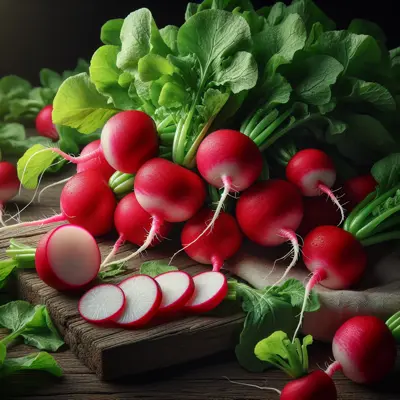
The quintessential beginner radish and All-America Selections winner that's been delighting gardeners since 1949. These perfectly round, bright red radishes with crisp white flesh mature incredibly quickly and have a mild, sweet flavor that even kids love. Perfect for successive plantings and container growing.
Harvest
22-30d
Days to harvest
Sun
Full sun to partial shade
Zones
5–11
USDA hardiness
Height
3 feet
Planting Timeline
Showing dates for Cherry Belle Radish in USDA Zone 7
All Zone 7 brassica →Zone Map
Click a state to update dates
Cherry Belle Radish · Zones 5–11
Growing Details
Zone-by-Zone Planting Calendar
| Zone | Indoor Start | Transplant | Direct Sow | Harvest |
|---|---|---|---|---|
| Zone 3 | March – April | May – June | May – June | May – October |
| Zone 4 | March – April | May – June | April – June | May – October |
| Zone 5 | February – March | April – May | April – May | May – November |
| Zone 6 | February – March | April – May | April – May | April – November |
| Zone 7 | February – March | April – May | March – May | April – November |
| Zone 8 | January – February | March – April | March – April | March – December |
| Zone 9 | January – January | February – March | February – March | February – December |
| Zone 10 | January – January | February – March | January – March | February – December |
Complete Growing Guide
Cherry Belle radishes thrive in cool weather, so plan your first planting 2-4 weeks before your last expected frost. For zones 7-9, you can often grow them through winter. Choose a sunny spot with loose, well-draining soil—these radishes will tolerate clay better than most root crops, but they'll develop their characteristic round shape best in amended soil.
Prepare your bed by working in 1-2 inches of compost, focusing on the top 6 inches where these shallow roots develop. Avoid fresh manure, which can cause forking and hairy roots. Cherry Belle radishes prefer a soil pH between 6.0-7.0, but they're remarkably tolerant of variations.
Always direct sow—never start indoors or attempt transplanting, as disturbed roots will fork or become stunted. Plant seeds ¼ inch deep and ½ inch apart in rows 6 inches apart. The key to tender radishes is consistent moisture, so water immediately after planting and maintain steady soil moisture throughout their short growing cycle.
Thin seedlings when they're 1 inch tall, leaving the strongest plants spaced 1 inch apart. Don't skip this step—overcrowded radishes will produce all tops and no roots. Use the thinned greens in salads.
Fertilize lightly with a balanced fertilizer at planting, then avoid nitrogen-heavy feeding which promotes leaf growth over root development. A light side-dressing of compost tea at 2 weeks is sufficient.
For continuous harvest, plant new rows every 10-14 days until temperatures consistently reach 75°F, then pause until fall. In zones 8-10, resume planting in September.
Common mistakes include planting in compacted soil (roots become stunted), irregular watering (causes splitting or woody texture), and leaving them in the ground too long after maturity (they become pithy). Cherry Belle's quick maturity is your advantage—harvest promptly for best quality.
In containers, use pots at least 6 inches deep with excellent drainage. Window boxes work perfectly for successive small plantings.
Harvesting
Cherry Belle radishes are ready when they reach ¾ to 1¼ inches in diameter, typically 22-30 days from planting. The shoulders will push slightly above soil level when mature, showing their characteristic bright red color. Harvest in the morning when they're fully hydrated and crisp.
To check readiness, gently brush soil away from the largest radish. It should feel firm and solid—if it gives under gentle pressure, wait a few more days. The perfect Cherry Belle has taut, unblemished skin with vibrant red coloring.
Harvest by grasping the leaves close to the root and pulling straight up with a gentle twisting motion. In loose soil, they'll pop right out. Don't leave mature radishes in the ground hoping they'll grow larger—Cherry Belle becomes woody and develops a harsh bite if left too long. Pull the entire crop within a week of first maturity for optimal eating quality.
Storage & Preservation
Remove the greens immediately after harvest, leaving about ½ inch of stem to prevent bleeding. Store unwashed radishes in perforated plastic bags in the refrigerator's crisper drawer, where they'll maintain their crispness for 2-3 weeks at 32-40°F with high humidity.
For longer storage, Cherry Belle radishes pickle beautifully—their dense flesh holds up well to quick refrigerator pickles or traditional lacto-fermentation. Slice them thin for refrigerator pickles that are ready in 24 hours, or ferment whole small radishes for 3-5 days at room temperature.
You can also preserve the greens separately—they freeze well when blanched for 2 minutes, shocked in ice water, and frozen in portions. Whole radishes don't freeze well due to their high water content, but they can be dehydrated into chips for a peppery snack when sliced thin and dried at 125°F for 8-12 hours.
History & Origin
Cherry Belle radish earned its place in gardening history when it won the prestigious All-America Selections award in 1949, making it one of the earliest vegetable varieties to receive this recognition. Developed in the 1940s by American seed breeders who wanted to create the perfect beginner radish, Cherry Belle was specifically bred for its reliable germination, uniform round shape, and mild flavor that would appeal to American palates.
The variety was revolutionary for its time because it combined the quick maturity that radish growers wanted with exceptional resistance to the cracking and pithiness that plagued other varieties. Its development coincided with the post-war victory garden movement, when home gardening was experiencing a renaissance.
For over 75 years, Cherry Belle has remained virtually unchanged—a testament to the breeders' success in creating a nearly perfect radish. It became the standard against which all other round red radishes are measured, and its genetics have been used to develop numerous other successful radish varieties. Today, it's often the first radish variety new gardeners try, continuing its legacy as the ultimate beginner's radish.
Advantages
- +Exceptional reliability with near-perfect germination rates even in cool soil
- +Incredibly fast maturity at just 22-30 days allows multiple crops per season
- +Maintains sweet, mild flavor even when slightly overgrown, unlike peppery varieties
- +Superior crack resistance prevents splitting during spring rains or irregular watering
- +Perfect round shape develops consistently even in less-than-ideal soil conditions
- +Excellent cold tolerance allows very early spring and late fall plantings
- +Compact size makes it ideal for container growing and intensive spacing methods
Considerations
- -Becomes woody and loses crispness quickly if left in warm soil past maturity
- -Limited heat tolerance means no summer growing in most climates
- -Small size provides less harvest volume compared to larger radish varieties
- -Prone to flea beetle damage on young leaves, especially in early spring
- -Short storage life of 2-3 weeks even under optimal refrigerated conditions
Companion Plants
Plant Together
Lettuce
Radishes break up soil for shallow lettuce roots and mature quickly before lettuce needs space
Spinach
Similar growing conditions and radishes harvest early, leaving space for spinach to expand
Carrots
Radishes break up compacted soil making it easier for carrots to grow straight
Nasturtiums
Trap crop for flea beetles and aphids that commonly attack radishes
Chives
Repel root maggots and aphids while improving soil with their root system
Marigolds
Deter flea beetles and root-knot nematodes that damage radish roots
Peas
Fix nitrogen in soil and provide light shade for radishes in warm weather
Cucumber
Radishes repel cucumber beetles and mature before cucumbers need full space
Keep Apart
Hyssop
Inhibits growth of most brassicas including radishes through allelopathic compounds
Grape
Radishes can stunt grape vine growth and compete for nutrients
Turnips
Same family plants compete for nutrients and attract similar pests like flea beetles
Nutrition Facts
Per 100g serving. % Daily Value based on 2,000 calorie diet. Source: USDA FoodData Central (FDC #169276)
Pests & Disease Resistance
Resistance
Good resistance to cracking and pithiness when grown in cool weather
Common Pests
Flea beetles, root maggots, aphids
Diseases
Clubroot, black rot, damping-off