Vegetable Marrow (Long Green Trailing)
Cucurbita pepo 'Long Green Trailing'
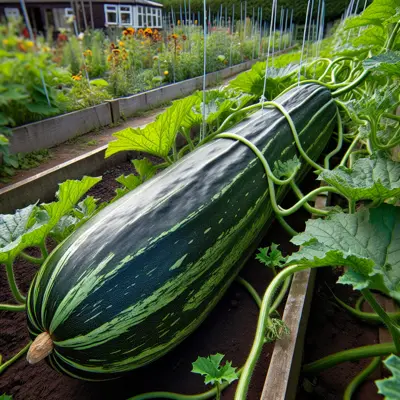
A traditional British heirloom that produces enormous, prize-winning fruits that can reach 2-3 feet long and provide abundant harvests for large families or competitive gardening. This vigorous trailing variety is perfect for gardeners who want to grow something truly impressive, with its ability to produce marrows weighing 10+ pounds from compact plants. The mild, versatile flesh is excellent stuffed, in soups, or as a potato substitute in traditional British cooking.
Harvest
60-80d
Days to harvest
Sun
Full sun
Zones
3–11
USDA hardiness
Height
1-3 feet
Planting Timeline
Showing dates for Vegetable Marrow (Long Green Trailing) in USDA Zone 7
All Zone 7 squash →Zone Map
Click a state to update dates
Vegetable Marrow (Long Green Trailing) · Zones 3–11
Growing Details
Succession Planting
Long Green Trailing marrow is a continuous producer — keep harvesting and the plant keeps setting fruit — so you don't need to stagger sowings the way you would with arugula or salad mix. A second direct sowing 3–4 weeks after your first, anywhere between late April and early June in zone 7, can extend your harvest window and give you a backup if the first planting takes a hit from squash vine borers (Melittia cucurbitae).
That borer pressure is the hard stop on late sowings. NC State Extension's IPM guidance is explicit: squash seeded as early as the soil allows will reach maturity before borer populations peak in July. A sowing pushed past mid-June sends your most vulnerable young plants straight into that flight period, and they'll spend their first weeks fighting both borers and peak cucumber beetle pressure. Cut off new sowings by June 15.
Complete Growing Guide
This vigorous trailing variety demands ample space to sprawl—at least 4-6 feet in each direction—making it unsuitable for confined beds despite producing from relatively compact plants. Start seeds indoors 3-4 weeks before your last frost, or direct sow after soil reaches 70°F, since germination is slow and the 60-80 day maturity clock begins once vines establish. Unlike bush squash varieties, 'Long Green Trailing' requires consistent moisture and weekly feeding to support those massive 10+ pound fruits; allow soil to dry slightly between waterings to prevent powdery mildew, which this variety attracts readily in humid conditions. Watch for spider mites and squash vine borers, the latter being particularly problematic for trailing types with extended vine exposure. A practical strategy: pinch back excessive vine growth once fruits begin sizing, directing energy into marrow development rather than endless foliage—this also improves air circulation and reduces disease pressure while keeping harvests manageable for household use.
Light: Full sun (6 or more hours of direct sunlight a day). Soil: High Organic Matter, Loam (Silt). Soil pH: Neutral (6.0-8.0). Drainage: Good Drainage, Moist. Height: 1 ft. 0 in. - 3 ft. 0 in.. Spread: 2 ft. 0 in. - 25 ft. 0 in.. Spacing: 12 inches-3 feet. Growth rate: Rapid. Maintenance: High. Propagation: Seed. Regions: Coastal, Mountains, Piedmont.
Harvesting
Harvest Long Green Trailing marrows when the skin darkens to deep forest green and loses its glossy sheen, typically at 2-3 feet long, though smaller fruits (12-18 inches) offer superior tenderness and flavor. The skin should feel firm and resist thumbnail puncture, indicating mature development. This variety produces continuously throughout the season, so harvest every 7-10 days to encourage ongoing flowering and fruit set rather than allowing overripe specimens to dominate the plant's energy. Pick fruits in early morning when cooler to minimize stress on the vigorous vines, and never allow marrows to exceed 3 feet in length, as oversized fruits become watery and fibrous despite their impressive appearance.
A type of berry called a pepo that has a hard rind. Fruits may be long or round, large or small, smooth or warty– some have edible flesh and some are too hard or insipid to eat, though the seeds of all are edible. Has a harder, thicker stem compared to other species.
Color: Black, Cream/Tan, Gold/Yellow, Green, Orange, Pink, Red/Burgundy, Variegated, White. Type: Berry. Length: > 3 inches. Width: > 3 inches.
Garden value: Edible, Showy
Harvest time: Fall
Storage & Preservation
Young marrows keep 1-2 weeks refrigerated in the crisper drawer, wrapped loosely in plastic to prevent moisture loss while allowing some air circulation. Mature marrows are excellent keepers—store in a cool, dry location (50-55°F) with good ventilation, and they'll last 2-4 months.
For preservation, young marrows freeze well when cut into cubes and blanched for 3 minutes, though they'll be softer when thawed. Mature marrows are perfect for canning as chunks in light syrup or pressure-canning as savory preparations. The mild flesh also dehydrates successfully when sliced thin and dried until leathery. Traditional British cooks often make marrow jam or chutney, combining the neutral flesh with sugar, vinegar, and warming spices for long-term pantry storage.
History & Origin
The Vegetable Marrow represents a distinctly British culinary tradition rather than a precisely documented cultivar with identified breeders. This variety emerged during the Victorian era when marrows gained popularity among British gardeners seeking large, productive vegetables for family meals and agricultural shows. The Long Green Trailing form likely developed through informal selection practices within British gardening communities, with seeds saved and exchanged among growers who favored vigorous, prolific plants. While the specific origins remain undocumented in formal breeding records, the variety's name and characteristics reflect its establishment as a heirloom staple in British kitchen gardens by the late nineteenth century, where it became valued for both productive harvests and competitive exhibition potential.
Origin: North America
Advantages
- +Produces impressively large 2-3 foot fruits perfect for competitive gardening shows.
- +Traditional heirloom variety offers authentic British cooking heritage and nostalgia.
- +Vigorous trailing plants yield abundant 10+ pound marrows from compact space.
- +Mild, versatile flesh suits stuffing, soups, and potato substitute dishes well.
- +Compact plants deliver prize-winning harvests ideal for large families.
Considerations
- -Highly susceptible to powdery and downy mildew in humid growing conditions.
- -Vulnerable to squash vine borers and multiple beetle pests requiring vigilance.
- -Requires 60-80 days to maturity, demanding longer growing season in cool climates.
- -Sprawling trailing habit needs substantial garden space or careful trellising management.
Companion Plants
Nasturtiums and marigolds are the two plants most worth fitting into a marrow bed. Nasturtiums pull aphids off the squash — they're a genuine trap crop, not just a pretty border — and their sprawling habit suits the edges of a vined planting naturally. Tagetes patula marigolds offer some deterrence against cucumber beetles, which matters here because those beetles are the primary vector for bacterial wilt (Erwinia tracheiphila). Radishes are worth direct sowing at the base of the vines early in the season; they'll be out of the ground before the marrow canopy closes over them. Corn and beans share the water and fertility timing that marrow needs, and NC State Extension notes that grouping plants with similar cultural requirements keeps all of them performing better.
Potatoes share soilborne disease pressure with marrow and compete hard for the same nutrients — pairing them invites problems from two directions at once. Fennel produces allelopathic compounds that stunt most vegetables within a few feet, so keep it isolated or skip it entirely. Sage and rosemary thrive on dry, well-drained soil, which is the opposite of the 2–3 inches of weekly water this vine needs during fruit development; the cultural mismatch alone is reason enough to plant them elsewhere.
Plant Together
Nasturtiums
Trap crop for squash bugs and cucumber beetles, repels aphids
Marigolds
Repel cucumber beetles, squash bugs, and nematodes
Radishes
Repel squash vine borers and cucumber beetles
Corn
Provides vertical support and shade, part of Three Sisters planting
Beans
Fix nitrogen in soil, complete the Three Sisters combination
Catnip
Strong repellent for squash bugs and cucumber beetles
Dill
Attracts beneficial predatory insects that control squash pests
Sunflowers
Provide shade and attract beneficial insects, trap crop for stink bugs
Keep Apart
Potatoes
Both are heavy feeders competing for nutrients, potatoes inhibit squash growth
Fennel
Allelopathic properties inhibit growth of squash and most vegetables
Aromatic herbs (sage, rosemary)
Strong oils can inhibit squash germination and growth
Nutrition Facts
Per 100g serving. % Daily Value based on 2,000 calorie diet. Source: USDA FoodData Central (FDC #168040)
Pests & Disease Resistance
Resistance
Moderate disease resistance, susceptible to powdery mildew in humid conditions
Common Pests
Squash bugs, cucumber beetles, squash vine borers, slugs
Diseases
Powdery mildew, downy mildew, bacterial wilt, mosaic virus
Troubleshooting Vegetable Marrow (Long Green Trailing)
What you'll see, why it happens, and what to do about it.
Vine wilts suddenly from the base up, no drought explanation; sawdust-like frass visible at the stem near soil level
Likely Causes
- Squash vine borer (Melittia cucurbitae) — larvae tunnel into the stem and eat the interior
- Late planting that put young plants in the ground during peak borer egg-laying in July
What to Do
- 1.Slit the stem lengthwise at the frass entry point, extract the larvae by hand, then bury the wounded stem section under a few inches of moist soil so it can re-root
- 2.Wrap the bottom 6 inches of young stems with aluminum foil or nylon stocking before borers are active — NC State Extension's IPM handbook notes this physical barrier as effective
- 3.Next season, direct sow as early as the soil allows (soil temps above 60°F) so the vine reaches maturity before July borer flights begin
Leaves covered in white powdery coating, starting on older foliage, usually mid-to-late summer
Likely Causes
- Powdery mildew — a fungal disease favored by warm days, cool nights, and poor airflow between vines
- Crowded spacing; Long Green Trailing vines need 60–72 inches between plants and will spread 8–12 feet
What to Do
- 1.Strip the worst-affected leaves and put them in the trash, not the compost pile
- 2.Apply a diluted baking soda solution (1 tablespoon per gallon of water) or a labeled potassium bicarbonate product at first sign of infection
- 3.Give vines more room next year and switch to drip or base watering — wet foliage overnight accelerates spread
Plant wilts during the day and recovers at night initially, then collapses entirely within a week or two; no borer frass at the stem
Likely Causes
- Bacterial wilt (Erwinia tracheiphila), transmitted by cucumber beetles (Acalymma vittatum and Diabrotica undecimpunctata) feeding on leaves
- High cucumber beetle pressure, especially in beds where cucurbits grew the previous season
What to Do
- 1.Cut a wilted stem near the base, press the two cut ends together for a few seconds, then pull them apart slowly — thin, thread-like strands stretching between them confirm bacterial wilt; pull and trash the plant immediately
- 2.Use row cover on seedlings to exclude cucumber beetles (remove at flowering so pollinators can reach the blooms), or apply kaolin clay as a physical deterrent — NC State Extension's IPM section lists kaolin as a viable barrier approach
- 3.There is no cure once a plant is infected; shift your energy to beetle management the following season
Ragged holes chewed in leaves and young fruits, slime trails visible on soil and lower foliage, damage worse after rain or irrigation
Likely Causes
- Slugs (Deroceras reticulatum and related species) — most active in wet conditions and under the dense canopy that trailing vines create
- Heavy mulch or plant debris sitting directly against the stems, which gives slugs a cool, moist place to shelter during the day
What to Do
- 1.Set beer traps — shallow containers sunk to soil level and filled with cheap beer — near the base of plants; check and empty every 2–3 days
- 2.Pull mulch back 4–6 inches from the main stem so the soil surface dries out between waterings
- 3.Scatter iron phosphate bait (e.g., Sluggo) around the plants; it breaks down into fertilizer and is safe around edible crops
Frequently Asked Questions
How long does vegetable marrow Long Green Trailing take to grow?▼
Can you grow Long Green Trailing marrow in containers?▼
What does Long Green Trailing vegetable marrow taste like?▼
Is Long Green Trailing marrow good for beginners?▼
When should I plant Long Green Trailing marrow seeds?▼
How much space does Long Green Trailing marrow need?▼
Zone-by-Zone Planting Calendar
| Zone | Indoor Start | Transplant | Direct Sow | Harvest |
|---|---|---|---|---|
| Zone 1 | — | — | July – August | October – August |
| Zone 2 | — | — | June – August | September – September |
| Zone 11 | — | — | January – March | April – June |
| Zone 12 | — | — | January – March | April – June |
| Zone 13 | — | — | January – March | April – June |
| Zone 3 | — | — | June – July | September – October |
| Zone 4 | — | — | June – July | September – October |
| Zone 5 | — | — | May – June | August – October |
| Zone 6 | — | — | May – June | August – September |
| Zone 7 | — | — | April – June | July – September |
| Zone 8 | — | — | April – May | July – August |
| Zone 9 | — | — | March – April | June – July |
| Zone 10 | — | — | February – April | May – July |
Growing Guides from Wind River Greens
Sources & References
External authority sources used in compiling this guide.
See the Methodology page for how this data is sourced, what's AI-assisted, and known limitations.