Table King Bush Acorn Squash
Cucurbita pepo 'Table King Bush'
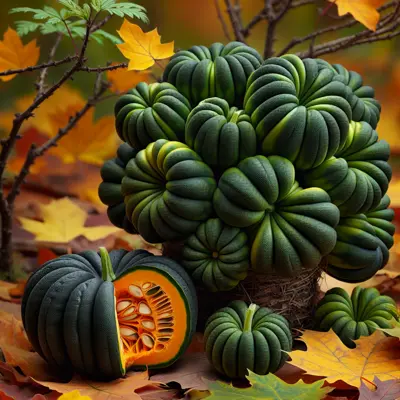
A space-saving bush variety that delivers all the classic acorn squash flavor without the sprawling vines. This compact plant produces perfectly proportioned, single-serving acorn squashes with deep ridges and sweet, orange flesh that becomes incredibly tender when roasted. Its bush habit makes it perfect for smaller gardens while still providing excellent yields.
Harvest
85-95d
Days to harvest
Sun
Full sun
Zones
3–11
USDA hardiness
Height
1-3 feet
Planting Timeline
Showing dates for Table King Bush Acorn Squash in USDA Zone 7
All Zone 7 squash →Zone Map
Click a state to update dates
Table King Bush Acorn Squash · Zones 3–11
Growing Details
Succession Planting
Direct sow Table King Bush starting around April 15 in zone 7, once soil temps are reliably above 60°F. A second sowing in late May to early June gives you a fall harvest in the September–October window before first frost. Don't push past June 15 — an 85–95 day crop started any later runs a real risk of hitting frost before the fruit matures.
Two sowings spaced about 5–6 weeks apart is plenty; this isn't a cut-and-come-again crop that rewards tight 14-day intervals. If you're growing for storage, the later planting often keeps better — fruit that matures in cooler September air cures down more cleanly than summer-harvested squash. Cure at 80–85°F for about 10 days after harvest and Table King will hold for up to 2 months.
Complete Growing Guide
The compact bush habit of Table King Bush Acorn Squash requires different spacing than vining varieties—plant 18-24 inches apart rather than the 3-4 feet typical acorn squashes need, making efficient use of limited space without sacrificing air circulation. Time planting so harvest occurs before first frost, as the 85-95 day maturity window is tighter than sprawling types; in northern regions, start seeds indoors 3-4 weeks before the last frost date. This cultivar thrives in full sun with consistently warm soil (at least 70°F) and benefits from mulching to regulate moisture, which prevents the bitter flavoring common in drought-stressed squash. Watch for powdery mildew on the dense foliage by ensuring adequate spacing and removing lower leaves once flowering begins. A practical advantage: the single-serving fruit size means you can stagger harvesting over several weeks rather than managing dozens of large squashes simultaneously, extending your fresh harvest window considerably.
Light: Full sun (6 or more hours of direct sunlight a day). Soil: High Organic Matter, Loam (Silt). Soil pH: Neutral (6.0-8.0). Drainage: Good Drainage, Moist. Height: 1 ft. 0 in. - 3 ft. 0 in.. Spread: 2 ft. 0 in. - 25 ft. 0 in.. Spacing: 12 inches-3 feet. Growth rate: Rapid. Maintenance: High. Propagation: Seed. Regions: Coastal, Mountains, Piedmont.
Harvesting
Table King Bush Acorns reach peak harvest maturity when their skin transforms to a deep, dark green with minimal glossy appearance, and individual fruits reach 4-5 inches in diameter. The skin should feel hard and resist fingernail puncture, while the bottom spot where the squash rested on soil will turn from green to creamy yellow or orange. Unlike indeterminate varieties, Table King produces fruit in concentrated flushes rather than continuously, so plan for a main harvest window around 85-95 days from transplant. For optimal sweetness, allow squashes to remain on the vine for at least two weeks after they achieve full size, as the starches convert to sugars during this maturation period.
A type of berry called a pepo that has a hard rind. Fruits may be long or round, large or small, smooth or warty– some have edible flesh and some are too hard or insipid to eat, though the seeds of all are edible. Has a harder, thicker stem compared to other species.
Color: Black, Cream/Tan, Gold/Yellow, Green, Orange, Pink, Red/Burgundy, Variegated, White. Type: Berry. Length: > 3 inches. Width: > 3 inches.
Garden value: Edible, Showy
Harvest time: Fall
Storage & Preservation
Cure freshly harvested Table King Bush squash in a warm, dry location (80-85°F) for 7-10 days to harden the skin and heal any minor cuts. After curing, store in a cool, dry place with temperatures between 50-55°F and 50-70% humidity – a basement, garage, or pantry works well.
Properly cured and stored squash will keep for 3-5 months. Check stored squash monthly and use any showing soft spots immediately. For preservation, cut squash in half, remove seeds, and roast until tender before freezing the flesh in portions. The cooked flesh freezes excellently for up to 12 months and works perfectly for soups, purees, and baked goods. You can also pickle the tender young fruits when they're 3-4 inches long for a unique preserve.
History & Origin
The Table King Bush Acorn Squash descends from the classic acorn squash (Cucurbita pepo), a domesticated species with roots in pre-Columbian Mesoamerica. While precise breeder documentation for this specific cultivar remains limited in readily available sources, it reflects the broader mid-to-late twentieth-century horticultural trend toward compact, bush-type vegetables suited to home gardens. The variety likely emerged from breeding programs at major seed companies or agricultural institutions seeking to adapt the sprawling acorn squash vine into a space-efficient form without sacrificing yield or flavor, though detailed parentage records are not well-documented in standard agricultural literature.
Origin: North America
Advantages
- +Compact bush habit saves significant garden space compared to vining varieties.
- +Produces single-serving sized squashes perfect for small households and meals.
- +Matures in just 85-95 days, enabling multiple harvests in longer seasons.
- +Excellent sweet, nutty flavor becomes richly tender when roasted.
- +Reliable yields despite smaller plant footprint make it space-efficient.
Considerations
- -Susceptible to powdery mildew, bacterial wilt, and downy mildew issues.
- -Vulnerable to squash bugs, cucumber beetles, and destructive vine borers.
- -Moderate difficulty level requires consistent pest and disease management attention.
Companion Plants
Nasturtiums pull aphid pressure away from the squash — the aphids find them first and mostly stay there — and their scent has some track record of disrupting cucumber beetle orientation. That matters a lot for Table King, since cucumber beetles transmit bacterial wilt (Erwinia tracheiphila) and there's no cure once a plant is infected. French marigolds (Tagetes patula) are worth planting for root-knot nematode suppression; they need a full season in the ground to do much, so put them in early. The Three Sisters combination — corn, beans, squash — works here because bush acorn stays compact enough at 1–3 feet that it doesn't shade out the beans, and the beans are quietly fixing nitrogen the squash will pull from the soil all season.
Potatoes don't belong in the same rotation as squash, let alone the same bed — they share susceptibility to several soil-borne pathogens, and planting them together year after year concentrates that pressure exactly where you don't want it. NC State Extension's disease guidance recommends rotating out of the same crop family for at least 3 years to break pest and disease cycles; potatoes and squash aren't the same family, but they share enough problems that the logic still applies. Strong aromatics like rosemary planted within a foot or two can slow establishment of young squash seedlings through root-zone competition — save those for a separate container or a bed with more separation.
Plant Together
Nasturtiums
Acts as trap crop for squash bugs and cucumber beetles, repels aphids
Marigolds
Deters cucumber beetles, squash bugs, and nematodes with natural compounds
Radishes
Repels squash vine borers and cucumber beetles, breaks up soil
Corn
Provides vertical structure and shade, part of traditional Three Sisters planting
Beans
Fixes nitrogen in soil for squash, completes Three Sisters companion system
Catnip
Strong repellent for squash bugs, cucumber beetles, and aphids
Oregano
Repels cucumber beetles and provides ground cover to retain soil moisture
Sunflowers
Attracts beneficial insects and provides windbreak protection
Keep Apart
Potatoes
Competes for nutrients and space, may harbor similar soil-borne diseases
Aromatic herbs (strong)
Plants like sage and rosemary can inhibit squash growth through allelopathy
Brassicas
Heavy feeders that compete for nutrients, may stunt squash development
Nutrition Facts
Per 100g serving. % Daily Value based on 2,000 calorie diet. Source: USDA FoodData Central (FDC #168472)
Pests & Disease Resistance
Resistance
Good resistance to powdery mildew
Common Pests
Squash bugs, cucumber beetles, vine borers
Diseases
Powdery mildew, bacterial wilt, downy mildew
Troubleshooting Table King Bush Acorn Squash
What you'll see, why it happens, and what to do about it.
Wilting plant that doesn't recover overnight, even with adequate water — stems may show orange-yellow discoloration inside when cut
Likely Causes
- Bacterial wilt (Erwinia tracheiphila), transmitted by cucumber beetles feeding on leaves
- Squash vine borer (Melittia cucurbitae) tunneling inside the main stem
What to Do
- 1.Cut a wilted stem near the base and touch the cut ends together — if stringy threads pull between them, it's bacterial wilt; pull and dispose of the plant immediately, it won't recover
- 2.For vine borer, slit the stem lengthwise near the entry hole, remove the larva, and mound soil over the wound — the plant may still root and survive
- 3.Control cucumber beetles with row cover from germination through flowering to cut off the wilt transmission pathway
White powdery coating on upper leaf surfaces, usually appearing after fruit set in late summer
Likely Causes
- Powdery mildew — most commonly Podosphaera xanthii or Erysiphe cichoracearum on cucurbits
- High humidity with warm days and cool nights, common in late August and September
What to Do
- 1.Remove the worst-affected leaves and dispose of them in the trash, not the compost pile
- 2.Apply a potassium bicarbonate or neem oil spray every 7 days — start at first sign, not after it's taken over
- 3.If plants are past day 80, prioritize harvest over saving the foliage — the fruit is likely close to maturity anyway
Angular, water-soaked spots on leaves that turn yellow then brown, with lesions limited by leaf veins — may look greasy or oily on the underside
Likely Causes
- Downy mildew (Pseudoperonospora cubensis), a water mold that spreads fast in wet, humid conditions
- NC State Extension notes downy mildew on cucurbits shows up at different times and places each year, so scouting matters
What to Do
- 1.Give plants their full 4–5 foot spacing — crowding accelerates spread by cutting off airflow
- 2.Switch from overhead irrigation to drip or soaker hose if you have the option
- 3.Copper-based fungicide applied every 5–7 days can slow progression, but won't reverse existing damage — start the moment you see lesions
Leaves stippled or bronzed, with small orange-brown insects clustered on stems and leaf undersides — brick-red egg masses visible on leaf undersides or near the soil line
Likely Causes
- Squash bugs (Anasa tristis) — adults and nymphs both feed, but a fresh hatch of nymphs in a tight group causes the worst damage in the shortest time
- Dense mulch or debris near the stem base giving adults a place to shelter
What to Do
- 1.Scrape the egg clusters off leaf undersides by hand — tedious, but a single pass through the bed every few days breaks the cycle without any spray
- 2.Set a board or folded cardboard near the plant base at dusk; squash bugs pile under it overnight and you can collect and kill them the next morning
- 3.Strip the bed completely at season's end — NC State Extension's IPM guidance points out that adults overwinter in plant debris, so leaving spent vines in place is essentially setting out a welcome mat for next year
Frequently Asked Questions
How long does Table King Bush acorn squash take to grow?▼
Can you grow Table King Bush acorn squash in containers?▼
Is Table King Bush good for beginners?▼
What does Table King Bush acorn squash taste like?▼
When should I plant Table King Bush acorn squash?▼
Table King Bush vs regular acorn squash – what's the difference?▼
Zone-by-Zone Planting Calendar
| Zone | Indoor Start | Transplant | Direct Sow | Harvest |
|---|---|---|---|---|
| Zone 1 | — | — | July – August | November – August |
| Zone 2 | — | — | June – August | October – September |
| Zone 11 | — | — | January – March | May – July |
| Zone 12 | — | — | January – March | May – July |
| Zone 13 | — | — | January – March | May – July |
| Zone 3 | — | — | June – July | October – October |
| Zone 4 | — | — | June – July | September – October |
| Zone 5 | — | — | May – June | September – October |
| Zone 6 | — | — | May – June | September – October |
| Zone 7 | — | — | April – June | August – October |
| Zone 8 | — | — | April – May | August – September |
| Zone 9 | — | — | March – April | July – August |
| Zone 10 | — | — | February – April | June – August |
Growing Guides from Wind River Greens
Sources & References
External authority sources used in compiling this guide.
See the Methodology page for how this data is sourced, what's AI-assisted, and known limitations.