Forsythia
Forsythia × intermedia
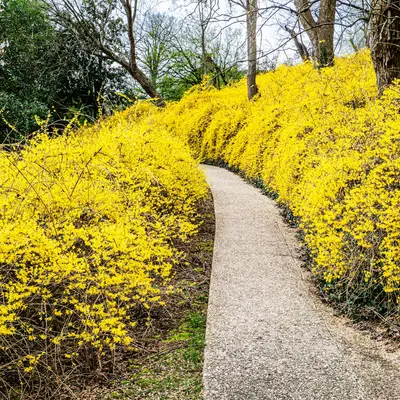
One of the earliest spring bloomers, forsythia creates a spectacular display of bright yellow flowers before the leaves emerge, signaling winter's end. This fast-growing, arching shrub is virtually maintenance-free and provides excellent screening when not in bloom. The profuse golden flowers can be forced indoors in late winter for early spring color.
Sun
Full sun to partial shade
Zones
5–8
USDA hardiness
Height
3-10 feet
Planting Timeline
Showing dates for Forsythia in USDA Zone 7
All Zone 7 shrub →Zone Map
Click a state to update dates
Forsythia · Zones 5–8
Growing Details
Complete Growing Guide
Light: Full sun (6 or more hours of direct sunlight a day), Partial Shade (Direct sunlight only part of the day, 2-6 hours). Soil: Clay, High Organic Matter, Loam (Silt). Drainage: Good Drainage. Height: 3 ft. 0 in. - 10 ft. 0 in.. Spread: 4 ft. 0 in. - 7 ft. 0 in.. Growth rate: Medium. Maintenance: Low. Propagation: Layering, Stem Cutting. Regions: Coastal, Mountains, Piedmont.
Harvesting
Two celled capsule with many winged seeds.
Type: Capsule.
Harvest time: Fall, Summer
Edibility: Only the flowers are edible
Storage & Preservation
Forsythia branches are typically harvested for fresh cut flowers and stored in a cool location. Keep cut stems in water at room temperature (65-70°F) away from direct sunlight; they'll last 1-2 weeks in a vase. For longer preservation, condition branches by re-cutting stems at a 45-degree angle and changing water every 2-3 days. Dry preservation: hang bundles upside down in a well-ventilated area for 2-3 weeks to create dried arrangements. Forcing method: cut branches in late winter, place in warm water indoors (70°F+) to encourage early blooming within 2-3 weeks.
History & Origin
Origin: China, Japan, and southeastern Europe (Yugoslavia & Albania)
Advantages
- +Edible: Only the flowers are edible
- +Low maintenance
Companion Plants
Daffodils and tulips are practical partners — they peak at roughly the same time as Forsythia's yellow bloom and fill the bare ground before the shrub leafs out fully, without competing for root space. Azaleas and lilacs share a similar pH comfort zone (6.0–7.0) and fit naturally into a mixed shrub border without undercutting each other's water or nutrients. Hostas slot in nicely on the north or east side of a mature plant where the canopy throws afternoon shade. Large evergreens are the pairing to avoid — not because of any chemical interaction, but because they'll eventually shade out a shrub that needs 4–6 hours of sun to flower reliably.
Plant Together
Daffodils
Bloom simultaneously with forsythia, complement yellow flowers, and deter rodents
Tulips
Sequential blooming extends spring color display and both prefer well-drained soil
Azaleas
Similar soil and light requirements, complementary spring flowering periods
Hostas
Provide attractive foliage contrast after forsythia blooms fade
Lilacs
Compatible growth habits and bloom timing extends spring flowering season
Spirea
Similar pruning requirements and complementary flowering times
Perennial Grasses
Provide textural contrast and help prevent soil erosion around shrub base
Clematis
Can use forsythia as natural support structure while adding summer blooms
Keep Apart
Black Walnut
Produces juglone which is toxic to many plants including forsythia
Large Evergreens
Create too much shade and compete for nutrients, reducing forsythia bloom quality
Mint
Aggressive spreading nature can overwhelm forsythia root zone and compete for nutrients
Pests & Disease Resistance
Resistance
Very hardy and disease resistant
Common Pests
Few pest problems, occasionally aphids
Diseases
Generally disease-free, occasional leaf spot
Troubleshooting Forsythia
What you'll see, why it happens, and what to do about it.
Shrub blooms sparsely or not at all in spring, even though it looked healthy all summer
Likely Causes
- Pruned at the wrong time — Forsythia sets flower buds on old wood in summer, so cutting it back in fall or late summer removes next year's blooms
- Too much shade — fewer than 4 hours of direct sun suppresses flowering significantly
What to Do
- 1.Prune only immediately after bloom in spring, within 4–6 weeks of flowers dropping — that's your entire window
- 2.If the plant is under a tree canopy that's filled in over the years, consider transplanting to a sunnier spot in early fall
Older canes growing nearly horizontal, flopping outward, and rooting where they touch the soil
Likely Causes
- Natural layering habit of Forsythia × intermedia — arching canes will self-root if left on the ground for a season
- Lack of structural pruning over several years, allowing the center to become overcrowded
What to Do
- 1.Cut the oldest, thickest canes (more than 1 inch diameter at the base) down to ground level each spring after bloom — remove no more than one-third of the total canes per year
- 2.If you want new plants, let a cane root naturally, then sever and transplant it in fall — free shrubs
Leaves developing irregular tan or brown spots with a yellow halo, appearing mid to late summer
Likely Causes
- Cercospora leaf spot — a fungal disease that shows up in humid conditions with poor airflow
- Overcrowded planting or a dense interior canopy trapping moisture against the foliage
What to Do
- 1.Rake and bag spotted leaves — don't compost them
- 2.Thin the interior by removing crossing branches to open up airflow; that step does more than any spray
- 3.In recurring cases, apply a copper-based fungicide in early summer before symptoms appear — it won't reverse existing damage, only slow new spread
New shoot tips and undersides of young leaves coated with small, soft-bodied green or yellow insects in spring
Likely Causes
- Aphid infestation — common on the tender new growth that flushes right after bloom
- Excess nitrogen from fertilizing, which pushes the soft new growth aphids prefer
What to Do
- 1.Knock them off with a firm spray of water — effective if you catch it early and repeat every 2–3 days
- 2.If numbers don't drop after a week, apply insecticidal soap directly to affected shoots
- 3.Skip the nitrogen fertilizer; Forsythia doesn't need much feeding, and a flush of soft growth invites another round of the same problem
Frequently Asked Questions
When should I plant forsythia shrubs?▼
How long does it take forsythia to bloom?▼
Can you force forsythia branches indoors?▼
Is forsythia good for beginners?▼
How do you prune forsythia?▼
What's the difference between forsythia and similar spring bloomers?▼
Zone-by-Zone Planting Calendar
Growing Guides from Wind River Greens
Sources & References
External authority sources used in compiling this guide.
- ExtensionNC State Extension
See the Methodology page for how this data is sourced, what's AI-assisted, and known limitations.