Boxwood Common
Buxus sempervirens
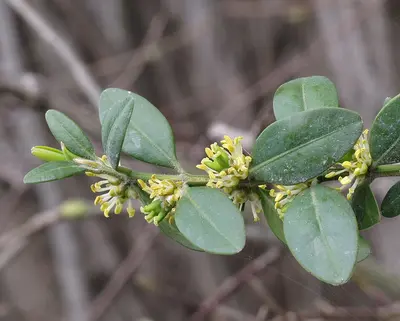
The classic evergreen shrub prized for its dense, fine-textured foliage and exceptional tolerance to pruning and shaping. Perfect for formal hedges, topiaries, and foundation plantings, boxwood provides year-round structure to the garden. This slow-growing shrub can be maintained at any desired height and is a cornerstone of traditional landscape design.
Sun
Full sun to partial shade
Zones
5–8
USDA hardiness
Height
5-20 feet
Planting Timeline
Showing dates for Boxwood Common in USDA Zone 7
All Zone 7 shrub →Zone Map
Click a state to update dates
Boxwood Common · Zones 5–8
Growing Details
Complete Growing Guide
Light: Full sun (6 or more hours of direct sunlight a day), Partial Shade (Direct sunlight only part of the day, 2-6 hours). Soil: Clay, High Organic Matter, Loam (Silt), Sand. Soil pH: Neutral (6.0-8.0). Drainage: Good Drainage, Occasionally Wet. Height: 5 ft. 0 in. - 20 ft. 0 in.. Spread: 5 ft. 0 in. - 15 ft. 0 in.. Spacing: 6-feet-12 feet, 12-24 feet. Growth rate: Slow. Maintenance: Medium. Propagation: Stem Cutting. Regions: Coastal, Mountains, Piedmont.
Harvesting
Globose, 1/3 inch dehiscent capsule that matures to brown.
Color: Brown/Copper. Type: Capsule. Length: < 1 inch. Width: < 1 inch.
Storage & Preservation
Boxwood is an ornamental shrub and does not require food storage or preservation. For propagation material (cuttings), store in cool conditions (50-60°F) with high humidity until planting. Hardwood cuttings can be kept in moist perlite or sand in a cool location for several weeks. Softwood cuttings root best when placed in humid propagation trays. For transplanted boxwood, ensure consistent moisture during establishment. In harsh winters, mulch around the base to protect roots. Pruned branches can be stored in water in cool shade for short-term use in arrangements.
History & Origin
Origin: Europe to N. Iran, N. Africa
Considerations
- -Toxic (Leaves): Low severity
- -Causes contact dermatitis
Companion Plants
Lavender and rosemary are genuinely low-competition neighbors — both are drought-tolerant once established and won't fight boxwood for water the way shallow-rooted annuals do. Catnip fills the same niche lower to the ground; research has shown Nepeta species deter aphids and some beetles, which is a real benefit given how much boxwood psyllid damage can set a planting back. Marigolds (Tagetes patula specifically) add pest deterrence near the soil line, and heuchera or hosta handle the shadier spots where boxwood often gets tucked without crowding the root zone.
Black walnut is the plant to keep off the same property if you can manage it — the roots, husks, and decomposing leaf litter all release juglone, a compound toxic to many woody ornamentals, and boxwood shows decline quickly enough that you may lose the plant before you trace the cause. Pine needles are a slower problem: steady needle drop acidifies the soil over several seasons, pulling pH below the 6.5 minimum boxwood needs and triggering iron and manganese deficiency. Eucalyptus releases growth-inhibiting phenolic compounds through both its roots and litter — a different mechanism than juglone, but the outcome for nearby shrubs is similar.
Plant Together
Lavender
Repels pests like moths and beetles, shares similar soil and sun requirements
Rosemary
Deters harmful insects and thrives in similar well-draining soil conditions
Hosta
Provides contrasting foliage texture and thrives in partial shade beneath boxwood
Catnip
Natural pest deterrent that repels ants, aphids, and rodents
Marigold
Repels nematodes and aphids while adding colorful blooms
Astilbe
Complements boxwood in shade gardens and adds seasonal color
Heuchera
Provides colorful foliage contrast and shares similar growing conditions
Impatiens
Adds seasonal color in shaded areas and benefits from boxwood's wind protection
Keep Apart
Black Walnut
Produces juglone which is toxic to boxwood and can cause yellowing and decline
Eucalyptus
Releases allelopathic compounds that can inhibit boxwood root development
Pine Trees
Creates acidic soil conditions and dense shade that boxwood cannot tolerate long-term
Pests & Disease Resistance
Resistance
Susceptible to boxwood blight in humid conditions
Common Pests
Boxwood leafminer, psyllids, mites
Diseases
Boxwood blight, root rot, leaf spot
Troubleshooting Boxwood Common
What you'll see, why it happens, and what to do about it.
Leaves bronzed or stippled, fine webbing visible on undersides of foliage, especially in hot dry spells
Likely Causes
- Boxwood spider mites (Eurytetranychus buxi) — populations explode when conditions are hot and dry
- Dusty, unirrigated conditions that stress the plant and favor mite reproduction
What to Do
- 1.Blast the undersides of leaves with a strong jet of water every few days to knock mite populations down
- 2.Apply insecticidal soap or neem oil in the early morning, coating leaf undersides thoroughly — repeat every 7 days for 3 applications
- 3.Mulch the root zone 2–3 inches deep to retain soil moisture and reduce plant stress
Tan or straw-colored patches spreading across leaves and stems, with black streaking visible on the inner bark of affected stems when you scratch them
Likely Causes
- Boxwood blight (Calonectria pseudonaviculata) — a fungal disease that spreads rapidly in warm, humid conditions above 60°F
- Overhead irrigation or rain that keeps foliage wet for extended periods
- Contaminated tools or plant material brought in from another site
What to Do
- 1.Remove and bag all infected material immediately — do not compost it
- 2.Disinfect pruning tools with a 10% bleach solution or 70% isopropyl alcohol between every cut
- 3.Avoid overhead watering; switch to drip or soaker hose to keep foliage dry
Blistered, yellowed leaves with a hollow or papery feel; small orange-yellow larvae visible when you tear open a leaf
Likely Causes
- Boxwood leafminer (Monarthropalpus flavus) — larvae feed inside the leaf tissue from late spring through summer
- Heavy infestations are worse on plants stressed by poor drainage or compacted soil
What to Do
- 1.Prune out the most heavily infested branches in late April before adult flies emerge and lay new eggs
- 2.Apply a systemic insecticide containing imidacloprid as a soil drench in early spring — NC State Extension lists this as effective for leafminer control
- 3.Improve drainage around the root zone; plants sitting in poorly drained soil consistently show worse leafminer damage
Frequently Asked Questions
Is boxwood good for beginners?▼
Can you grow boxwood in containers?▼
When should I plant boxwood?▼
How long does boxwood live?▼
What are the main pests affecting boxwood?▼
How often should I prune boxwood?▼
Zone-by-Zone Planting Calendar
Growing Guides from Wind River Greens
Sources & References
External authority sources used in compiling this guide.
- ExtensionNC State Extension
See the Methodology page for how this data is sourced, what's AI-assisted, and known limitations.